Lesson · Grade 10 · Science
The Big Bang: Space Itself Is Expanding
- Grade 10
- Science
- 1 min 49 s
- British Columbia
- BC10-SC-43
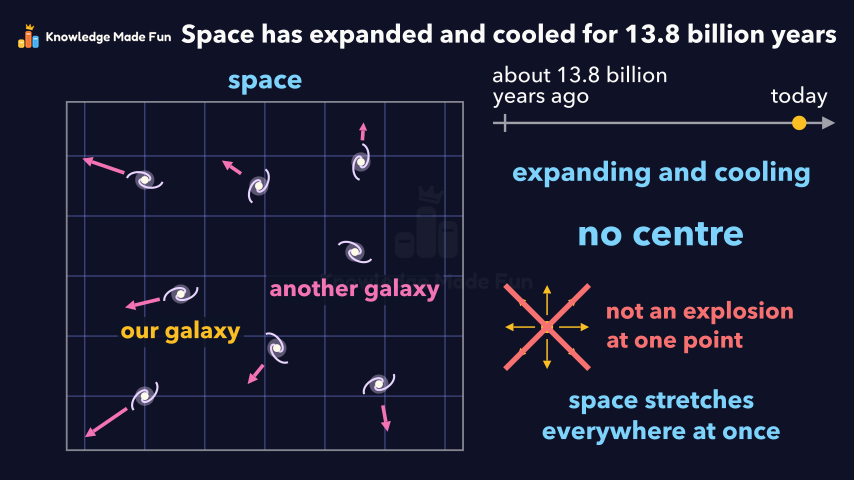
A patch of space, drawn as a grid, starts packed tight and glowing hot about 13.8 billion years ago, then stretches and cools; galaxies form in it and move apart while keeping their own size, like raisins in rising bread dough. Arrows show Hubble's 1929 finding that farther galaxies move away faster, then the same picture from another galaxy, showing that the expansion has no centre and was not an explosion at one point.
Concept: The big bang theory: space itself expanding
Anyone can watch two lessons on the website without an account. Signing in is free, no payment and no card, and opens three a day; Plus has no limit.
Loading
In one sentence
The question this lesson answers
How did the universe begin, and what has it been doing ever since?
About 13.8 billion years ago, the universe was extremely hot and dense, which means everything was packed tightly together.
Transcript
What the lesson says
How did the universe begin, and what has it been doing ever since?
About 13.8 billion years ago, the universe was extremely hot and dense, which means everything was packed tightly together.
Since then, space itself has been expanding, which means it stretches, so the distances between places grow.
As space expands, the universe cools down.
This idea is called the big bang theory.
Over time, matter gathered into galaxies, which are huge groups of stars held together by gravity.
As space keeps stretching, galaxies that are far apart move away from each other.
It is like raisins in rising bread dough: as the dough rises, every raisin moves away from every other raisin.
But galaxies themselves do not stretch, because gravity holds their stars together.
In 1927, the scientist Georges Lemaître proposed that the universe is expanding.
In 1929, Edwin Hubble showed that distant galaxies are moving away from us.
Nearer galaxies move away more slowly, and the farther away a galaxy is, the faster it moves away.
Seen from any other galaxy, distant galaxies move away too, so the expansion has no centre.
So the big bang was not an explosion at one point into empty space. Space itself stretches everywhere at once.
The big bang theory: for about 13.8 billion years, space itself has been expanding and cooling.
Curriculum
Where this fits
- British Columbia, Grade 10
Science 10, Earth science: formation of the universe: big bang theoryBC10-SC-43
Next: From quarks to galaxies: how the universe's matter formed
The outcomes and strands follow the British Columbia curriculum.
Keep going
 1 min 43 s
Absolute dating: radioactive decay is a clock for rocks
Grade 7 · 1 min 43 s 1 min 19 s
Climate Change and Living Things: Move, Change, or Die Out
Grade 7 · 1 min 19 s 1 min 14 s
Day and Night: Earth Spins on Its Axis
Grade 4 · 1 min 14 s 1 min 50 s
Dynamic equilibrium: balanced but always changing
Grade 9 · 1 min 50 s 1 min 11 s
Earth Materials: From Boulders to Clay
Grade 5 · 1 min 11 s 1 min 11 s
Erosion and Deposition: How Wind, Water and Ice Move Land
Grade 3 · 1 min 11 s 1 min 53 s
From quarks to galaxies: how the universe's matter formed
Grade 10 · 1 min 53 s 47 s
Hot, Warm, Cool and Cold: What Do We Wear?
Kindergarten · 47 s
- All Grade 10 Science lessons
- Create a free account to watch three lessons a day, no payment and no card.