Lesson · Grade 11 · Chemistry
Electrons in Orbitals: The Quantum Mechanical Model
- Grade 11
- Chemistry
- 2 min 3 s
- British Columbia
- BC11-SC-01
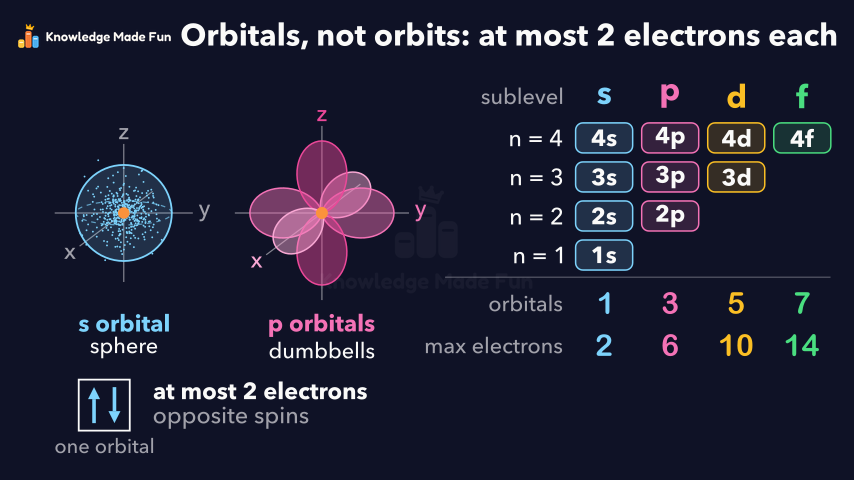
A Bohr atom with neat circular orbits gives way to a probability cloud of dots, whose 90% edge is an orbital, which then becomes the spherical s orbital beside the three p dumbbells on the x, y and z axes. Alongside, a chart splits energy levels n = 1 to 4 into s, p, d and f sublevels with 1, 3, 5 and 7 orbitals, and shows that each orbital holds at most two electrons of opposite spin, so the sublevels hold 2, 6, 10 and 14.
Concept: The quantum mechanical model: electrons in orbitals
Anyone can watch two lessons on the website without an account. Signing in is free, no payment and no card, and opens three a day; Plus has no limit.
Loading
In one sentence
The question this lesson answers
Where exactly is an electron inside an atom?
In the Bohr model, electrons circle the nucleus in fixed orbits, like planets around the Sun.
Transcript
What the lesson says
Where exactly is an electron inside an atom?
In the Bohr model, electrons circle the nucleus in fixed orbits, like planets around the Sun.
But electrons do not really move along neat, planet-like paths like these.
The quantum mechanical model gives no exact path, only the chance of finding the electron at each place.
Denser dots show where the electron is more likely to be, sparser dots where it is less likely.
A region where an electron is likely to be found is called an orbital.
Its edge is usually drawn where there is a 90 percent chance that the electron is inside.
Orbitals are grouped into main energy levels, numbered n equals 1, 2, 3, 4 and so on.
Each level splits into sublevels, named s, p, d and f.
Level n has n sublevels: level 1 has only s, level 2 adds p, level 3 adds d, and level 4 adds f.
Each type of sublevel has a set number of orbitals: s has 1, p has 3, d has 5 and f has 7.
The orbital we drew is an s orbital, a sphere centred on the nucleus.
The three p orbitals are dumbbells: one along the x axis, one along y, and one along z.
Each orbital holds at most two electrons, with opposite spins: one arrow up and one arrow down.
So an s sublevel holds up to 2 electrons, p holds 6, d holds 10 and f holds 14.
Electrons are found in orbitals, not fixed orbits, and each orbital holds at most two electrons.
Curriculum
Where this fits
- British Columbia, Grade 11
Chemistry 11, Atoms and electrons: quantum mechanical model and electron configurationBC11-SC-01
The outcomes and strands follow the British Columbia curriculum.
Keep going
 2 min 7 s
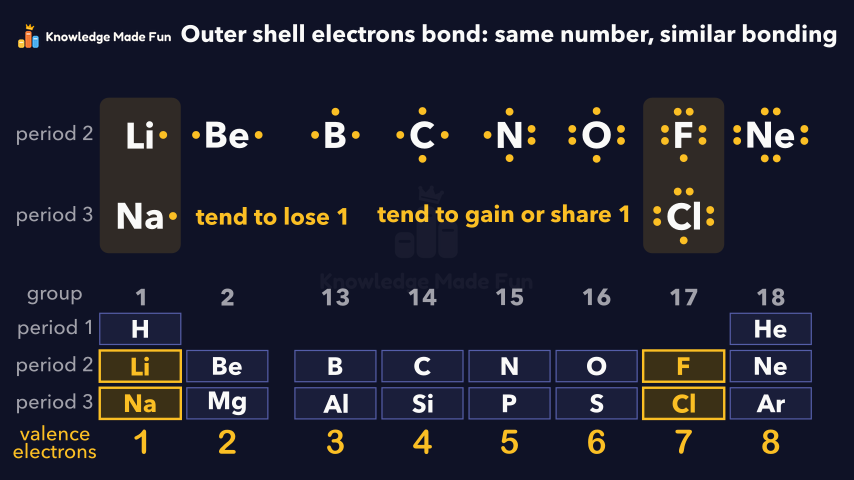
Valence electrons: the outer electrons that bond
Grade 11 · 2 min 7 s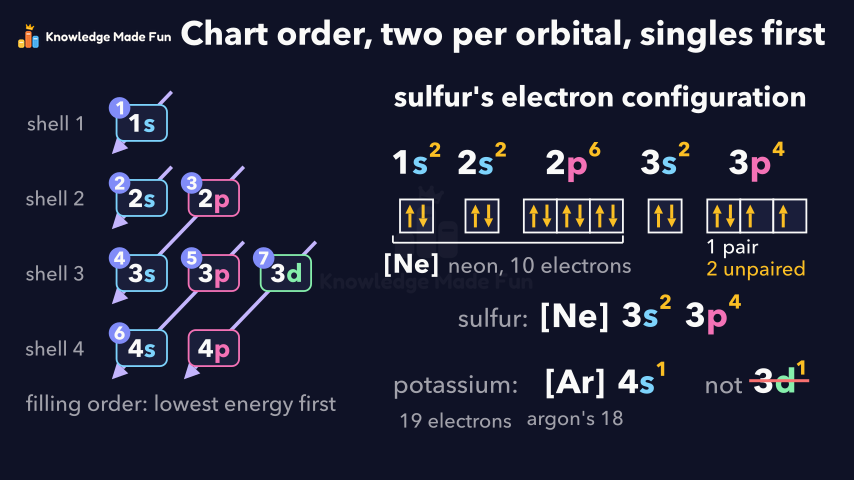 2 min 19 s
Writing Electron Configurations
Grade 11 · 2 min 19 s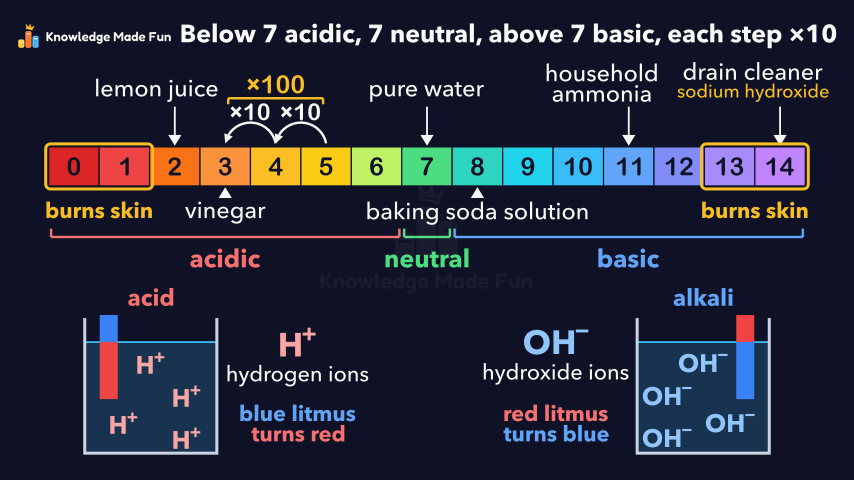 1 min 40 s
Acids and bases: the pH scale
Grade 10 · 1 min 40 s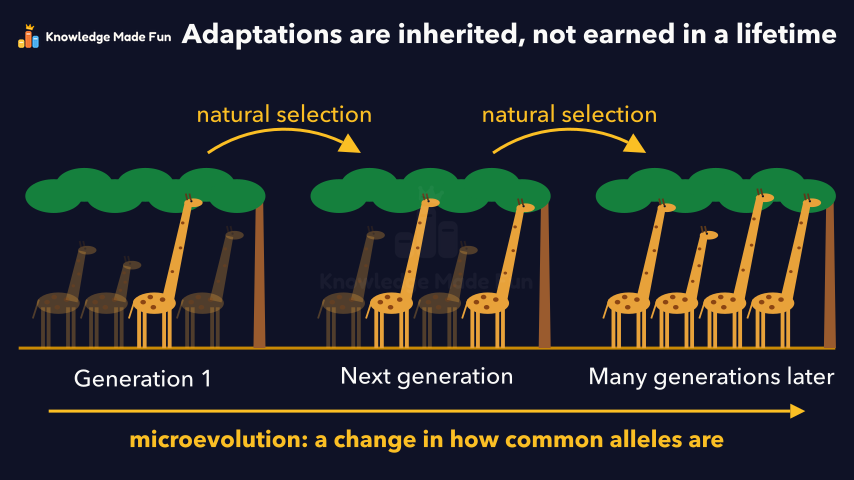 1 min 39 s
Adaptations Are Inherited, Not Earned in a Lifetime
Grade 11 · 1 min 39 s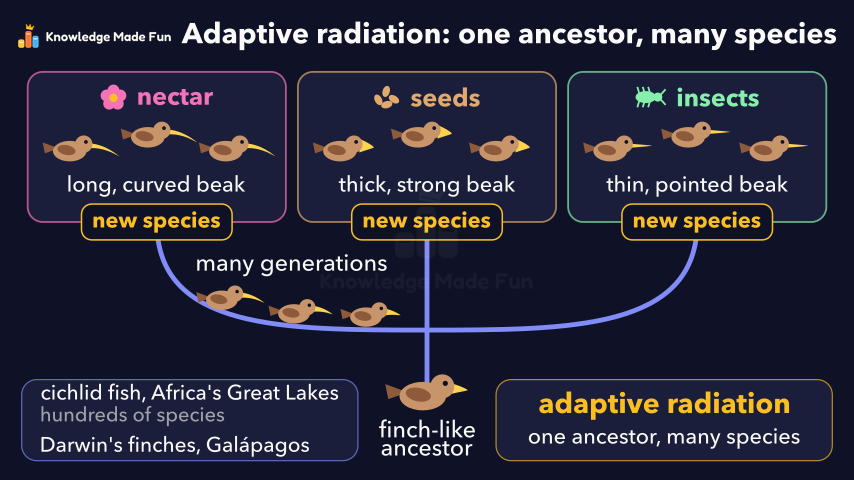 1 min 48 s
Adaptive radiation: one ancestor, many species
Grade 10 · 1 min 48 s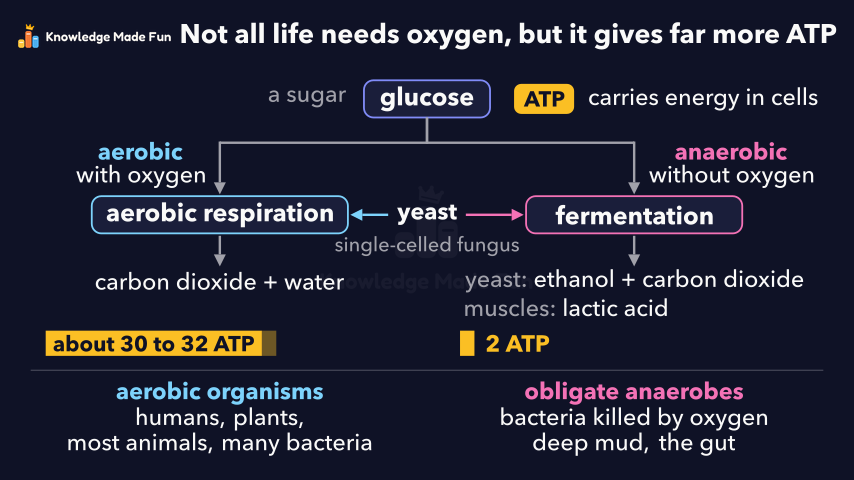 1 min 39 s
Aerobic and anaerobic organisms
Grade 11 · 1 min 39 s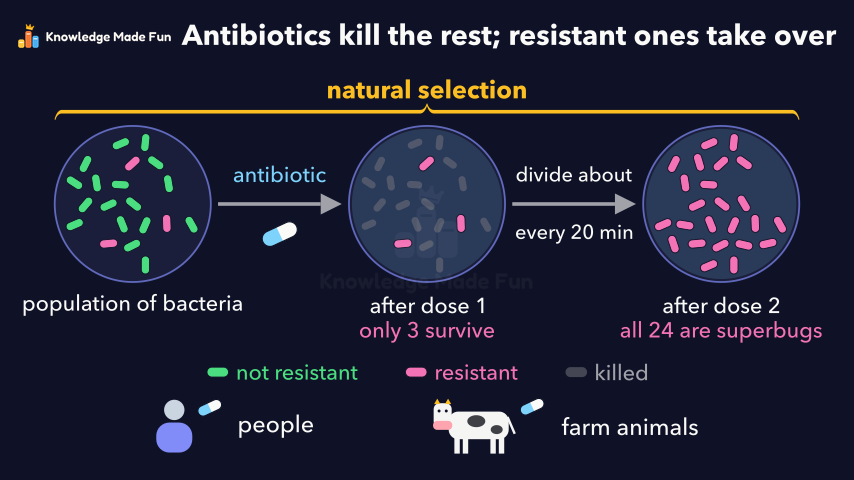 1 min 37 s
Antibiotic resistance: how superbugs evolve
Grade 8 · 1 min 37 s 1 min 35 s
Antibiotics kill bacteria, not viruses
Grade 8 · 1 min 35 s
- All Grade 11 Chemistry lessons
- Create a free account to watch three lessons a day, no payment and no card.