Lesson · Grade 10 · Science
The Cosmic Microwave Background: The Oldest Light We Can See
- Grade 10
- Science
- 1 min 56 s
- British Columbia
- BC10-SC-47
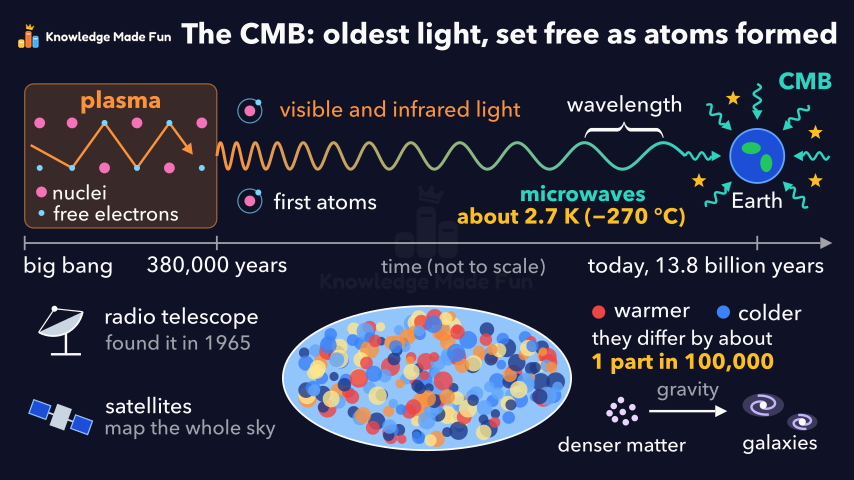
A timeline diagram follows the faint microwave glow that radio telescopes pick up from every direction (found by accident in 1965) back to the hot plasma after the big bang. It shows the light set free when the first atoms formed about 380,000 years later, then stretched over 1,000 times by expanding space into microwaves at about 2.7 K (−270 °C), so it is not starlight; a satellite all-sky map then shows warmer and colder spots that differ by about 1 part in 100,000, and how gravity grew these slightly denser regions into galaxies.
Anyone can watch two lessons on the website without an account. Signing in is free, no payment and no card, and opens three a day; Plus has no limit.
Loading
In one sentence
The question this lesson answers
Radio telescopes pick up a faint glow of microwaves from every direction in the sky.
Radio astronomers found it by accident in 1965, as a hiss their antenna could not get rid of.
Transcript
What the lesson says
Radio telescopes pick up a faint glow of microwaves from every direction in the sky.
Radio astronomers found it by accident in 1965, as a hiss their antenna could not get rid of.
It is called the cosmic microwave background, or CMB: microwaves from space filling the whole sky.
It is not starlight: it is just as bright between the stars, and older than any star.
After the big bang, the universe was too hot for atoms: a glowing fog of nuclei and free electrons, called plasma.
Light kept bouncing off the free electrons, so it could not travel far.
About 380,000 years after the big bang, it had cooled enough for electrons to join nuclei as the first atoms.
Now its visible and infrared light could travel freely across space.
As space expanded, it stretched the wavelength, the distance from crest to crest, over 1,000 times, into microwaves.
Today, 13.8 billion years later, the glow's temperature is about 2.7 kelvin, just above absolute zero: about minus 270 degrees Celsius.
Satellites have mapped this glow across the whole sky, shown here as one oval map.
The colours show warmer and colder spots, differing by only about 1 part in 100,000.
The spots show where matter was slightly denser. Gravity pulled in more matter there, and galaxies grew.
The cosmic microwave background is the oldest light we can see, set free when the first atoms formed.
Curriculum
Where this fits
- British Columbia, Grade 10
Science 10, Earth science: astronomical data and collection methodsBC10-SC-47
Previous: Redshift and Blueshift: What Light Tells Us About MotionNext: Telescopes for every kind of light
The outcomes and strands follow the British Columbia curriculum.
Keep going
 1 min 43 s
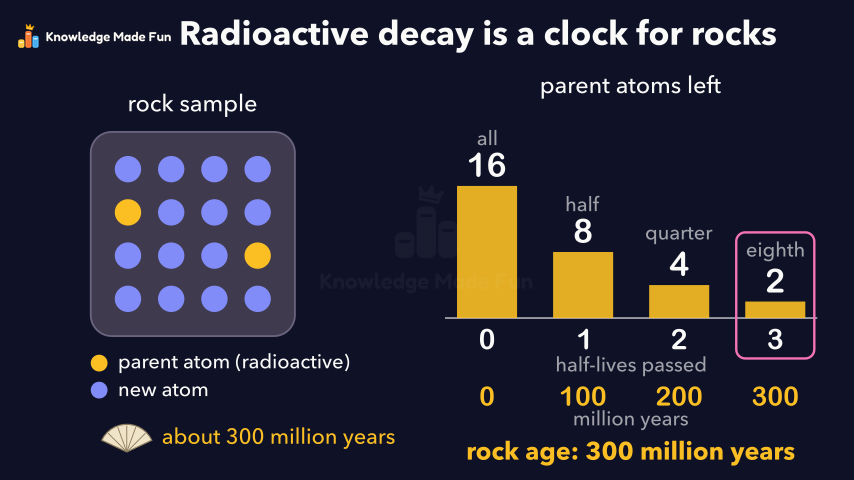
Absolute dating: radioactive decay is a clock for rocks
Grade 7 · 1 min 43 s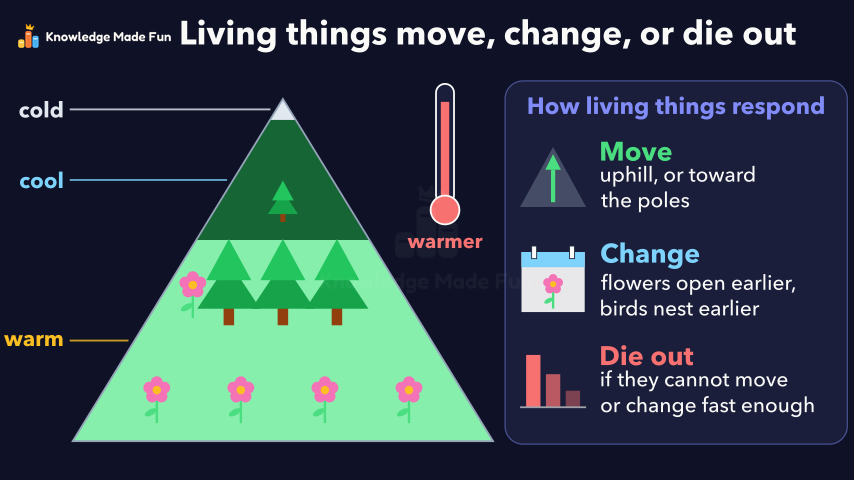 1 min 19 s
Climate Change and Living Things: Move, Change, or Die Out
Grade 7 · 1 min 19 s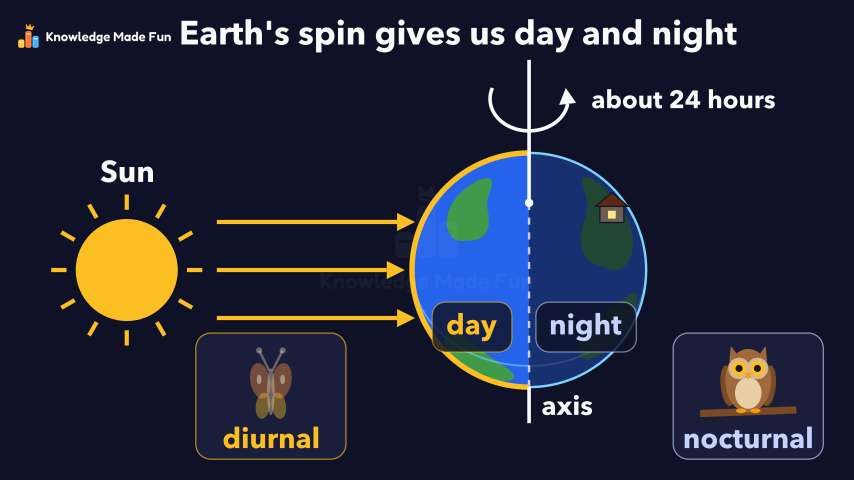 1 min 14 s
Day and Night: Earth Spins on Its Axis
Grade 4 · 1 min 14 s 1 min 50 s
Dynamic equilibrium: balanced but always changing
Grade 9 · 1 min 50 s 1 min 11 s
Earth Materials: From Boulders to Clay
Grade 5 · 1 min 11 s 1 min 11 s
Erosion and Deposition: How Wind, Water and Ice Move Land
Grade 3 · 1 min 11 s 1 min 53 s
From quarks to galaxies: how the universe's matter formed
Grade 10 · 1 min 53 s 47 s
Hot, Warm, Cool and Cold: What Do We Wear?
Kindergarten · 47 s
- All Grade 10 Science lessons
- Create a free account to watch three lessons a day, no payment and no card.