Lesson · Grade 7 · Science
Signs of a chemical change
- Grade 7
- Science
- 1 min 7 s
- British Columbia
- BC7-SC-20
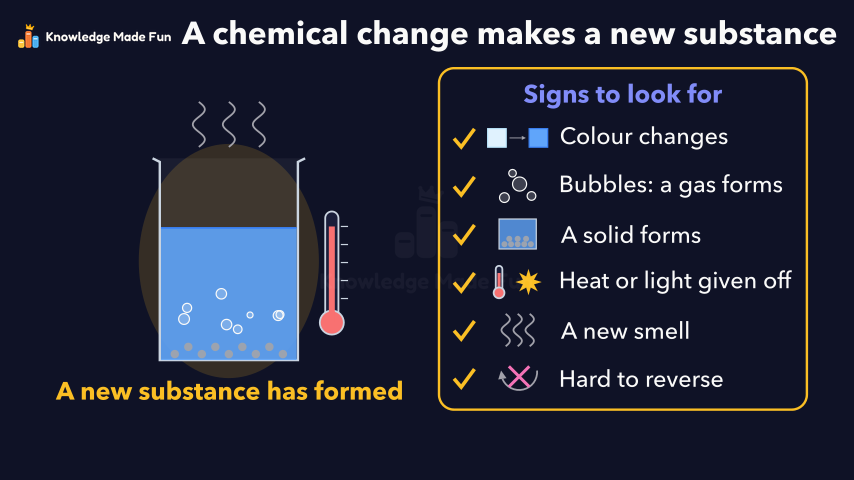
A second liquid is poured into a beaker, and the beaker then shows each sign of a chemical change in turn: the colour changes, bubbles rise, a solid sinks to the bottom, a thermometer climbs while the beaker glows, and a new smell drifts up, with each sign ticked off on a checklist that ends with "hard to reverse". A caution that one sign alone is not proof leads to the recap: a chemical change makes a new substance.
Anyone can watch two lessons on the website without an account. Signing in is free, no payment and no card, and opens three a day; Plus has no limit.
Loading
In one sentence
The question this lesson answers
How can you tell that a chemical change has happened?
Here is a beaker with a clear liquid. We pour a second liquid in and mix them.
Transcript
What the lesson says
How can you tell that a chemical change has happened?
Here is a beaker with a clear liquid. We pour a second liquid in and mix them.
In a chemical change, a new substance is made. Here are the signs to look for.
Sign one. The colour changes.
Sign two. Bubbles appear. A gas is being made.
Sign three. A solid forms in the liquid and sinks to the bottom. It is called a precipitate.
Sign four. Heat or light is given off. The beaker gets warmer, and it may even glow.
Sign five. There is a new smell, like when an egg goes rotten.
And a chemical change is hard to reverse. You cannot easily get the old substances back.
One sign on its own is not proof. Boiling water bubbles, but no new substance is made.
A chemical change makes a new substance. These signs tell you it has happened.
Curriculum
Where this fits
The outcomes and strands follow the British Columbia curriculum.
Keep going
 1 min 40 s
Acids and bases: the pH scale
Grade 10 · 1 min 40 s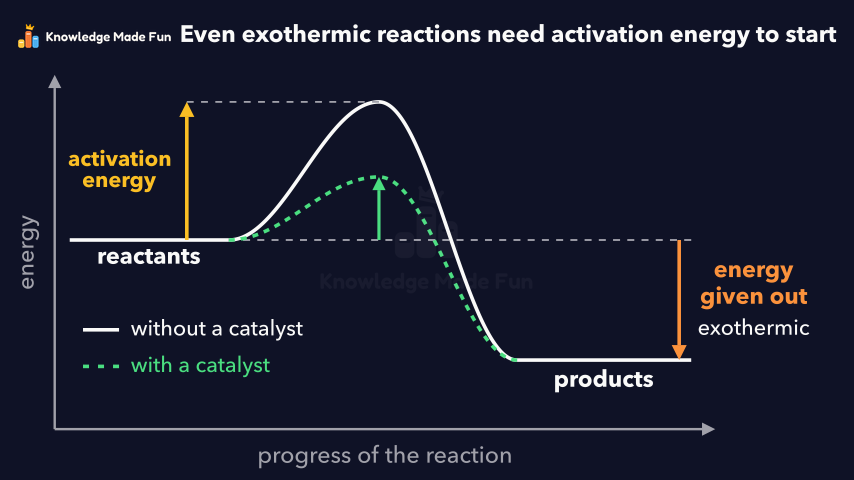 1 min 39 s
Activation energy: the push a reaction needs to start
Grade 10 · 1 min 39 s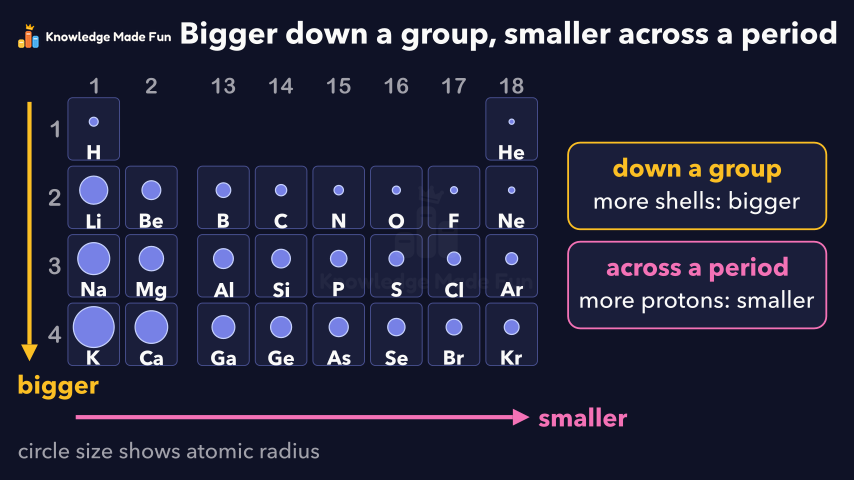 1 min 54 s
Atomic Size: Bigger Down a Group, Smaller Across a Period
Grade 9 · 1 min 54 s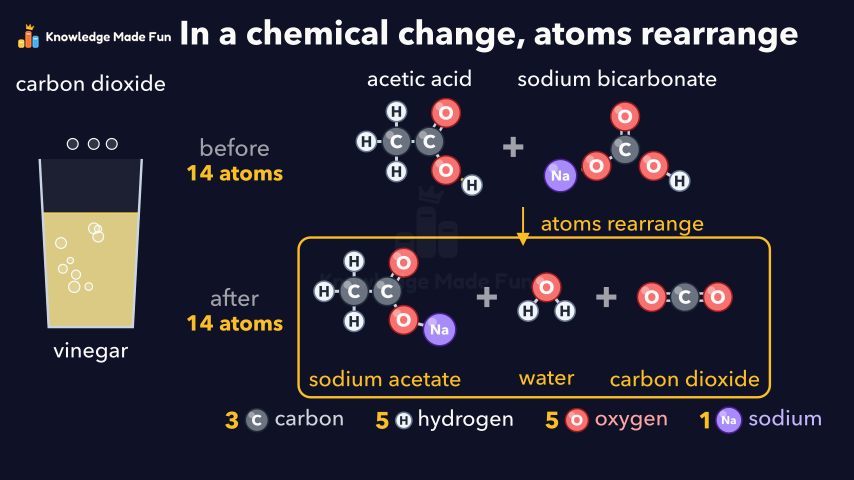 1 min 18 s
Atoms rearrange: vinegar and baking soda
Grade 7 · 1 min 18 s 1 min 16 s
Atoms: What Everything Is Made Of
Grade 7 · 1 min 16 s 2 min 3 s
Balancing Chemical Equations
Grade 10 · 2 min 3 s 1 min 54 s
Bohr Diagrams: Electrons in Shells and Valence Electrons
Grade 9 · 1 min 54 s 1 min 45 s
Brownian motion: evidence that molecules exist
Grade 8 · 1 min 45 s
- All Grade 7 Science lessons
- Create a free account to watch three lessons a day, no payment and no card.