Lesson · Grade 10 · Science
Selection pressure: what decides which traits spread
- Grade 10
- Science
- 1 min 55 s
- British Columbia
- BC10-SC-11
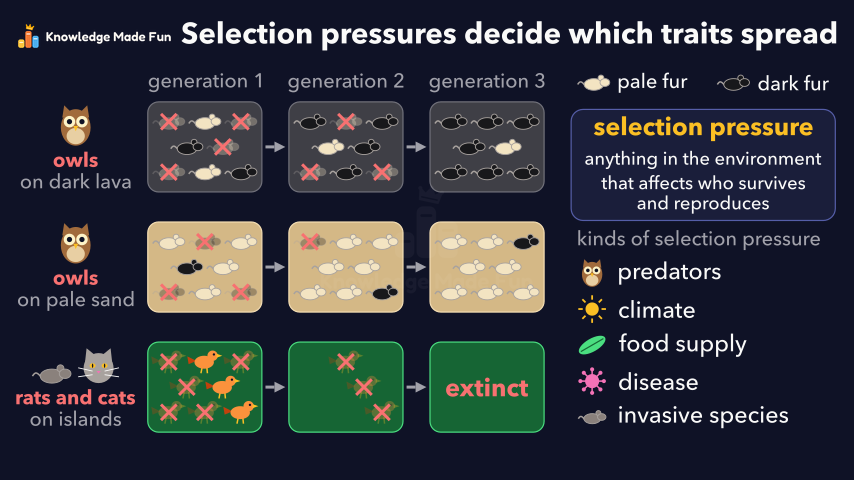
Rock pocket mice on dark lava go through three generations: owls catch more of the pale mice that stand out, so dark fur spreads, while on pale sand the same owls make pale fur spread. The video names owls as one selection pressure alongside climate, food supply, disease and invasive species, shows island birds going extinct after rats and cats arrived, and explains that the mice never changed on purpose: the dark fur was already there by chance, and the population changed over generations.
Anyone can watch two lessons on the website without an account. Signing in is free, no payment and no card, and opens three a day; Plus has no limit.
Loading
In one sentence
The question this lesson answers
Over many generations, some traits spread and others disappear. What decides which traits spread?
Picture rock pocket mice on dark lava rock. All the mice of one species in one place form a population.
Transcript
What the lesson says
Over many generations, some traits spread and others disappear. What decides which traits spread?
Picture rock pocket mice on dark lava rock. All the mice of one species in one place form a population.
Most have pale fur, a few have dark fur. These differences are called variation. Dark fur came from a mutation, a random change in a gene.
Owls hunt these mice. On dark rock the pale mice stand out, so owls catch more of them.
The survivors have young and pass on their genes, so more of the next generation is dark.
This repeats in every generation, until most mice are dark. This is natural selection.
The owls are a selection pressure: anything in the environment that affects who survives and reproduces.
On pale sand, the dark mice stand out instead, so owls catch more of them and pale fur spreads.
Owls are predators, one kind of selection pressure. Others are climate, food supply, disease and invasive species.
An invasive species is one brought to a new place, where it spreads and does harm, like rats and cats on islands.
Many island birds could not adapt in time, and whole species went extinct.
The mice did not turn dark on purpose because they needed to. Dark fur came first, by chance.
No mouse can change its fur. The owls only affect which mice survive, so the population changes.
Selection pressures decide who survives and reproduces, and so which traits spread.
Curriculum
Where this fits
- British Columbia, Grade 10
Science 10, Biology: mechanisms for the diversity of life: natural selection and artificial selectionBC10-SC-11
Previous: Mutagens and Carcinogens: What Damages DNANext: Adaptive radiation: one ancestor, many species
The outcomes and strands follow the British Columbia curriculum.
Keep going
 1 min 3 s
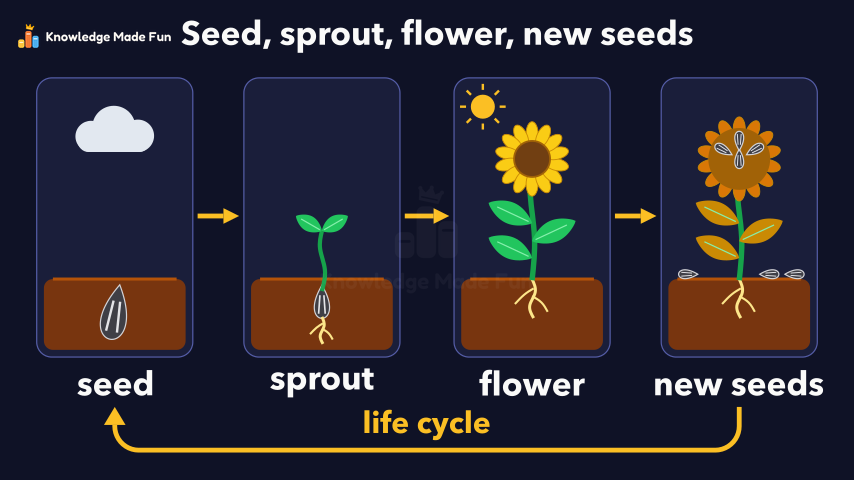
A Sunflower's Life Cycle: Seed, Sprout, Flower, Seed
Kindergarten · 1 min 3 s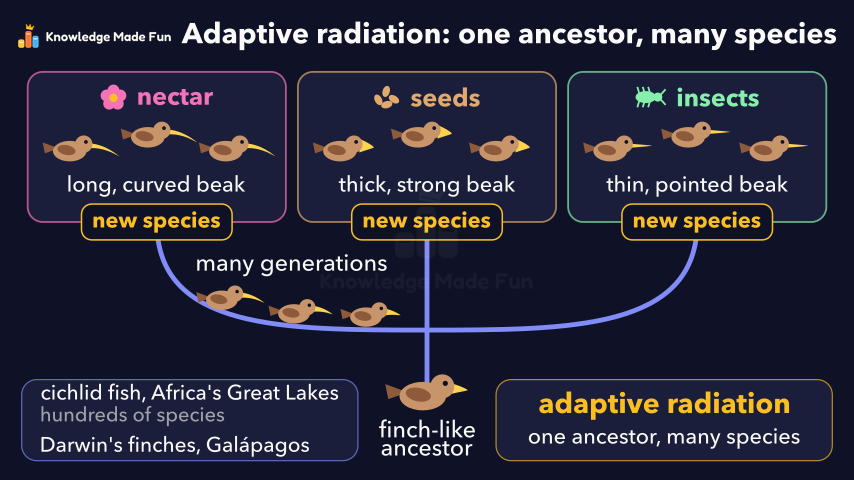 1 min 48 s
Adaptive radiation: one ancestor, many species
Grade 10 · 1 min 48 s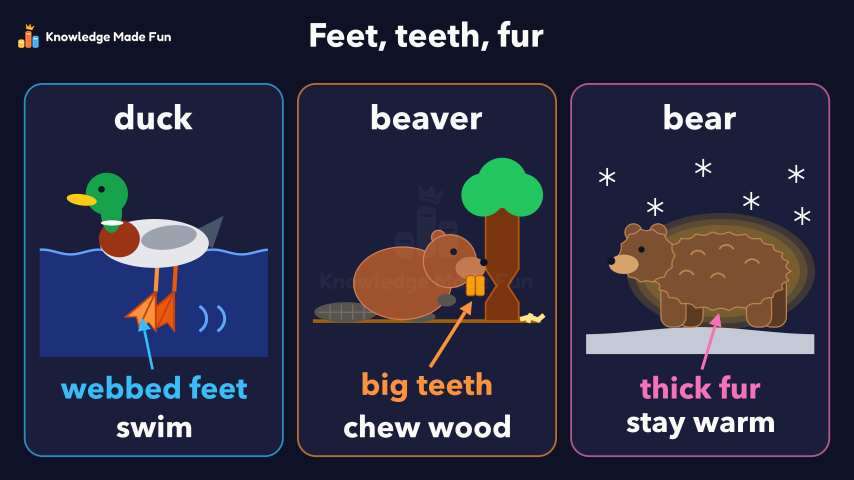 52 s
Animal Bodies That Help Them Live: Feet, Teeth and Fur
Kindergarten · 52 s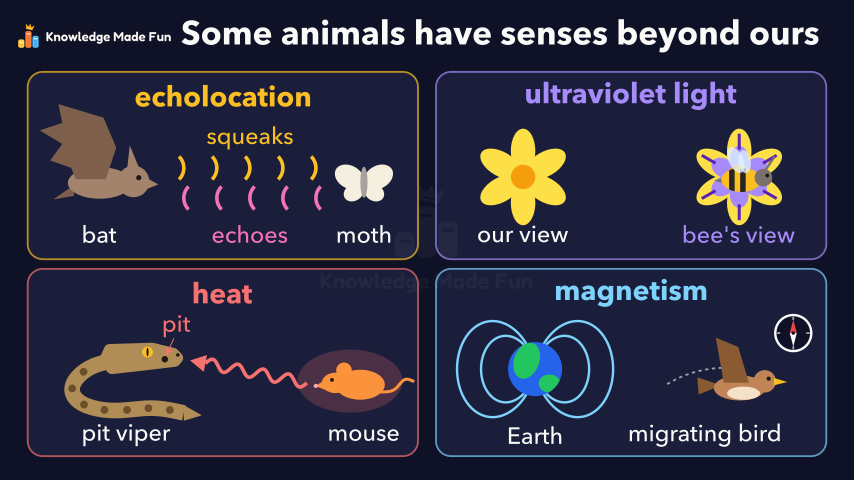 1 min 3 s
Animal senses beyond ours: echolocation, ultraviolet light, heat and magnetism
Grade 4 · 1 min 3 s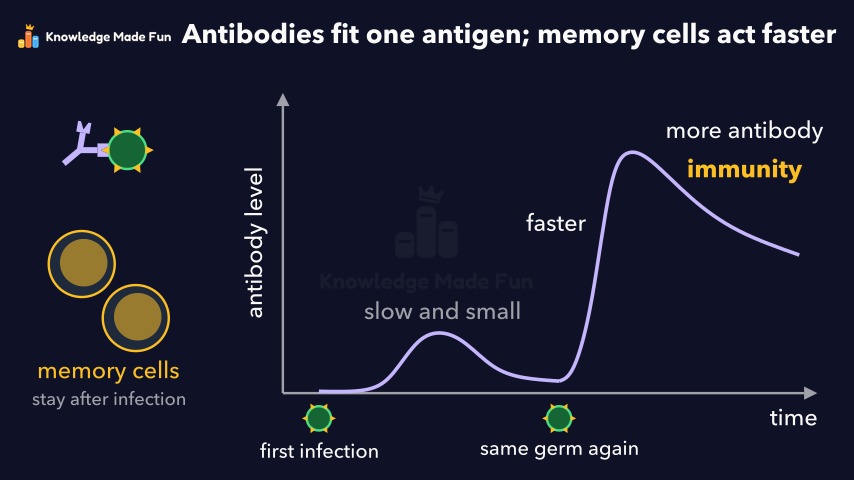 1 min 44 s
Antibodies and Memory Cells: The Body's Targeted Defence
Grade 8 · 1 min 44 s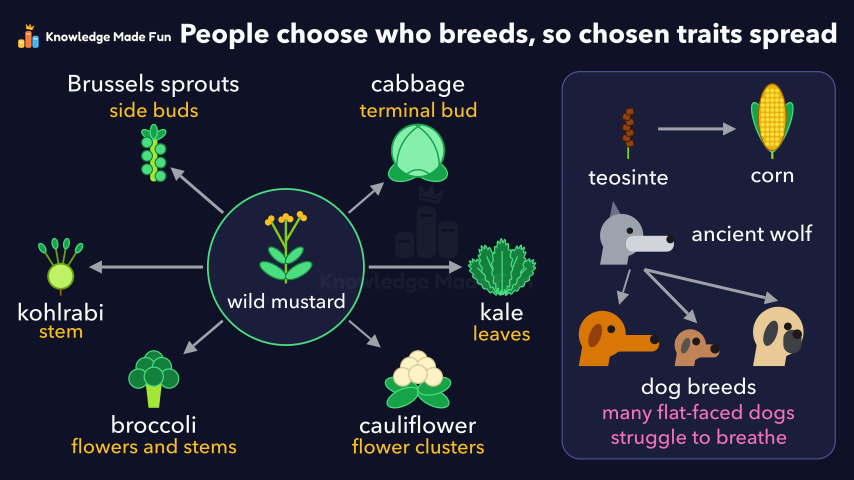 1 min 44 s
Artificial selection: people choose the traits
Grade 10 · 1 min 44 s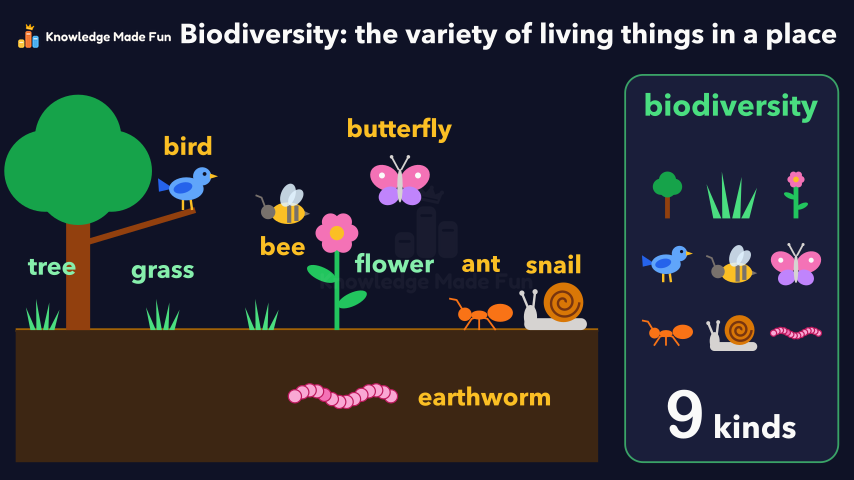 1 min 4 s
Biodiversity: The Variety of Living Things
Grade 3 · 1 min 4 s 1 min 8 s
Biomes: Sorted by Temperature and Precipitation
Grade 4 · 1 min 8 s
- All Grade 10 Science lessons
- Create a free account to watch three lessons a day, no payment and no card.