Lesson · Grade 10 · Science
Punnett Squares: Predicting Offspring
- Grade 10
- Science
- 2 min 10 s
- British Columbia
- BC10-SC-06
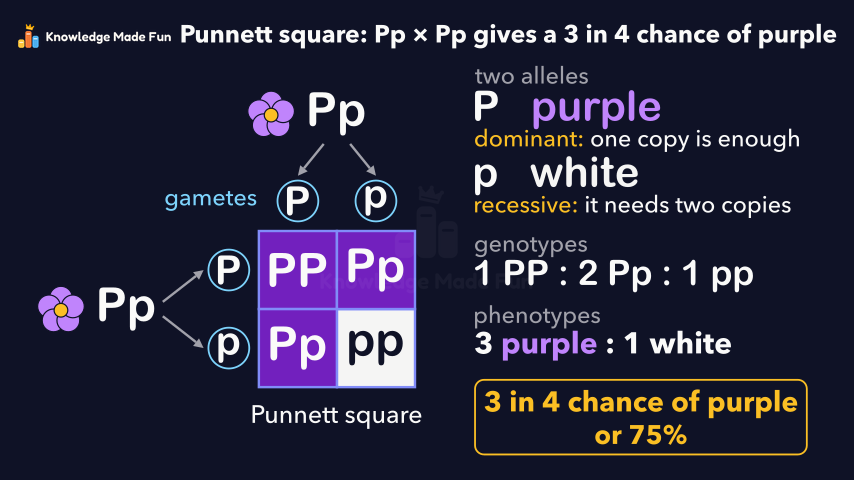
A Punnett square for pea flower colour fills in step by step for Pp × Pp, giving PP, Pp, Pp and pp: genotypes 1 : 2 : 1 and phenotypes 3 purple to 1 white, so each offspring has a 3 in 4 chance of purple, though four offspring won't always split 3 and 1. The same square then runs a test cross with a white pp plant, showing that any white offspring reveals a hidden Pp parent.
Anyone can watch two lessons on the website without an account. Signing in is free, no payment and no card, and opens three a day; Plus has no limit.
Loading
In one sentence
The question this lesson answers
Two purple pea plants are crossed. What will their offspring look like?
Flower colour in peas comes from one gene with two versions, called alleles.
Transcript
What the lesson says
Two purple pea plants are crossed. What will their offspring look like?
Flower colour in peas comes from one gene with two versions, called alleles.
Big P, for purple, is dominant: one copy is enough. Small p, for white, is recessive: it needs two copies.
Both parents have genotype big P small p, the alleles they carry, and phenotype purple, the trait we see.
Each gamete, or sex cell, gets one allele. A Punnett square puts one parent's gametes on top, the other's at the side.
Each box takes one allele from each parent: big P big P, big P small p, big P small p, and small p small p.
Counting gives 1 big P big P, 2 big P small p and 1 small p small p: a 1 to 2 to 1 genotype ratio.
Any box with a big P is purple: 3 purple to 1 white. So each offspring has a 3 in 4 chance of purple, or 75 percent.
But four offspring will not always split three to one: each one is a separate chance.
All four could be purple, or two could be white. Large numbers come close to 3 to 1.
Is a purple plant big P big P or big P small p? A test cross with a white plant, small p small p, tells us.
If it is big P big P, every box is big P small p, so all the offspring are purple.
If it is big P small p, half the boxes are small p small p: a 1 in 2 chance of white.
So any white offspring reveals big P small p. Many offspring, all purple, suggest big P big P.
A Punnett square shows chances: two big P small p parents give each offspring a 3 in 4 chance of purple.
Curriculum
Where this fits
- British Columbia, Grade 10
Science 10, Biology: patterns of inheritanceBC10-SC-06
Previous: Mendel's peas: dominant and recessive allelesNext: Incomplete Dominance and Codominance
The outcomes and strands follow the British Columbia curriculum.
Keep going
 1 min 3 s
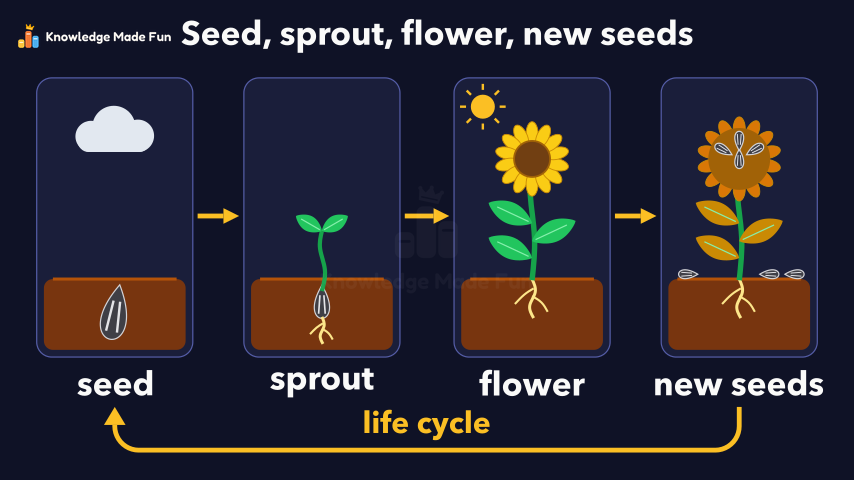
A Sunflower's Life Cycle: Seed, Sprout, Flower, Seed
Kindergarten · 1 min 3 s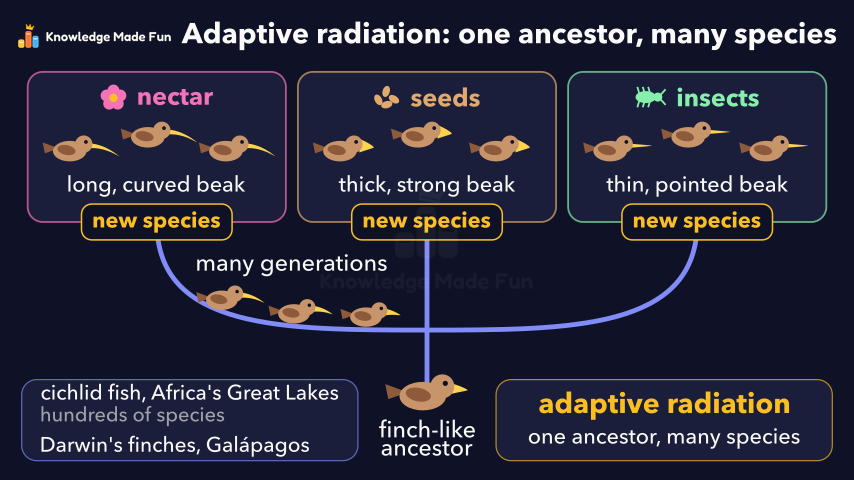 1 min 48 s
Adaptive radiation: one ancestor, many species
Grade 10 · 1 min 48 s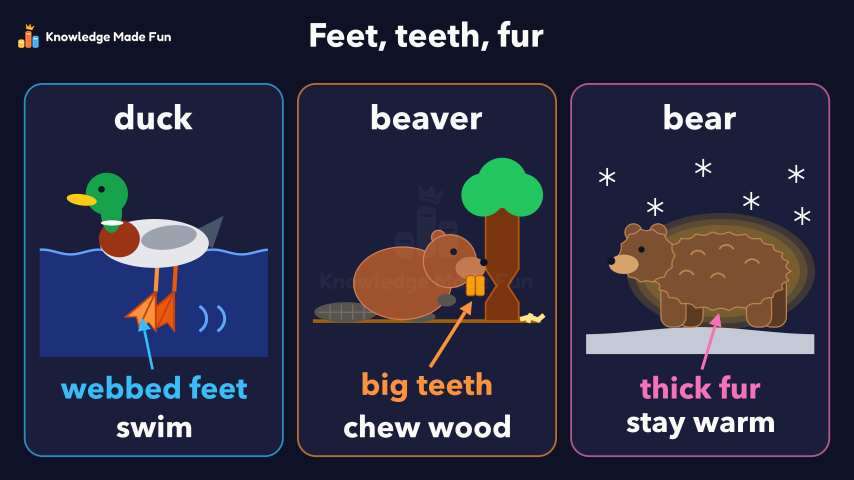 52 s
Animal Bodies That Help Them Live: Feet, Teeth and Fur
Kindergarten · 52 s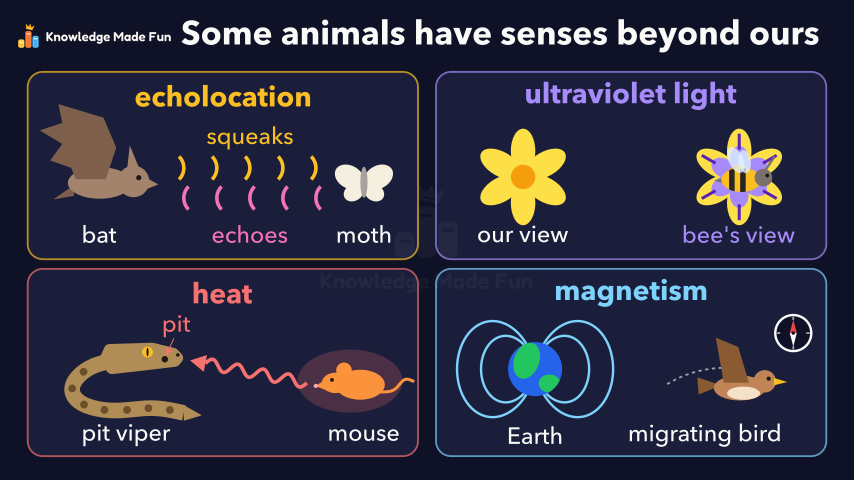 1 min 3 s
Animal senses beyond ours: echolocation, ultraviolet light, heat and magnetism
Grade 4 · 1 min 3 s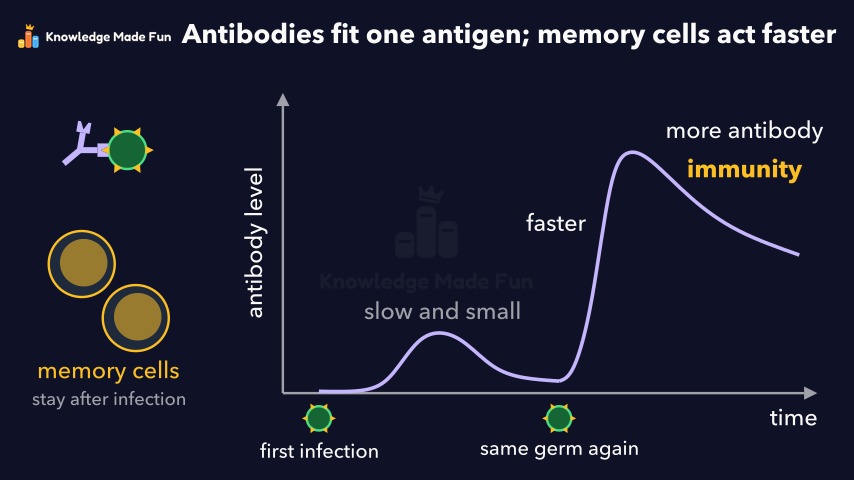 1 min 44 s
Antibodies and Memory Cells: The Body's Targeted Defence
Grade 8 · 1 min 44 s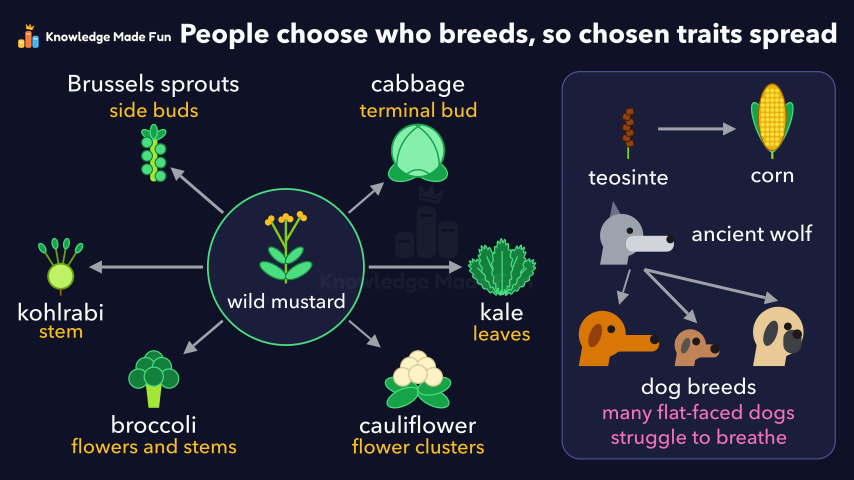 1 min 44 s
Artificial selection: people choose the traits
Grade 10 · 1 min 44 s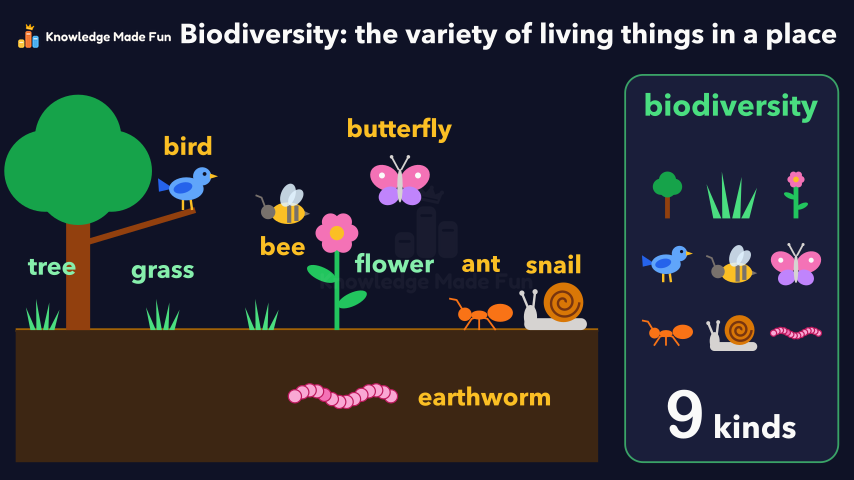 1 min 4 s
Biodiversity: The Variety of Living Things
Grade 3 · 1 min 4 s 1 min 8 s
Biomes: Sorted by Temperature and Precipitation
Grade 4 · 1 min 8 s
- All Grade 10 Science lessons
- Create a free account to watch three lessons a day, no payment and no card.