Lesson · Grade 10 · Science
Monoculture and Polyculture: Why Food Crops Need Variety
- Grade 10
- Science
- 1 min 51 s
- British Columbia
- BC10-SC-14
A field of one genetically identical crop sits beside a mixed field, and a pathogen kills every plant in the first but only the plants without resistance in the second. That links to natural and artificial selection. The video then covers the Gros Michel banana and potato blight, shows why the highest-yield crop is not always the safest choice, and ends with how polyculture and seed banks spread the risk.
Anyone can watch two lessons on the website without an account. Signing in is free, no payment and no card, and opens three a day; Plus has no limit.
Loading
In one sentence
The question this lesson answers
Why grow many kinds of crops, instead of only the one with the biggest harvest?
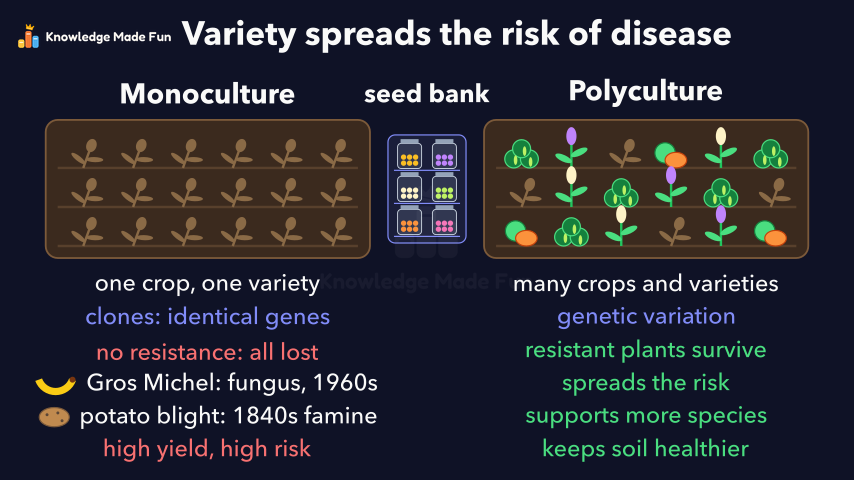
A monoculture is a field of just one crop, usually one variety. It is efficient to farm.
Transcript
What the lesson says
Why grow many kinds of crops, instead of only the one with the biggest harvest?
A monoculture is a field of just one crop, usually one variety. It is efficient to farm.
Its plants are genetically alike. Bananas and potatoes are even clones: copies with identical genes, grown from pieces of one parent.
A polyculture mixes several crops or varieties, so its plants have genetic variation: different genes.
Now a pathogen arrives: a living thing that causes disease, such as a fungus.
In the monoculture, no plant has resistance, an inherited ability to fight the disease, so it spreads to every plant.
In the polyculture, only plants without resistance die. Resistant plants survive and pass on their genes: natural selection.
This really happened: by the 1960s, a fungus had wiped out the cloned Gros Michel banana on export farms.
In the 1840s, potato blight swept through fields of genetically similar potatoes and caused a famine.
These crops come from artificial selection: people breed the plants that give the most food, the highest yield.
But the highest yield crop is not always the safest choice: one disease can destroy all of it.
Polyculture spreads the risk, supports more species, and keeps soil healthier.
Seed banks store seeds of many varieties, so breeders can find resistance genes for new diseases.
Variety spreads the risk, so one disease is far less likely to destroy the whole harvest.
Curriculum
Where this fits
- British Columbia, Grade 10
Science 10, Biology: mechanisms for the diversity of life: natural selection and artificial selectionBC10-SC-14
Previous: Artificial selection: people choose the traitsNext: Genetic Engineering: Moving a Gene into Another Organism
The outcomes and strands follow the British Columbia curriculum.
Keep going
 1 min 3 s
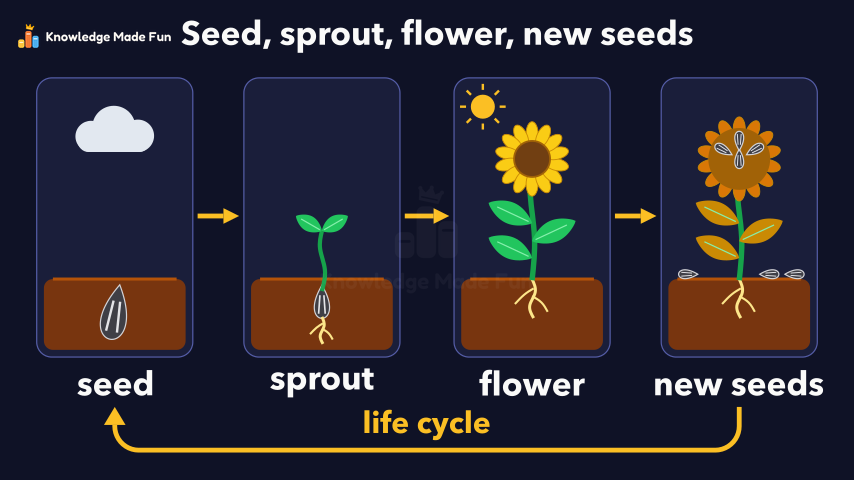
A Sunflower's Life Cycle: Seed, Sprout, Flower, Seed
Kindergarten · 1 min 3 s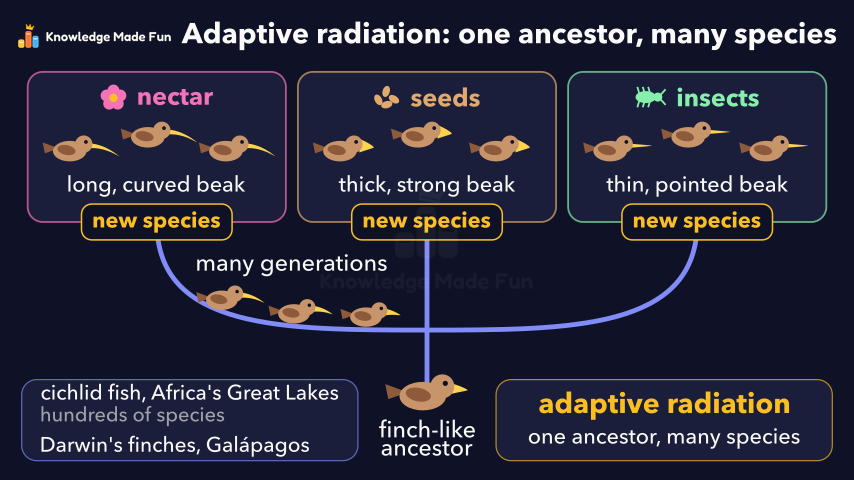 1 min 48 s
Adaptive radiation: one ancestor, many species
Grade 10 · 1 min 48 s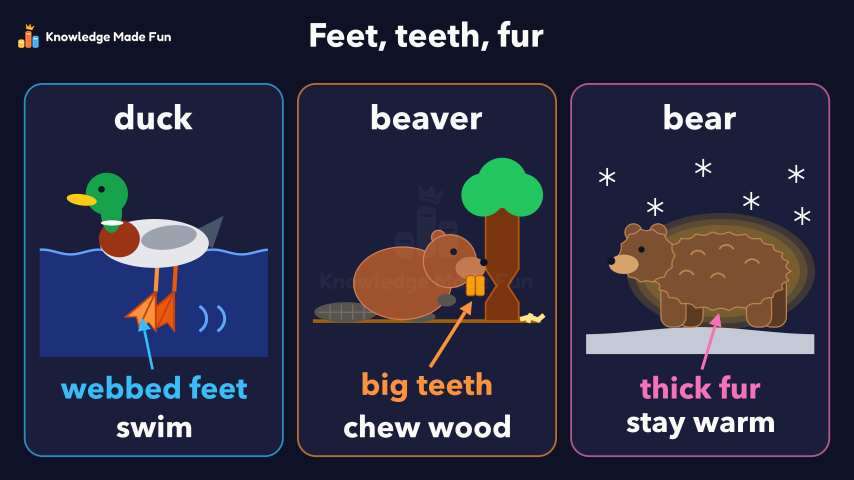 52 s
Animal Bodies That Help Them Live: Feet, Teeth and Fur
Kindergarten · 52 s 1 min 3 s
Animal senses beyond ours: echolocation, ultraviolet light, heat and magnetism
Grade 4 · 1 min 3 s 1 min 44 s
Antibodies and Memory Cells: The Body's Targeted Defence
Grade 8 · 1 min 44 s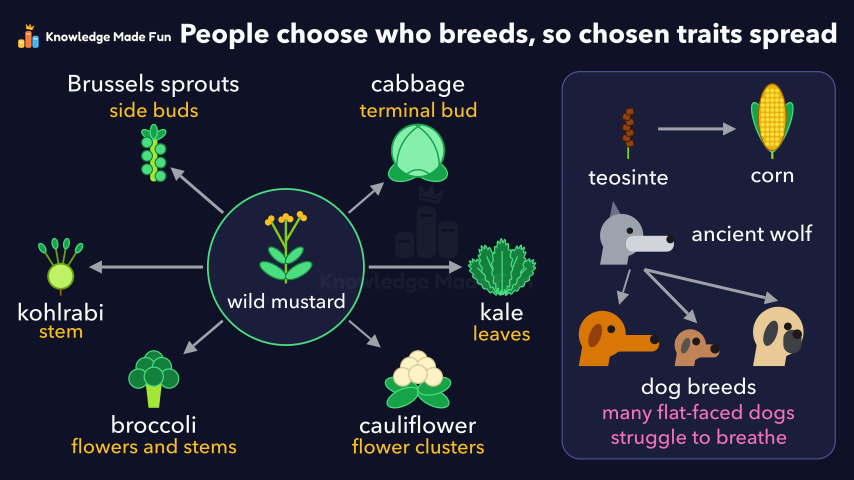 1 min 44 s
Artificial selection: people choose the traits
Grade 10 · 1 min 44 s 1 min 4 s
Biodiversity: The Variety of Living Things
Grade 3 · 1 min 4 s 1 min 8 s
Biomes: Sorted by Temperature and Precipitation
Grade 4 · 1 min 8 s
- All Grade 10 Science lessons
- Create a free account to watch three lessons a day, no payment and no card.