Lesson · Grade 7 · Science
How Crystals Form
- Grade 7
- Science
- 1 min 16 s
- British Columbia
- BC7-SC-16
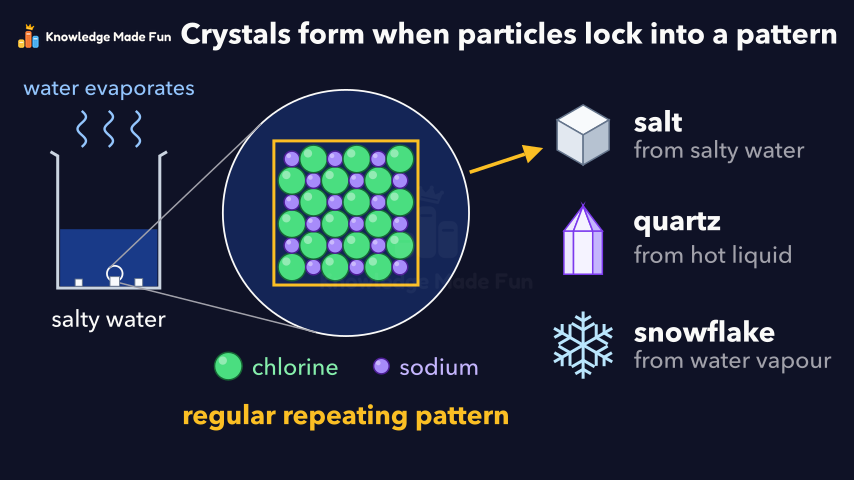
Salt particles move freely in a beaker of salty water. As the water evaporates they crowd together, lock into a regular, repeating pattern and build a crystal one layer at a time, whose flat faces and straight edges make salt grow as cubes. Quartz and snowflakes grow the same way, from hot liquid underground and from water vapour in clouds, and each kind of crystal's own pattern of particles gives it its own shape.
Anyone can watch two lessons on the website without an account. Signing in is free, no payment and no card, and opens three a day; Plus has no limit.
Loading
In one sentence
The question this lesson answers
Salt, quartz and snowflakes are all crystals, but how do crystals form?
Let us watch salt crystals form in a beaker of salty water.
Transcript
What the lesson says
Salt, quartz and snowflakes are all crystals, but how do crystals form?
Let us watch salt crystals form in a beaker of salty water.
Zoom in to see the sodium and chlorine particles moving freely in the water.
As the water evaporates, the particles get crowded closer together.
Some of them meet and lock into place in a regular, repeating pattern.
More particles join at the edges, one layer at a time.
This regular, repeating pattern of particles is what makes a solid a crystal.
The pattern shows on the outside as flat faces and straight edges.
Salt particles line up in squares, so salt crystals grow as little cubes.
Quartz grows the same way, as hot liquid deep underground slowly cools.
Snowflakes grow in clouds, as water vapour freezes straight into ice.
Each kind of crystal has its own pattern of particles, which gives it its own shape.
So crystals form when particles lock together in a regular, repeating pattern.
Curriculum
Where this fits
- British Columbia, Grade 7
Science, Chemistry: crystalline structure of solidsBC7-SC-16
Previous: What Makes Each Pure Substance DifferentNext: Physical change or chemical change?
The outcomes and strands follow the British Columbia curriculum.
Keep going
 1 min 40 s
Acids and bases: the pH scale
Grade 10 · 1 min 40 s 1 min 39 s
Activation energy: the push a reaction needs to start
Grade 10 · 1 min 39 s 1 min 54 s
Atomic Size: Bigger Down a Group, Smaller Across a Period
Grade 9 · 1 min 54 s 1 min 18 s
Atoms rearrange: vinegar and baking soda
Grade 7 · 1 min 18 s 1 min 16 s
Atoms: What Everything Is Made Of
Grade 7 · 1 min 16 s 2 min 3 s
Balancing Chemical Equations
Grade 10 · 2 min 3 s 1 min 54 s
Bohr Diagrams: Electrons in Shells and Valence Electrons
Grade 9 · 1 min 54 s 1 min 45 s
Brownian motion: evidence that molecules exist
Grade 8 · 1 min 45 s
- All Grade 7 Science lessons
- Create a free account to watch three lessons a day, no payment and no card.