Lesson · Grade 10 · Science
Conservation of Energy: Tracking the Total
- Grade 10
- Science
- 1 min 50 s
- British Columbia
- BC10-SC-36
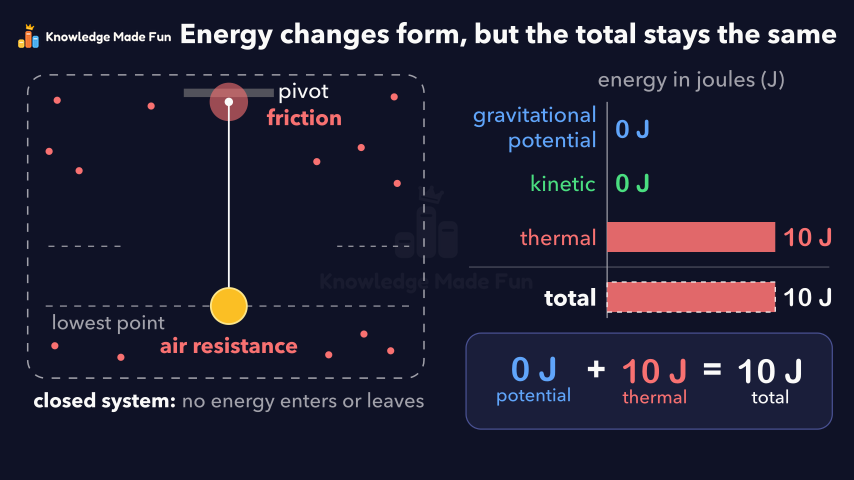
A pendulum swings inside a dashed "closed system" box while live bars beside it track its gravitational potential, kinetic and total energy: 10 J of potential energy turns into kinetic energy at the bottom and back again, and the total stays at 10 J. Once friction and air resistance are added, each swing is lower and the missing energy shows up as thermal energy (7 J + 3 J, and finally 0 J + 10 J), so the total is still 10 J and energy is never used up.
Concept: Conservation of energy: tracking the total in a closed system
Anyone can watch two lessons on the website without an account. Signing in is free, no payment and no card, and opens three a day; Plus has no limit.
Loading
In one sentence
The question this lesson answers
A swinging pendulum slows down and stops. Where does its energy go?
A pendulum is a heavy ball, the bob, on a string hanging from a pivot.
Transcript
What the lesson says
A swinging pendulum slows down and stops. Where does its energy go?
A pendulum is a heavy ball, the bob, on a string hanging from a pivot.
Treat the pendulum and the air around it as a closed system: no energy enters or leaves.
The bob starts with 10 joules of gravitational potential energy, stored because of its height above the lowest point.
With no friction yet, the bob falls and speeds up, gaining kinetic energy: the energy of motion.
At the lowest point, all 10 joules are kinetic, and the bob moves fastest.
As it rises, it slows down, and kinetic energy turns back into potential energy.
Add them up at any moment: the total energy is always 10 joules.
This is the law of conservation of energy: energy changes form, but is never created or destroyed.
But a real pendulum swings lower each time. Is energy used up?
No. Friction at the pivot and air resistance on the bob cause heating.
Thermal energy is the energy of moving particles. The pivot and air gain some and get slightly warmer.
At the top, 7 joules of potential plus 3 joules of thermal energy still make 10 joules.
Swing by swing, more energy becomes thermal. When it stops, all 10 joules are thermal energy.
The energy is not lost. It is spread out, and far less useful.
Energy changes form, but in a closed system the total always stays the same.
Curriculum
Where this fits
- British Columbia, Grade 10
Science 10, Physics: law of conservation of energyBC10-SC-36
Previous: Nuclear Technology: Benefits and RisksNext: Gravitational Potential Energy: Ep = mgh
- British Columbia, Grade 11
Physics 11, Energy: conservation of energy; principle of work and energyBC11-SC-212
This lesson is also listed in Grade 11.
The outcomes and strands follow the British Columbia curriculum.
Keep going
 1 min 51 s
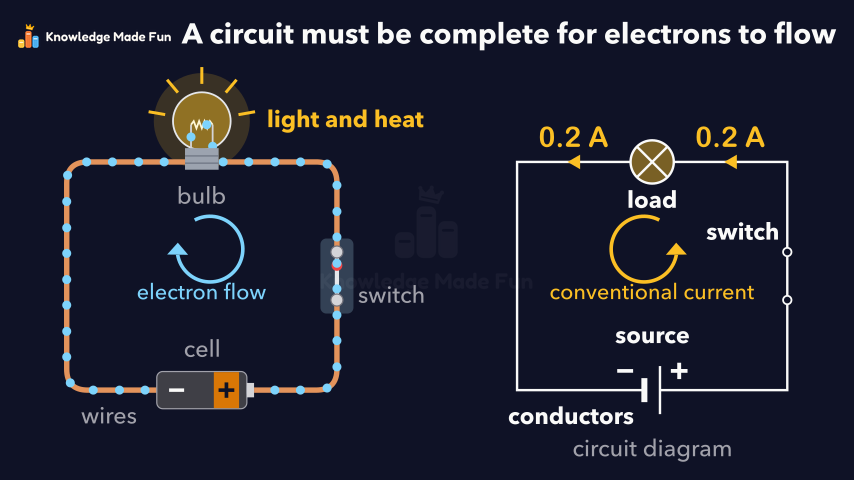
A Complete Circuit: Source, Load, Conductors and Switch
Grade 9 · 1 min 51 s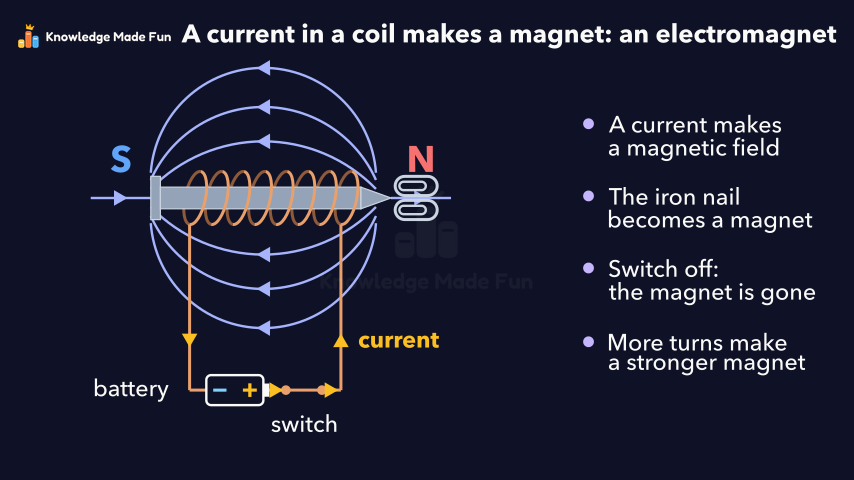 1 min 18 s
A current makes a magnet: the electromagnet
Grade 7 · 1 min 18 s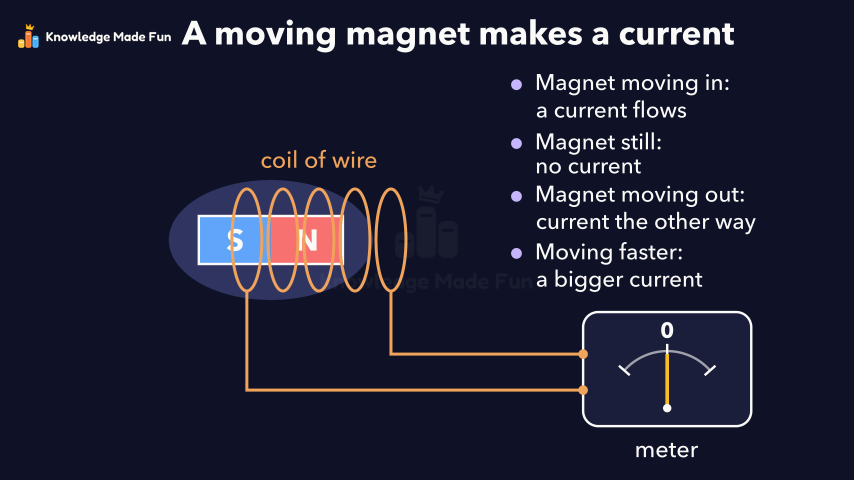 1 min 12 s
A Moving Magnet Makes a Current
Grade 7 · 1 min 12 s 54 s
A Push or a Pull Makes Things Move
Kindergarten · 54 s 1 min 48 s
AC and DC: Two Ways Current Can Flow
Grade 9 · 1 min 48 s 1 min 3 s
Air Resistance: Why a Flat Sheet Falls Slower
Grade 2 · 1 min 3 s 1 min 40 s
Alpha, Beta and Gamma Radiation
Grade 10 · 1 min 40 s 1 min 6 s
Balanced and Unbalanced Forces in Sport and Play
Grade 6 · 1 min 6 s
- All Grade 10 Science lessons
- Create a free account to watch three lessons a day, no payment and no card.