Lesson · Grade 10 · Science
Gravitational Potential Energy: Ep = mgh
- Grade 10
- Science
- 1 min 59 s
- British Columbia
- BC10-SC-37
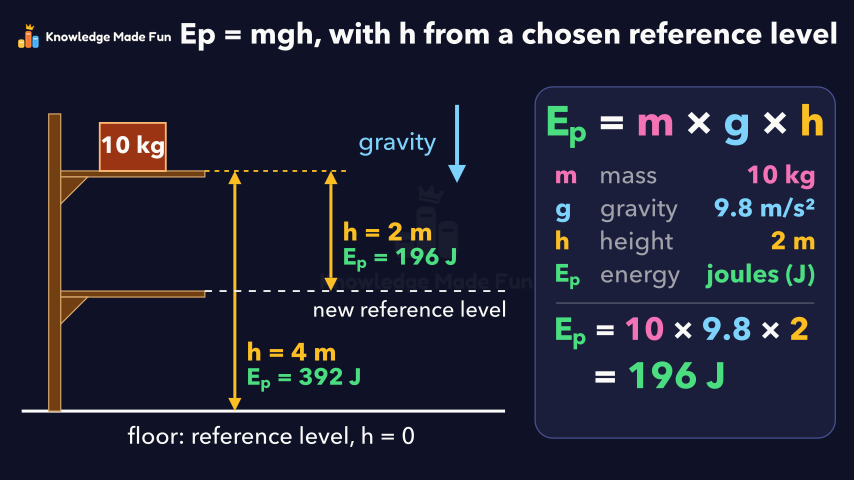
A 10 kg box is lifted onto a shelf 2 m up and Ep = mgh is filled in one term at a time to get 196 J, then lifting it to 4 m gives 392 J, showing that doubling the height doubles the energy. Measured from the lower shelf instead of the floor, the same unmoved box has only 196 J, showing that Ep depends on the chosen reference level and not on the box alone.
Concept: Gravitational potential energy: mass, gravity and height
Anyone can watch two lessons on the website without an account. Signing in is free, no payment and no card, and opens three a day; Plus has no limit.
Loading
In one sentence
The question this lesson answers
When you lift a box onto a shelf, what energy does it gain, and how much?
Gravity pulls this 10 kilogram box down, toward Earth.
Transcript
What the lesson says
When you lift a box onto a shelf, what energy does it gain, and how much?
Gravity pulls this 10 kilogram box down, toward Earth.
To lift it 2 metres onto the shelf, you push up against that pull.
The box gains gravitational potential energy, E p: energy stored because of its height.
To calculate it, use E p equals m times g times h.
The m stands for mass, in kilograms. Our box is 10 kilograms.
The g is the acceleration due to gravity: about 9.8 metres per second squared on Earth.
The h is the height in metres above a reference level, where height is zero. Here that is the floor, so h is 2 metres.
Energy is measured in joules, written J.
So E p equals 10 times 9.8 times 2.
That is 196 joules, measured from the floor.
Now lift the same box twice as high, to 4 metres.
This time, E p equals 10 times 9.8 times 4, which is 392 joules.
Double the height, double the energy: 392 is 2 times 196.
But choose the lower shelf as the reference level instead, and the box is only 2 metres up.
From there, E p is 10 times 9.8 times 2, which is just 196 joules.
The box has not moved, yet E p changed: its value depends on the reference level you choose.
E p equals m g h, with h measured from a chosen reference level.
Curriculum
Where this fits
- British Columbia, Grade 10
Science 10, Physics: potential and kinetic energyBC10-SC-37
Previous: Conservation of Energy: Tracking the TotalNext: Kinetic energy: why doubling speed gives four times the energy
The outcomes and strands follow the British Columbia curriculum.
Keep going
 1 min 51 s
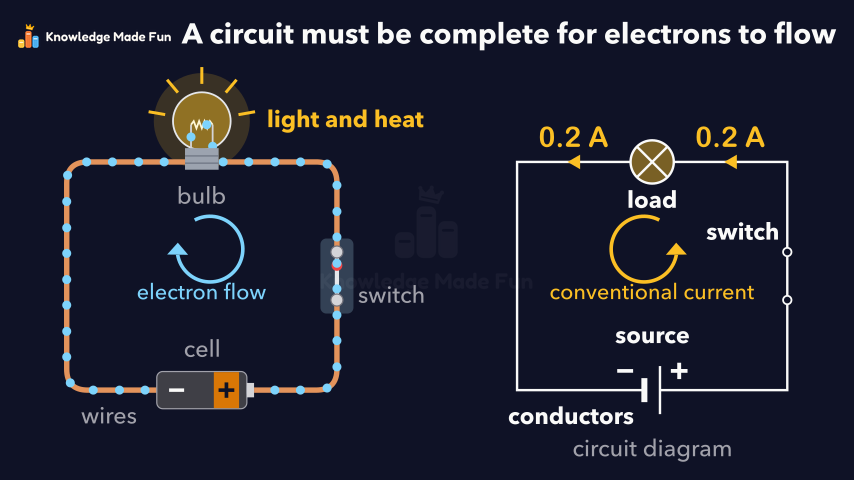
A Complete Circuit: Source, Load, Conductors and Switch
Grade 9 · 1 min 51 s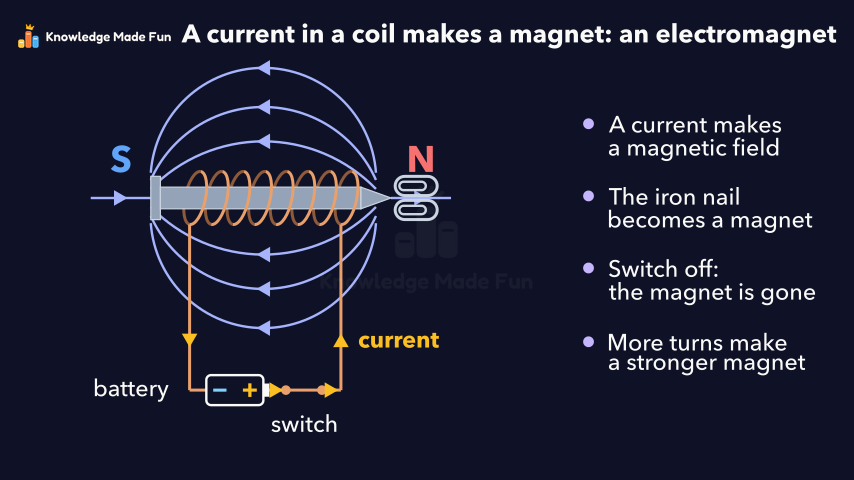 1 min 18 s
A current makes a magnet: the electromagnet
Grade 7 · 1 min 18 s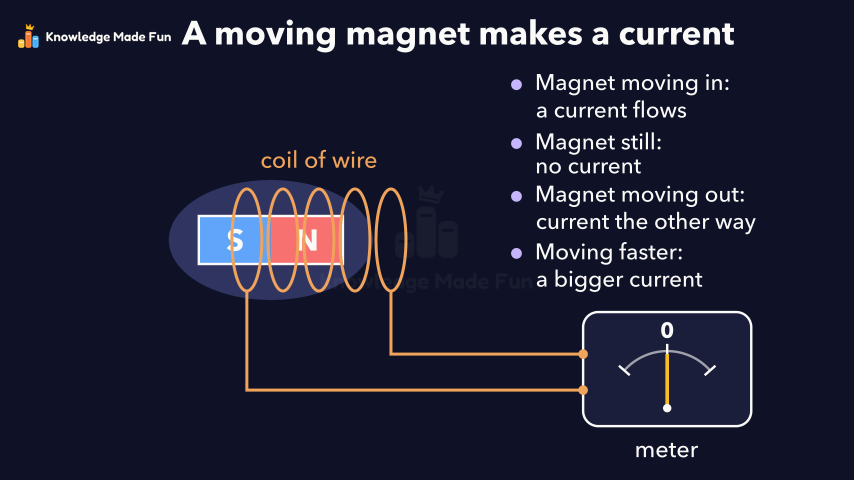 1 min 12 s
A Moving Magnet Makes a Current
Grade 7 · 1 min 12 s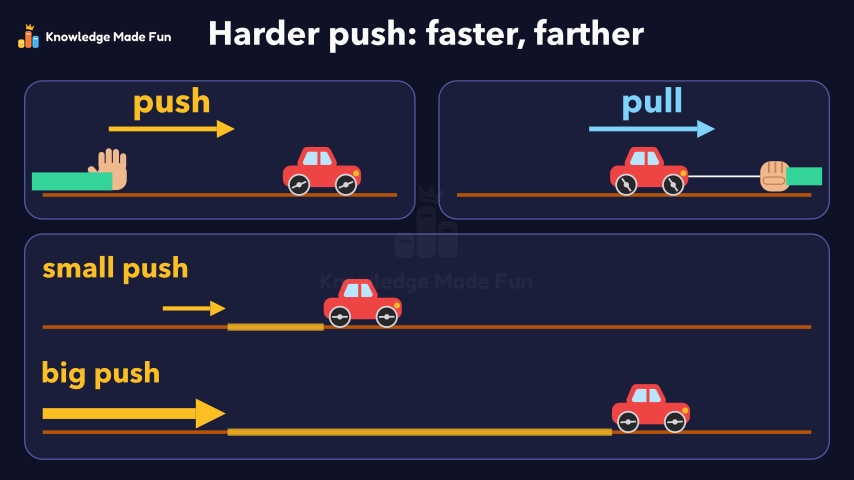 54 s
A Push or a Pull Makes Things Move
Kindergarten · 54 s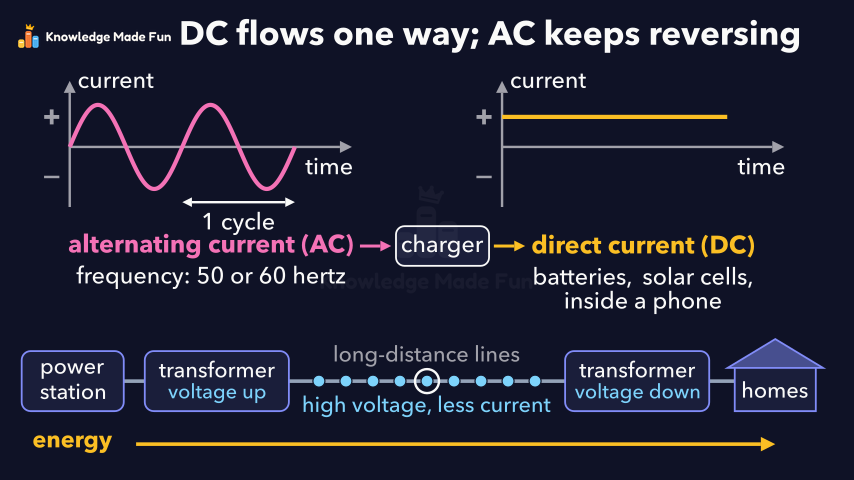 1 min 48 s
AC and DC: Two Ways Current Can Flow
Grade 9 · 1 min 48 s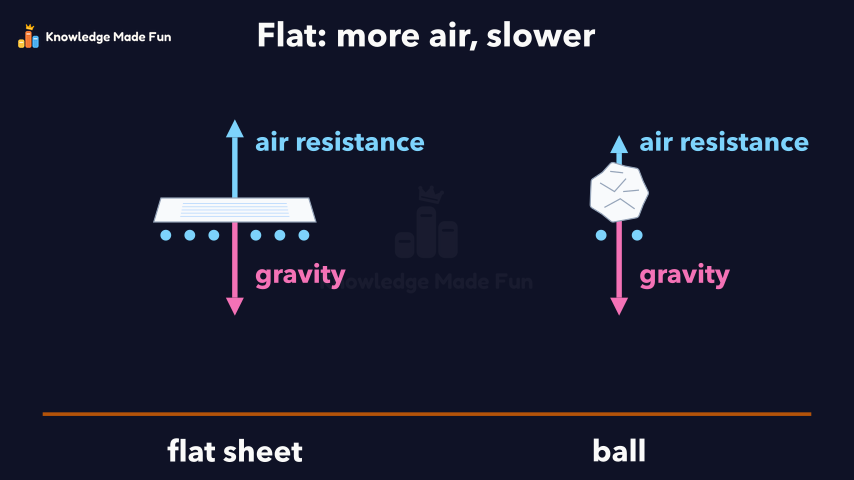 1 min 3 s
Air Resistance: Why a Flat Sheet Falls Slower
Grade 2 · 1 min 3 s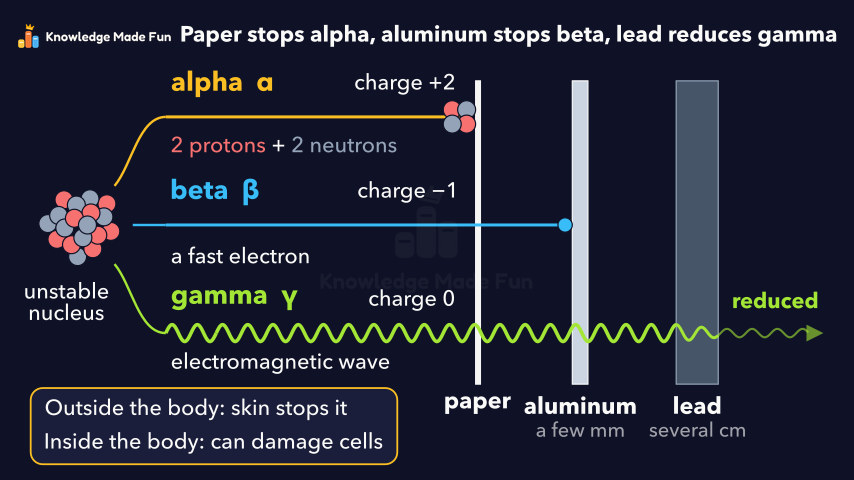 1 min 40 s
Alpha, Beta and Gamma Radiation
Grade 10 · 1 min 40 s 1 min 6 s
Balanced and Unbalanced Forces in Sport and Play
Grade 6 · 1 min 6 s
- All Grade 10 Science lessons
- Create a free account to watch three lessons a day, no payment and no card.