Lesson · Grade 9 · Science
Chemical families: alkali metals, halogens and noble gases
- Grade 9
- Science
- 1 min 51 s
- British Columbia
- BC9-SC-11
The first four rows of the periodic table are built up step by step, and four groups are coloured and named one at a time: alkali metals (soft and more reactive with water further down the group), alkaline earth metals, halogens (very reactive non-metals that make salts with metals, such as sodium chloride) and noble gases (full outer shells, so they barely react). The outer electrons under each group show why a group is a chemical family, and period 3 shows that elements in the same row do not behave alike.
Anyone can watch two lessons on the website without an account. Signing in is free, no payment and no card, and opens three a day; Plus has no limit.
Loading
In one sentence
The question this lesson answers
There are over a hundred elements. Which ones behave alike?
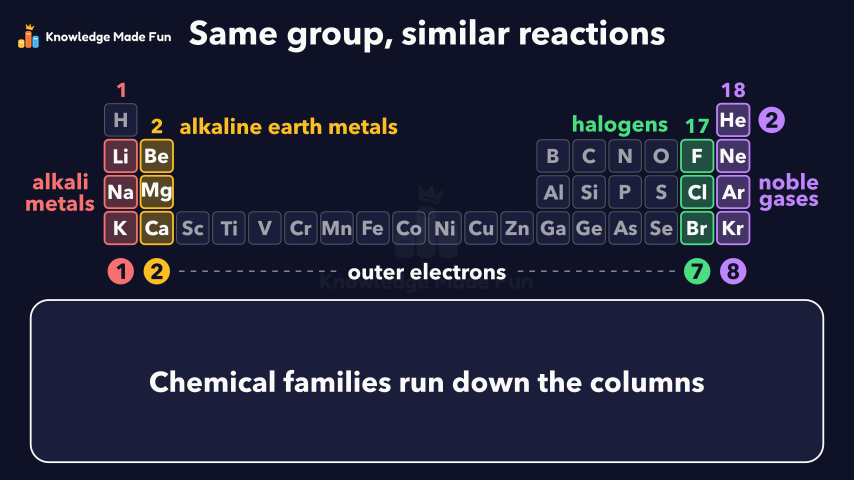
Here are the first four rows of the periodic table. Each row is a period, and each column is a group.
Transcript
What the lesson says
There are over a hundred elements. Which ones behave alike?
Here are the first four rows of the periodic table. Each row is a period, and each column is a group.
Elements in a group tend to react in similar ways, so a group is called a chemical family.
Apart from hydrogen, group 1 holds the alkali metals, such as lithium, sodium and potassium.
They are soft metals that react strongly with water.
Down the group the reaction gets stronger: lithium fizzes, sodium fizzes faster, and potassium catches fire.
Group 2 holds the alkaline earth metals. They are reactive too, but less than group 1.
Group 17 holds the halogens, very reactive non-metals such as fluorine, chlorine and bromine.
Halogens react with metals to make salts: sodium and chlorine make sodium chloride, table salt.
Group 18 holds the noble gases. Their outer shell of electrons is full, so they barely react.
Why? Atoms react using their outer electrons, the ones in the outermost shell, like this one in lithium.
Alkali metals have one outer electron, alkaline earth metals two, halogens seven, and noble gases a full shell: eight, or two for helium.
But elements in the same row do not behave alike. In period 3, sodium is a reactive metal, chlorine a reactive non-metal, and argon barely reacts.
So chemical families run down the columns: same group, similar reactions.
Curriculum
Where this fits
- British Columbia, Grade 9
Science, Chemistry: element properties as organized in the periodic tableBC9-SC-11
Previous: Metals, Non-metals and MetalloidsNext: Atomic Size: Bigger Down a Group, Smaller Across a Period
The outcomes and strands follow the British Columbia curriculum.
Keep going
 1 min 40 s
Acids and bases: the pH scale
Grade 10 · 1 min 40 s 1 min 39 s
Activation energy: the push a reaction needs to start
Grade 10 · 1 min 39 s 1 min 54 s
Atomic Size: Bigger Down a Group, Smaller Across a Period
Grade 9 · 1 min 54 s 1 min 18 s
Atoms rearrange: vinegar and baking soda
Grade 7 · 1 min 18 s 1 min 16 s
Atoms: What Everything Is Made Of
Grade 7 · 1 min 16 s 2 min 3 s
Balancing Chemical Equations
Grade 10 · 2 min 3 s 1 min 54 s
Bohr Diagrams: Electrons in Shells and Valence Electrons
Grade 9 · 1 min 54 s 1 min 45 s
Brownian motion: evidence that molecules exist
Grade 8 · 1 min 45 s
- All Grade 9 Science lessons
- Create a free account to watch three lessons a day, no payment and no card.