Lesson · Grade 9 · Mathematics
Collecting Data Fairly: Privacy, Consent, Timing and Cost
- Grade 9
- Mathematics
- 1 min 50 s
- British Columbia
- BC9-MA-30
A class fixes the first draft of a sleep survey step by step: it removes questions it does not need so the answers are anonymous, adds a consent section, and picks an ordinary school week instead of the morning after a holiday. It then works out that asking all 600 students would take 30 hours against 3 hours for a random sample of 60, and ends on a five-point checklist for fair data collection.
Concept: Collecting data fairly: privacy, consent, cost and timing
Anyone can watch two lessons on the website without an account. Signing in is free, no payment and no card, and opens three a day; Plus has no limit.
Loading
In one sentence
The question this lesson answers
A class plans a survey of how much students at their school sleep. How can they collect the data fairly?
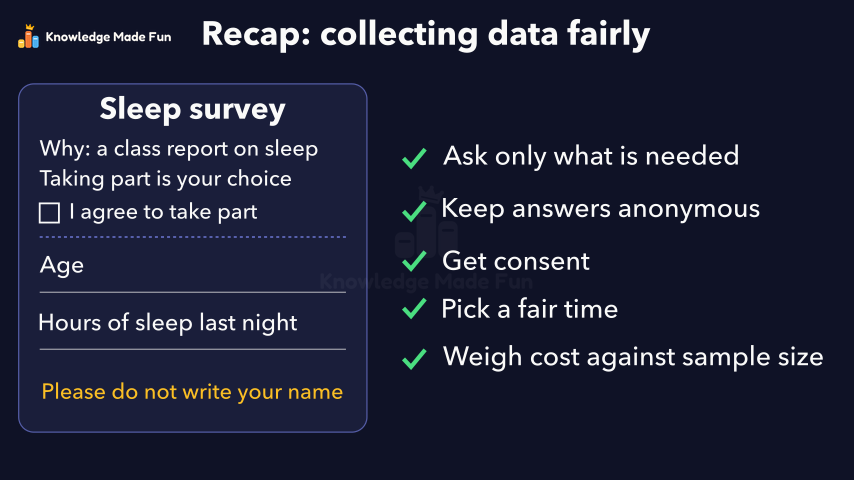
Their first draft asks for a name, home address, phone number, age and hours of sleep last night.
Transcript
What the lesson says
A class plans a survey of how much students at their school sleep. How can they collect the data fairly?
Their first draft asks for a name, home address, phone number, age and hours of sleep last night.
A common mistake is collecting names and details just in case. Each is more personal data to protect.
Privacy means people control who sees their details. This survey needs no name, address or phone number, so they go.
Now the form says not to write a name, so answers are anonymous: no one can tell who gave each answer.
Consent means agreeing to take part after being told what the data is for, so the form says why, that it is a choice, and asks people to agree.
Timing matters: after a holiday, a sleep survey the next morning can give odd answers, so the class picks an ordinary school week.
The population is the whole group studied, here all 600 students. A sample is the part you actually ask.
Each form takes about 3 minutes. Asking everyone takes 600 times 3, which is 1,800 minutes, or 30 hours.
A sample of 60 takes 60 times 3, which is 180 minutes, or just 3 hours.
A bigger sample is usually more reliable but costs more, so the class picks 60 students at random, each with the same chance.
To collect data fairly, ask only what is needed, keep answers anonymous, get consent, pick a fair time, and weigh cost against sample size.
Curriculum
Where this fits
- British Columbia, Grade 9
Mathematics, Data and probability: statistics in societyBC9-MA-30
Previous: Misleading Graphs: Broken Axes and Stretched Pictures
The outcomes and strands follow the British Columbia curriculum.
Keep going
 1 min 23 s
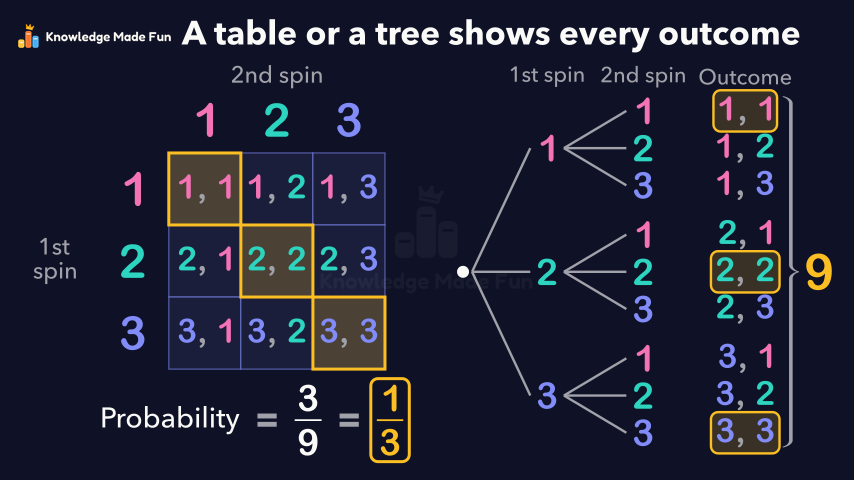
All the Outcomes of Two Spins: Tables and Tree Diagrams
Grade 7 · 1 min 23 s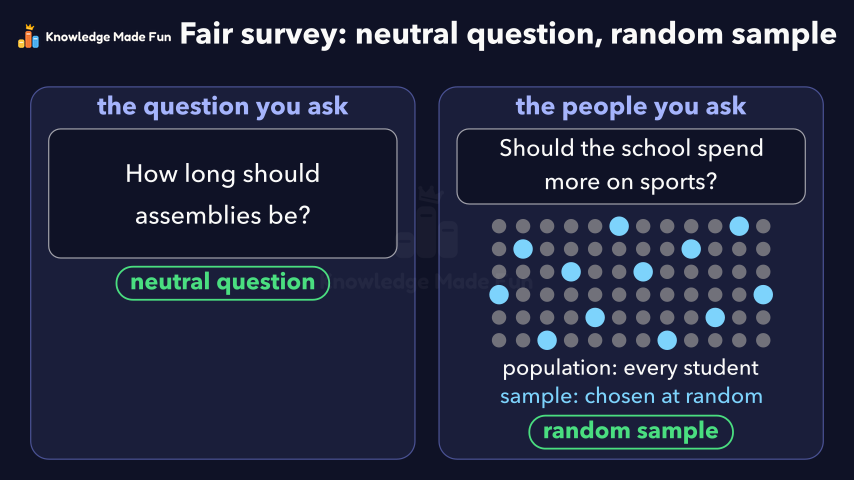 1 min 47 s
Bias in a Survey: Leading Questions and Unfair Samples
Grade 9 · 1 min 47 s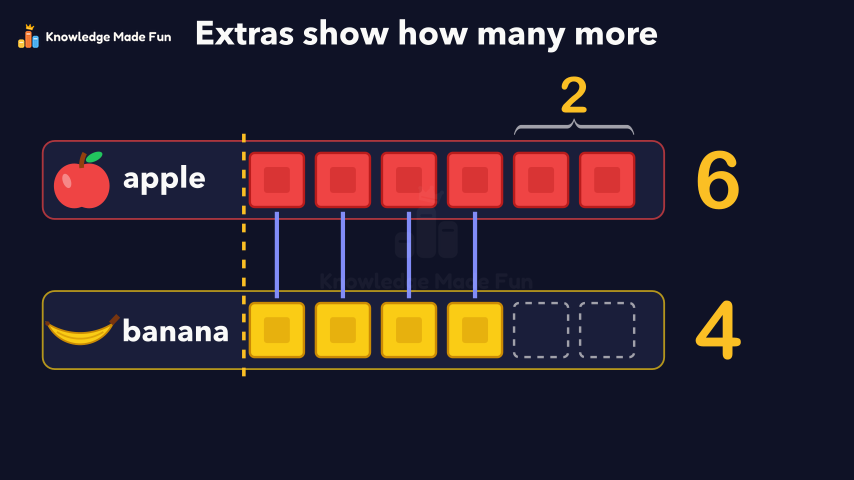 1 min
Block Graphs: Which Row Is Longer?
Grade 1 · 1 min 1 min 58 s
Choosing the best average: mean, median or mode
Grade 8 · 1 min 58 s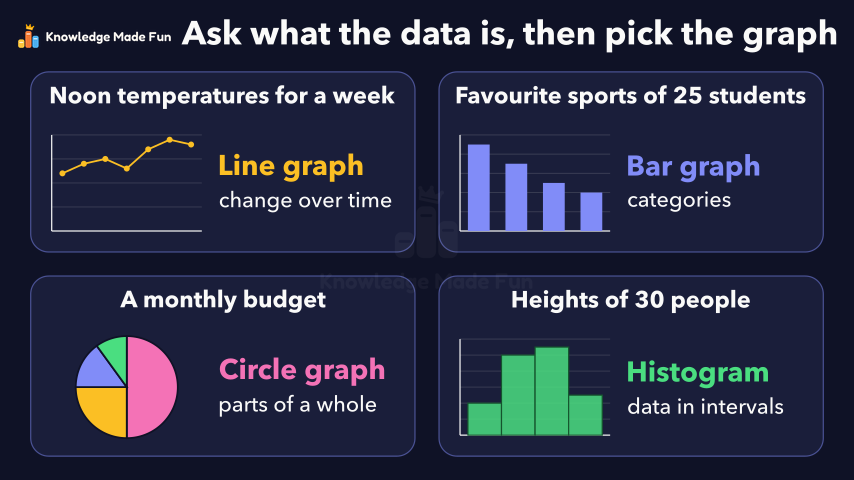 1 min 56 s
Choosing the right graph for the data
Grade 10 · 1 min 56 s 55 s
Could It Snow Tomorrow? Likely or Unlikely
Kindergarten · 55 s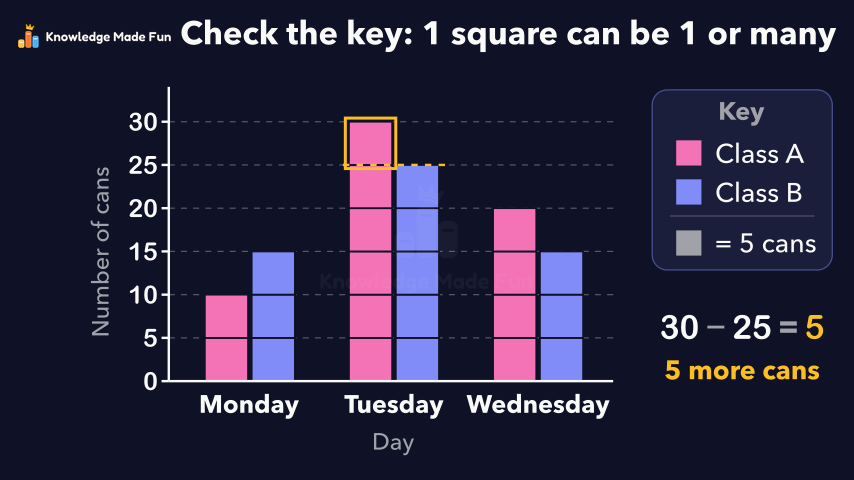 1 min 27 s
Double bar graphs with a scale
Grade 5 · 1 min 27 s 1 min 21 s
Drawing a circle graph from data
Grade 7 · 1 min 21 s
- All Grade 9 Mathematics lessons
- Try the graph paper, free for everyone, no account needed.
- Create a free account to watch three lessons a day, no payment and no card.