Lesson · Grade 7 · Social Studies
Who Did What: Social Pyramids in Ancient Societies
- Grade 7
- Social Studies
- 1 min 13 s
- British Columbia
- BC7-SS-24
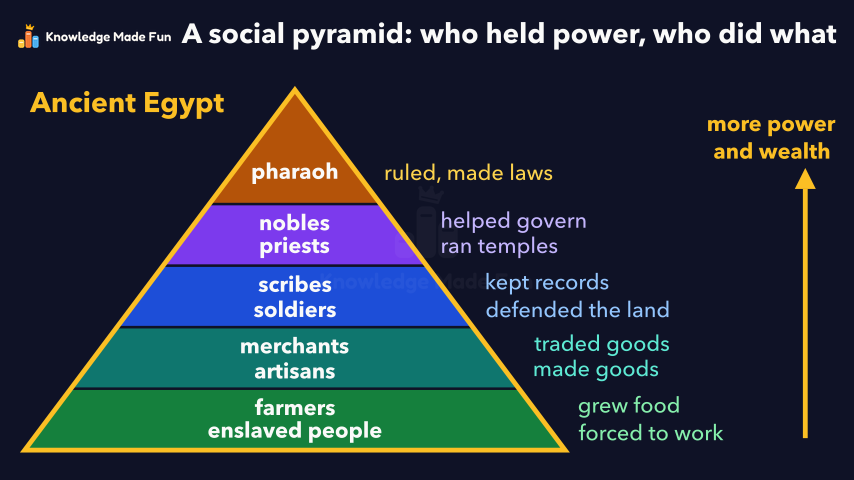
A social pyramid of ancient Egypt builds up level by level, from the pharaoh at the top to farmers and enslaved people at the bottom, with each group's jobs written beside it. The video then shows what the shape means: a few people at the top had the most power and wealth, most people were at the bottom and stayed in the level they were born into, and only a few moved up.
Anyone can watch two lessons on the website without an account. Signing in is free, no payment and no card, and opens three a day; Plus has no limit.
Loading
In one sentence
The question this lesson answers
In an ancient society, who did which jobs, and who held the power?
Many ancient societies were arranged in levels, like a pyramid.
Transcript
What the lesson says
In an ancient society, who did which jobs, and who held the power?
Many ancient societies were arranged in levels, like a pyramid.
Let's look at the social pyramid of ancient Egypt.
At the top, the pharaoh ruled and made the laws.
Next, nobles helped govern, and priests ran the temples.
Scribes kept written records, and soldiers defended the land.
Merchants traded goods, and artisans made goods by hand.
At the bottom, most people were farmers who grew the food.
Enslaved people were at the bottom too, forced to work and not free.
Only a few people were at the top, and most were at the bottom.
The higher the level, the more power and wealth people had.
Most people stayed in the level they were born into.
A few moved up, for example by training as scribes.
Other ancient societies had different levels, but many shared this shape.
A social pyramid shows who held power and who did each job.
Curriculum
Where this fits
- British Columbia, Grade 7
Social Studies, Ancient world to the 7th century: social, political, legal, governmental, and economic systems and structuresBC7-SS-24
The outcomes and strands follow the British Columbia curriculum.
Keep going
 1 min 23 s
Ancient China and the Yellow River
Grade 7 · 1 min 23 s 1 min 28 s
Ancient Egypt and the Nile
Grade 7 · 1 min 28 s 1 min 27 s
Ancient Greece: How the City-States Rose and Fell
Grade 7 · 1 min 27 s 1 min 13 s
Ancient Inventions We Still Use
Grade 7 · 1 min 13 s 1 min 28 s
Ancient Rome: How It Rose and Why the West Fell
Grade 7 · 1 min 28 s 1 min 31 s
Early humans and Neanderthals: our close relatives
Grade 7 · 1 min 31 s 1 min 9 s
From Barter to Money
Grade 7 · 1 min 9 s 1 min 33 s
From Hunting and Gathering to Farming
Grade 7 · 1 min 33 s
- All Grade 7 Social Studies lessons
- Create a free account to watch three lessons a day, no payment and no card.