Lesson · Grade 10 · Science
Rovers, Space Stations and Underground Labs: Gathering Evidence
- Grade 10
- Science
- 1 min 54 s
- British Columbia
- BC10-SC-49
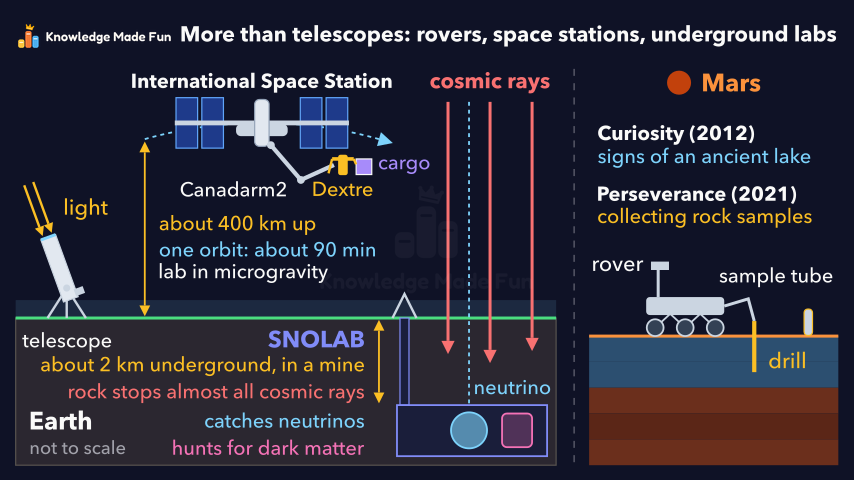
One diagram builds up step by step, starting from a telescope. It shows a Mars rover drilling rock, the International Space Station 400 km up, and SNOLAB 2 km underground, where rock blocks cosmic rays while neutrinos reach a detector. It ends on the idea that astronomy is more than telescopes, because rovers, space stations and underground labs all gather evidence too.
Anyone can watch two lessons on the website without an account. Signing in is free, no payment and no card, and opens three a day; Plus has no limit.
Loading
In one sentence
The question this lesson answers
Is astronomy only about looking through telescopes?
Telescopes are one way: they collect light from distant stars and galaxies.
Transcript
What the lesson says
Is astronomy only about looking through telescopes?
Telescopes are one way: they collect light from distant stars and galaxies.
Scientists also send instruments to other worlds, into orbit and deep underground.
A rover is a robot vehicle that explores another world, like Mars.
Rovers drill into rock and analyze it with instruments on board.
Curiosity, which landed in 2012, found signs of an ancient lake in rock layers.
Perseverance, which landed in 2021, has been collecting rock samples in sealed tubes.
The International Space Station, or ISS, orbits about 400 kilometres up. This drawing is not to scale.
It circles Earth about once every 90 minutes.
It is a lab in microgravity, where things float because the station is always falling around Earth.
The robotic arm Canadarm2 and the robot Dextre move cargo outside the station.
Cosmic rays are fast particles from space that hit Earth all the time.
SNOLAB is a lab about 2 kilometres underground, in a mine.
The rock above stops almost all cosmic rays, shielding the detectors.
Neutrinos are tiny particles that pass through rock easily, so a detector here can catch a few.
Other detectors hunt for dark matter, unseen matter that has not yet been detected directly.
So astronomy is more than telescopes: rovers, space stations and underground labs gather evidence too.
Curriculum
Where this fits
- British Columbia, Grade 10
Science 10, Earth science: astronomical data and collection methodsBC10-SC-49
The outcomes and strands follow the British Columbia curriculum.
Keep going
 1 min 43 s
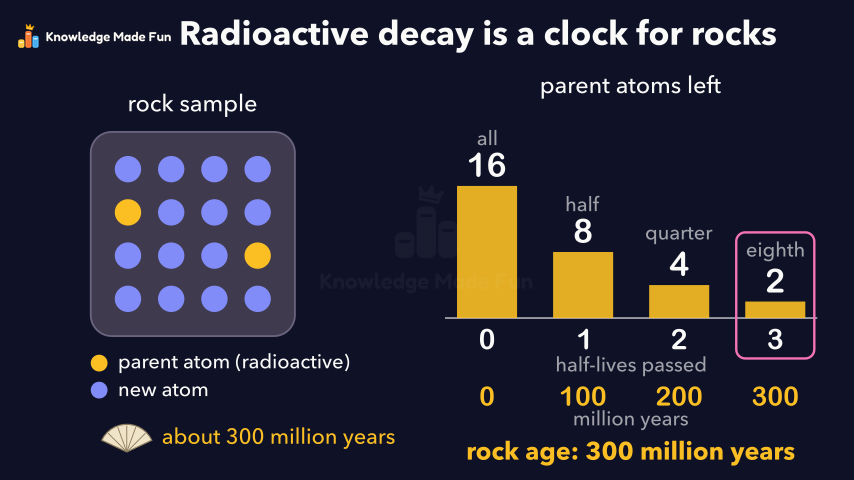
Absolute dating: radioactive decay is a clock for rocks
Grade 7 · 1 min 43 s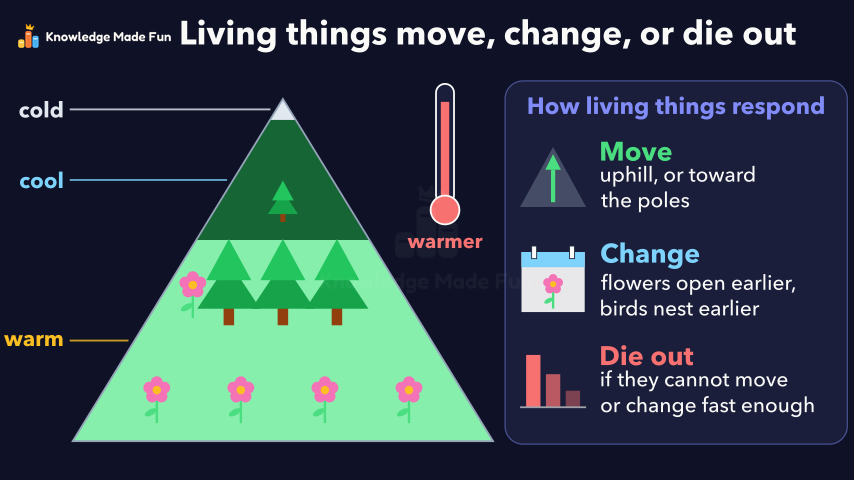 1 min 19 s
Climate Change and Living Things: Move, Change, or Die Out
Grade 7 · 1 min 19 s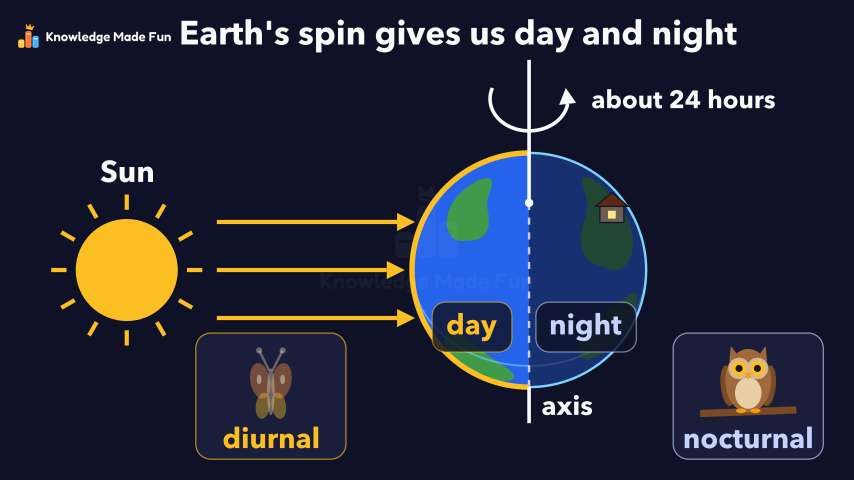 1 min 14 s
Day and Night: Earth Spins on Its Axis
Grade 4 · 1 min 14 s 1 min 50 s
Dynamic equilibrium: balanced but always changing
Grade 9 · 1 min 50 s 1 min 11 s
Earth Materials: From Boulders to Clay
Grade 5 · 1 min 11 s 1 min 11 s
Erosion and Deposition: How Wind, Water and Ice Move Land
Grade 3 · 1 min 11 s 1 min 53 s
From quarks to galaxies: how the universe's matter formed
Grade 10 · 1 min 53 s 47 s
Hot, Warm, Cool and Cold: What Do We Wear?
Kindergarten · 47 s
- All Grade 10 Science lessons
- Create a free account to watch three lessons a day, no payment and no card.