Lesson · Grade 7 · Science
Mass extinctions in the fossil record
- Grade 7
- Science
- 1 min 57 s
- British Columbia
- BC7-SC-36
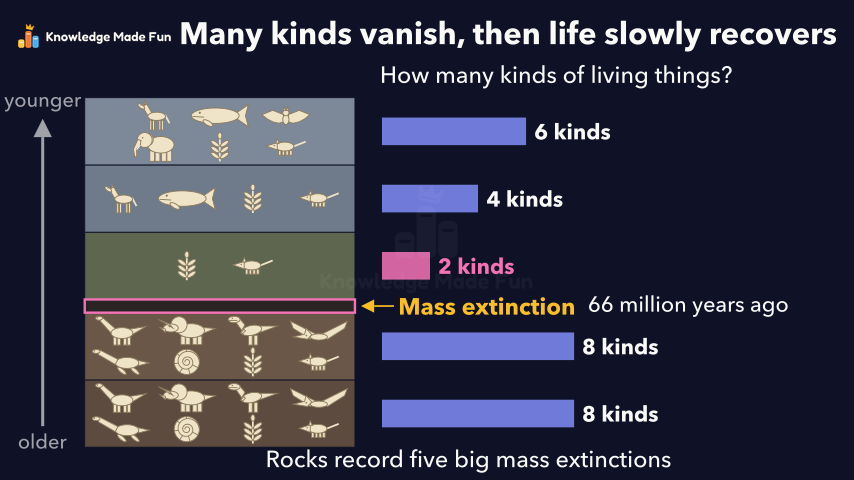
A column of rock layers builds up with fossils of eight kinds of living things in the lower layers, a thin dark layer, and only ferns and small mammals just above it, with bars beside each layer counting the kinds found. The count drops from 8 to 2 at the boundary tagged as the mass extinction of 66 million years ago, then rises again as new kinds appear, showing how the fossil record records biodiversity falling sharply and slowly recovering.
Anyone can watch two lessons on the website without an account. Signing in is free, no payment and no card, and opens three a day; Plus has no limit.
Loading
In one sentence
The question this lesson answers
Dinosaur fossils turn up in layer after layer of rock. Then, suddenly, they stop. Why?
Remember, the lower layers formed first, so they are older. The top layers are the youngest.
Transcript
What the lesson says
Dinosaur fossils turn up in layer after layer of rock. Then, suddenly, they stop. Why?
Remember, the lower layers formed first, so they are older. The top layers are the youngest.
The lower layers hold fossils of many kinds of living things: dinosaurs, flying reptiles, sea reptiles, ammonites, ferns and small mammals.
Count the different kinds in each layer. Here, each of these two layers holds eight kinds.
Then comes a thin, dark layer, found in rocks all over the world.
Just above it, most of those kinds are missing. No dinosaurs, flying reptiles, sea reptiles or ammonites are ever found again.
In this column, eight kinds fell to two. Most of the living things in the lower layers died out.
When many kinds of living things die out in a short time, all over the world, it is called a mass extinction.
This one happened 66 million years ago. It ended the age of the dinosaurs.
Scientists estimate that about three in every four kinds of living things died out.
But some kinds lived on, such as ferns and small mammals.
Over millions of years, the survivors spread, and new kinds appeared, such as horses and whales.
So the fossil record shows biodiversity, the number of different kinds of living things, falling sharply and then slowly rising again.
Rocks record five big mass extinctions in Earth's past. The one that ended the dinosaurs is just the most famous.
A mass extinction shows in the fossil record as many kinds vanishing at once, and life slowly recovering above.
Curriculum
Where this fits
- British Columbia, Grade 7
Science, Earth science: the fossil record provides evidence for changes in biodiversity over geological timeBC7-SC-36
Previous: Absolute dating: radioactive decay is a clock for rocksNext: Weather and climate: today's air versus the pattern over many years
The outcomes and strands follow the British Columbia curriculum.
Keep going
 1 min 43 s
Absolute dating: radioactive decay is a clock for rocks
Grade 7 · 1 min 43 s 1 min 19 s
Climate Change and Living Things: Move, Change, or Die Out
Grade 7 · 1 min 19 s 1 min 14 s
Day and Night: Earth Spins on Its Axis
Grade 4 · 1 min 14 s 1 min 50 s
Dynamic equilibrium: balanced but always changing
Grade 9 · 1 min 50 s 1 min 11 s
Earth Materials: From Boulders to Clay
Grade 5 · 1 min 11 s 1 min 11 s
Erosion and Deposition: How Wind, Water and Ice Move Land
Grade 3 · 1 min 11 s 1 min 53 s
From quarks to galaxies: how the universe's matter formed
Grade 10 · 1 min 53 s 47 s
Hot, Warm, Cool and Cold: What Do We Wear?
Kindergarten · 47 s
- All Grade 7 Science lessons
- Create a free account to watch three lessons a day, no payment and no card.