Lesson · Grade 9 · Science
How the Sun Drives Winds and Ocean Currents
- Grade 9
- Science
- 1 min 47 s
- British Columbia
- BC9-SC-25
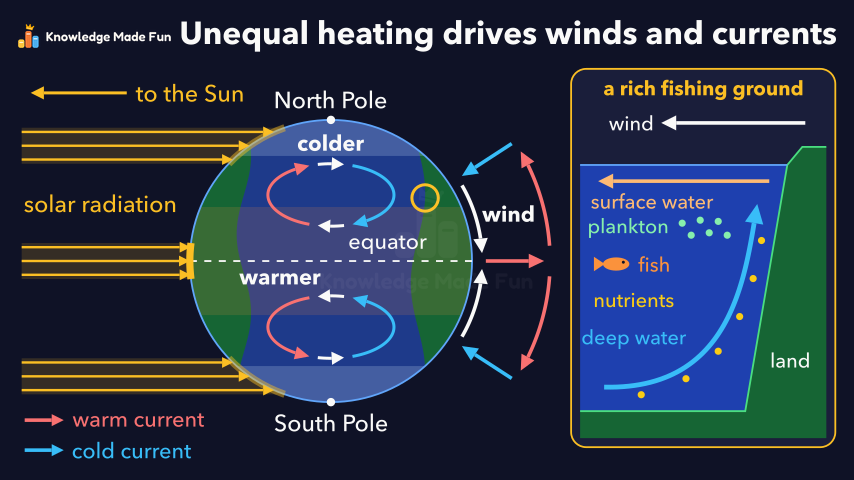
Three equal beams of sunlight hit Earth: near the equator the energy is concentrated, near the poles it spreads out, and this unequal heating (not distance from the Sun) makes warm air rise and cool air sink in convection currents that create wind. The winds drive surface ocean currents that carry warm water toward the poles and cold water back, and along some coasts upwelling brings up nutrient-rich deep water that feeds plankton, fish and rich fishing grounds.
Anyone can watch two lessons on the website without an account. Signing in is free, no payment and no card, and opens three a day; Plus has no limit.
Loading
In one sentence
The question this lesson answers
How does the Sun make winds blow and ocean currents flow?
Here is Earth, with the equator, the North Pole and the South Pole.
Transcript
What the lesson says
How does the Sun make winds blow and ocean currents flow?
Here is Earth, with the equator, the North Pole and the South Pole.
Energy from the Sun is solar radiation. Here are three equal beams.
Near the equator, a beam hits almost straight on, concentrating its energy on a small area.
Near the poles, the same beam hits at a low angle and spreads over a larger area.
So the equator warms more than the poles. This is unequal heating.
The equator is not hotter because it is closer to the Sun. It is only about 6,400 kilometres closer, out of about 150 million.
Air over the equator heats up, expands and becomes less dense, so it rises.
High up, it spreads toward the poles, cools, becomes denser and sinks.
Surface air flows back to the equator. This loop is a convection current, and the moving surface air is wind.
Winds drag surface water along, making surface currents, steady flows of seawater.
Warm currents carry heat toward the poles, and cold currents bring cooler water back.
Along some coasts, winds push surface water offshore, and cold deep water rises in its place. This is upwelling.
Deep water carries nutrients that feed plankton, tiny drifting living things. Plankton feed fish, making rich fishing grounds.
So unequal heating by the Sun drives the winds and the ocean currents.
Curriculum
Where this fits
- British Columbia, Grade 9
Science, Earth science: effects of solar radiation on the cycling of matter and energyBC9-SC-25
The outcomes and strands follow the British Columbia curriculum.
Keep going
 1 min 43 s
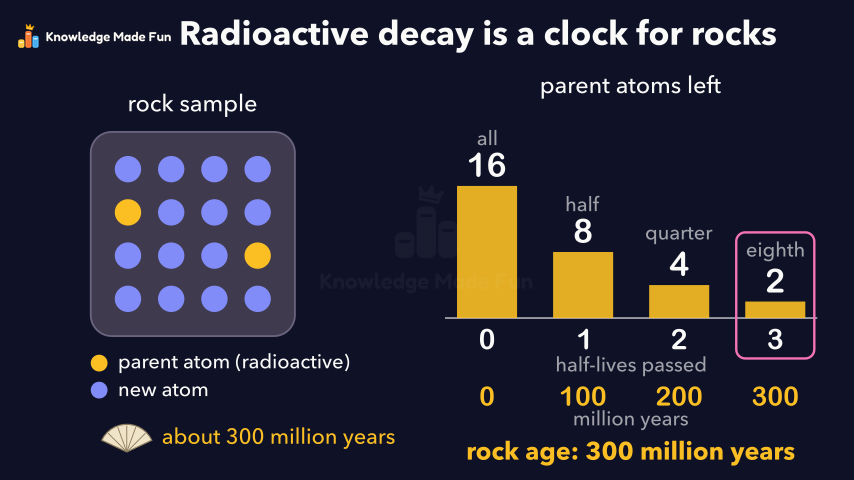
Absolute dating: radioactive decay is a clock for rocks
Grade 7 · 1 min 43 s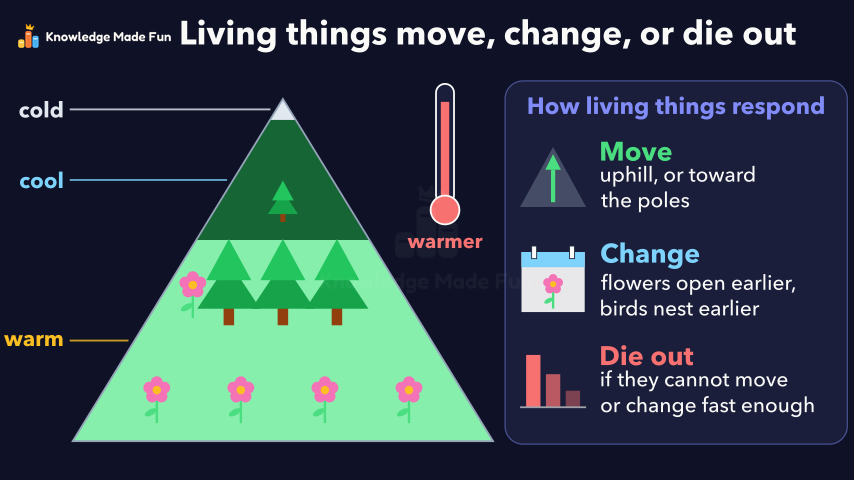 1 min 19 s
Climate Change and Living Things: Move, Change, or Die Out
Grade 7 · 1 min 19 s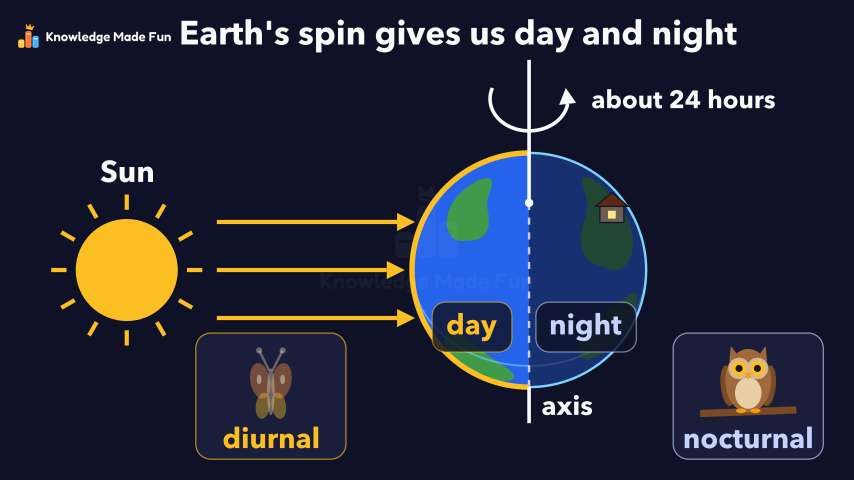 1 min 14 s
Day and Night: Earth Spins on Its Axis
Grade 4 · 1 min 14 s 1 min 50 s
Dynamic equilibrium: balanced but always changing
Grade 9 · 1 min 50 s 1 min 11 s
Earth Materials: From Boulders to Clay
Grade 5 · 1 min 11 s 1 min 11 s
Erosion and Deposition: How Wind, Water and Ice Move Land
Grade 3 · 1 min 11 s 1 min 53 s
From quarks to galaxies: how the universe's matter formed
Grade 10 · 1 min 53 s 47 s
Hot, Warm, Cool and Cold: What Do We Wear?
Kindergarten · 47 s
- All Grade 9 Science lessons
- Create a free account to watch three lessons a day, no payment and no card.