Lesson · Grade 7 · Science
Density: why some things float
- Grade 7
- Science
- 1 min 8 s
- British Columbia
- BC7-SC-14
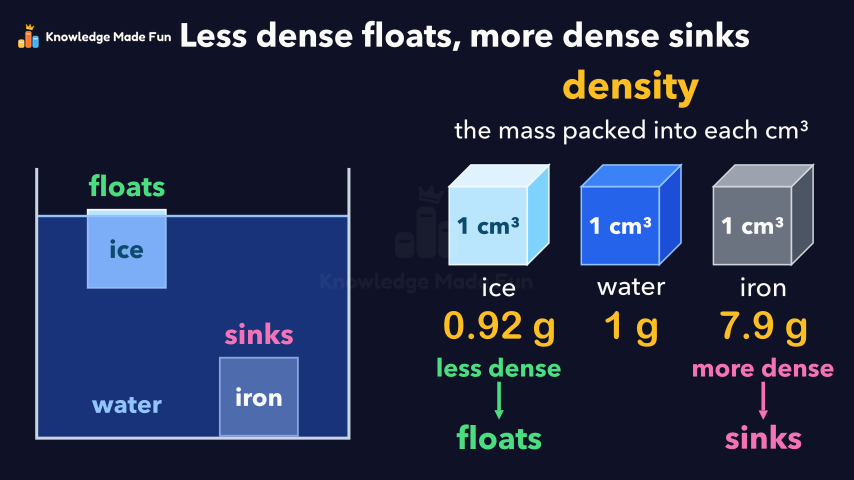
An ice cube dropped into a tank of water floats with just its top above the surface, while an iron cube of the same size sinks to the bottom. Comparing one cubic centimetre each of ice (0.92 g), water (1 g) and iron (7.9 g) shows that things less dense than water float and things more dense sink.
Anyone can watch two lessons on the website without an account. Signing in is free, no payment and no card, and opens three a day; Plus has no limit.
Loading
In one sentence
The question this lesson answers
Why do some things float in water, while others sink?
Drop in a cube of ice, and it floats with just its top above the water.
Transcript
What the lesson says
Why do some things float in water, while others sink?
Drop in a cube of ice, and it floats with just its top above the water.
Drop in an iron cube of the same size, and it sinks to the bottom.
The answer is a property called density.
Density is how much mass is packed into each cubic centimetre.
Let us take one cubic centimetre each of ice, water and iron.
One cubic centimetre of water has a mass of 1 gram.
The same amount of ice has a mass of only 0.92 grams.
So ice is less dense than water.
The same amount of iron has a mass of about 7.9 grams.
So iron is more dense than water.
Anything less dense than water floats in it.
Anything more dense than water sinks in it.
So a thing floats if it is less dense than water, and sinks if it is more dense.
Curriculum
Where this fits
- British Columbia, Grade 7
Science, Chemistry: elements and compounds are pure substancesBC7-SC-14
Previous: Pure substances and mixturesNext: What Makes Each Pure Substance Different
The outcomes and strands follow the British Columbia curriculum.
Keep going
 1 min 40 s
Acids and bases: the pH scale
Grade 10 · 1 min 40 s 1 min 39 s
Activation energy: the push a reaction needs to start
Grade 10 · 1 min 39 s 1 min 54 s
Atomic Size: Bigger Down a Group, Smaller Across a Period
Grade 9 · 1 min 54 s 1 min 18 s
Atoms rearrange: vinegar and baking soda
Grade 7 · 1 min 18 s 1 min 16 s
Atoms: What Everything Is Made Of
Grade 7 · 1 min 16 s 2 min 3 s
Balancing Chemical Equations
Grade 10 · 2 min 3 s 1 min 54 s
Bohr Diagrams: Electrons in Shells and Valence Electrons
Grade 9 · 1 min 54 s 1 min 45 s
Brownian motion: evidence that molecules exist
Grade 8 · 1 min 45 s
- All Grade 7 Science lessons
- Create a free account to watch three lessons a day, no payment and no card.