Lesson · Grade 10 · Foundations of Mathematics and Pre Calculus
Simplifying with exponent laws and negative exponents
- Grade 10
- Foundations of Mathematics and Pre Calculus
- 2 min 6 s
- British Columbia
- BC10-MA-02
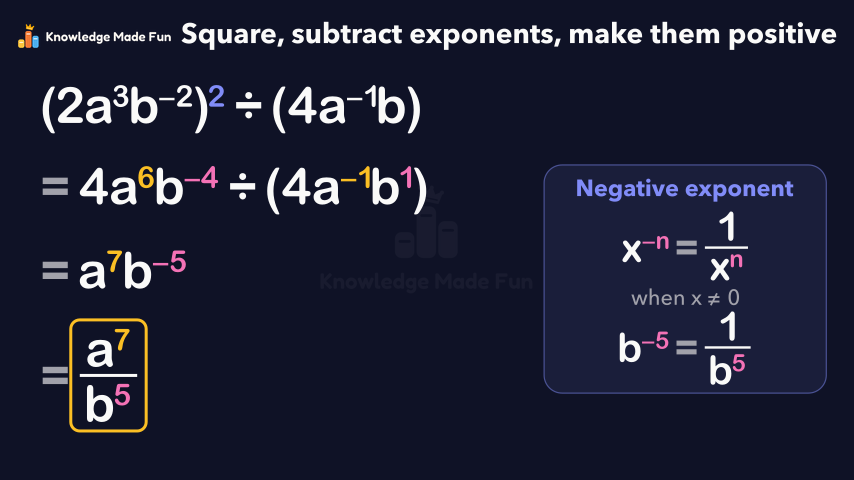
The video simplifies (2a³b⁻²)² ÷ (4a⁻¹b) step by step, naming each law as it is used: the power of a product and power of a power laws give 4a⁶b⁻⁴, then the quotient law gives a⁷b⁻⁵. Along the way it shows why 6 − (−1) is 7 and not 5 and checks it by adding back, then uses the negative exponent law to write the answer as a⁷/b⁵ and ends on a one-line recap.
Anyone can watch two lessons on the website without an account. Signing in is free, no payment and no card, and opens three a day; Plus has no limit.
Loading
In one sentence
The question this lesson answers
Let us simplify this expression, and write the answer with positive exponents.
In the power a cubed, a is the base and 3 is the exponent. It means a times a times a.
Transcript
What the lesson says
Let us simplify this expression, and write the answer with positive exponents.
In the power a cubed, a is the base and 3 is the exponent. It means a times a times a.
Step 1 is the square, because exponents come before division.
The bracket multiplies three factors: 2, a cubed and b to the negative 2.
The power of a product law says: square each factor.
2 squared is 2 times 2, which is 4.
For a cubed, squared, the power of a power law says multiply the exponents: 3 times 2 is 6.
For b, negative 2 times 2 is negative 4.
Step 2 is the division. The b on the right has no exponent shown, so its exponent is 1.
The quotient law says: to divide powers with the same base, subtract the exponents.
First the numbers: 4 divided by 4 is 1.
For a, that is 6 minus negative 1.
Subtracting a negative means adding, so 6 plus 1 is 7.
Watch out: 5 is a common mistake here. Check by adding back: 7 plus negative 1 is 6.
For b, negative 4 minus 1 is negative 5.
Multiplying by 1 changes nothing, so we have a to the 7, b to the negative 5.
The negative exponent law says x to the negative n is 1 over x to the n, when x is not 0.
So b to the negative 5 is 1 over b to the 5, and the answer is a to the 7 over b to the 5.
To recap: square each factor, subtract the exponents to divide, then make negative exponents positive.
Curriculum
Where this fits
- British Columbia, Grade 10
Foundations of Mathematics and Pre Calculus 10, Number: operations on powers with integral exponentsBC10-MA-02
Previous: Negative exponents: dividing instead of multiplyingNext: Evaluating Powers with the Order of Operations
- British Columbia, Grade 11
Pre Calculus 11, Real numbers and powers: powers with rational exponentsBC11-MA-64
Previous: The Real Number System: From Natural Numbers to IrrationalsNext: Rational exponents: a fraction power is a root
This lesson is also listed in Grade 11.
The outcomes and strands follow the British Columbia curriculum.
Keep going
 1 min 26 s
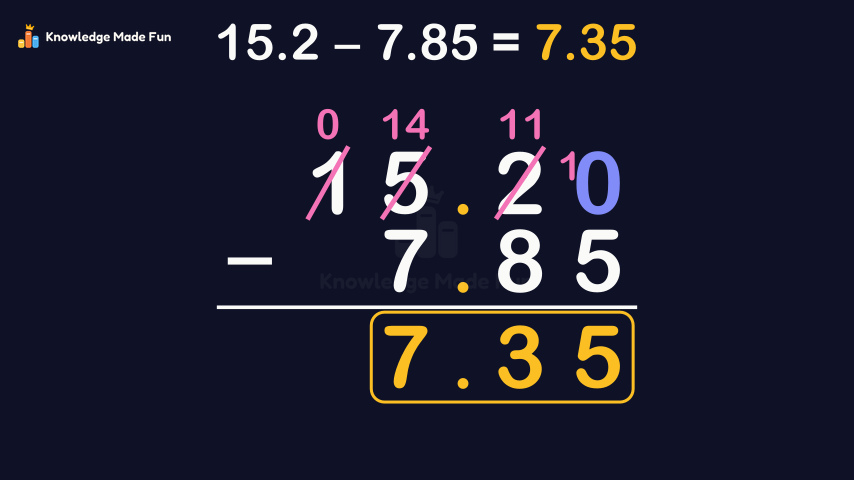
15.2 − 7.85
Grade 4 · 1 min 26 s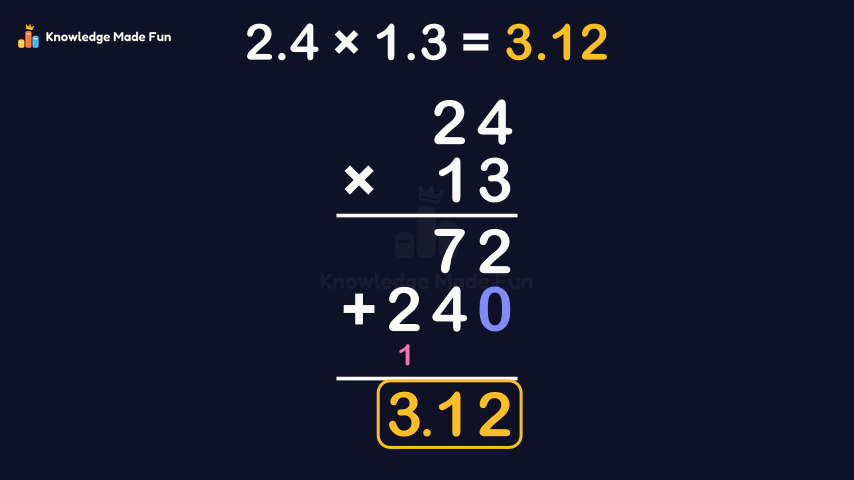 1 min 37 s
2.4 × 1.3
Grade 7 · 1 min 37 s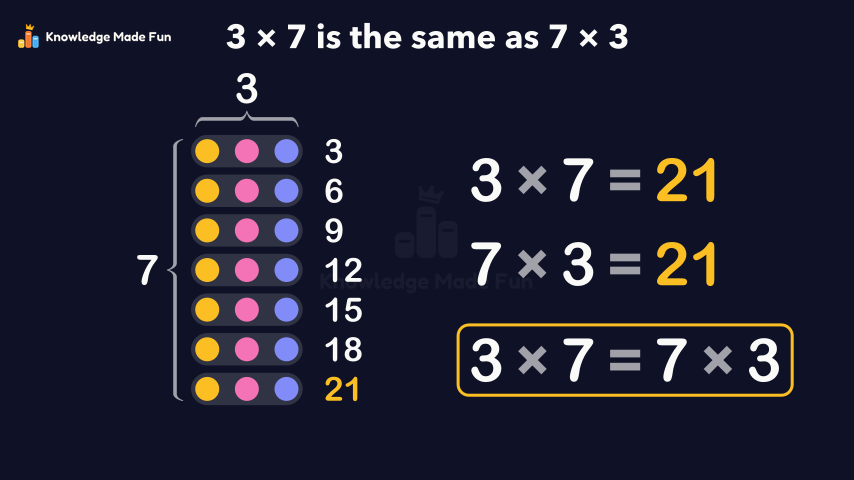 1 min 4 s
3 × 7 = 7 × 3: Equal Groups, Skip Counting and Arrays
Grade 4 · 1 min 4 s 59 s
3.75 + 8.6
Grade 4 · 59 s 1 min 32 s
7.56 ÷ 0.12
Grade 7 · 1 min 32 s 56 s
A Fraction Is Equal Parts of One Whole
Grade 3 · 56 s 57 s
A Fraction of a Group
Grade 3 · 57 s 1 min 23 s
Adding and subtracting are related
Grade 1 · 1 min 23 s
- All Grade 10 Foundations of Mathematics and Pre Calculus lessons
- Create a free account to watch three lessons a day, no payment and no card.