Lesson · Grade 11 · Pre Calculus
Rational exponents: a fraction power is a root
- Grade 11
- Pre Calculus
- 1 min 59 s
- British Columbia
- BC11-MA-65
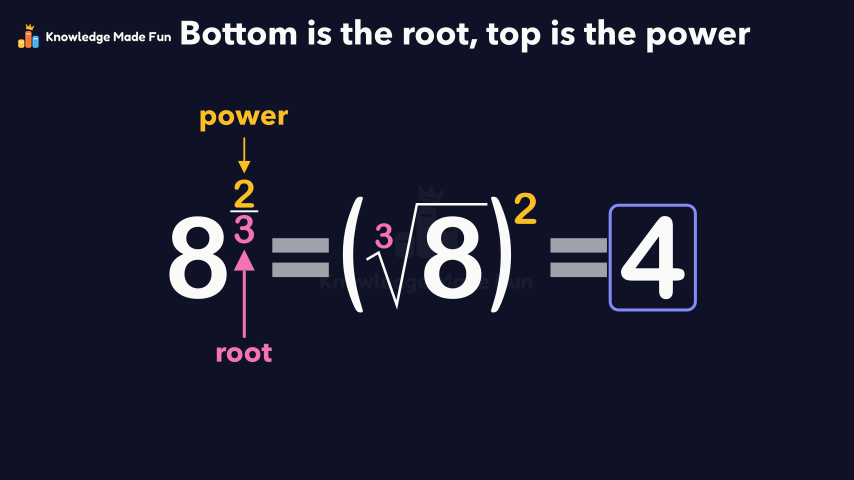
Three copies of 8^(1/3) multiply to 8^1 = 8, so 8^(1/3) is the cube root of 8; then 8^(2/3) = (∛8)² = 2² = 4, which shows that in a rational exponent the bottom of the fraction is the root and the top is the power. The answer is checked by squaring first (∛64 = 4), taking the root first is shown to keep the numbers small, and the common mistake of reading 8^(2/3) as 8 × 2/3 is ruled out.
Anyone can watch two lessons on the website without an account. Signing in is free, no payment and no card, and opens three a day; Plus has no limit.
Loading
In one sentence
The question this lesson answers
What does 8 to the power of two thirds mean?
8 is the base, and the small raised number, two thirds, is the exponent.
Transcript
What the lesson says
What does 8 to the power of two thirds mean?
8 is the base, and the small raised number, two thirds, is the exponent.
An exponent that is a fraction is called a rational exponent.
Start simpler: multiply 8 to the one third by itself three times.
Multiplying powers of the same base adds the exponents: one third plus one third plus one third is 1, and 8 to the power of 1 is 8.
So 8 to the one third is the number whose three copies multiply to 8: the cube root of 8.
The cube root of 8 is 2, because 2 times 2 times 2 is 8.
The same holds for any positive x: x to the one half is its square root, and x to the one third is its cube root.
So the bottom of the fraction, the denominator, tells you which root to take.
Back to two thirds: that is one third times 2, and a power of a power multiplies the exponents.
So 8 to the two thirds is the cube root of 8, squared. The top of the fraction is the power.
The cube root of 8 is 2, and 2 squared is 4.
Check by squaring first: 8 squared is 64, and the cube root of 64 is 4, because 4 times 4 times 4 is 64.
Both ways give 4, but taking the root first keeps the numbers small.
A common mistake is to read it as 8 times two thirds. That gives sixteen thirds, which is not 4.
In a rational exponent, the bottom is the root and the top is the power: 8 to the two thirds is 4.
Curriculum
Where this fits
- British Columbia, Grade 11
Pre Calculus 11, Real numbers and powers: powers with rational exponentsBC11-MA-65
Previous: Simplifying with exponent laws and negative exponentsNext: Simplifying, Adding and Multiplying Radicals
The outcomes and strands follow the British Columbia curriculum.
Keep going
 2 min 23 s
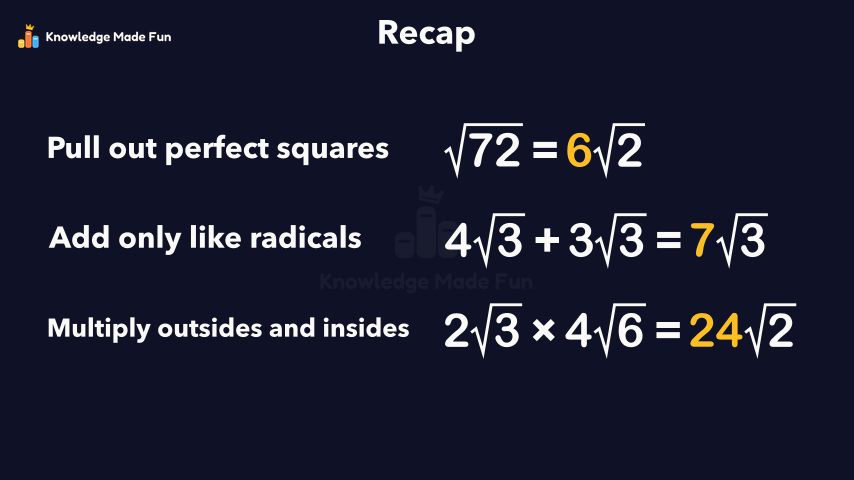
Simplifying, Adding and Multiplying Radicals
Grade 11 · 2 min 23 s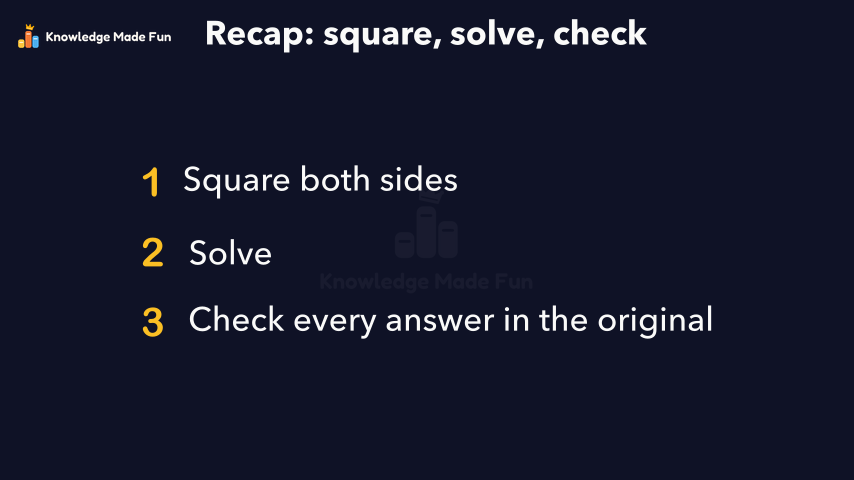 2 min 7 s
Solving a Radical Equation and Checking for Extraneous Roots
Grade 11 · 2 min 7 s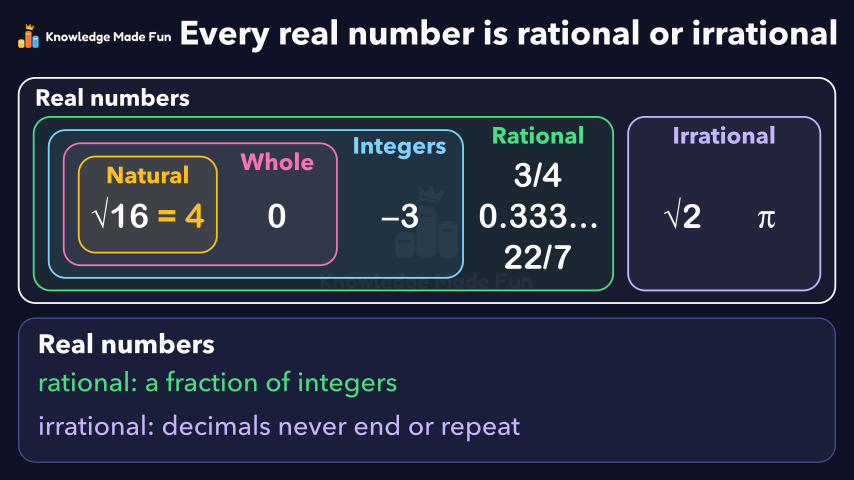 1 min 56 s
The Real Number System: From Natural Numbers to Irrationals
Grade 11 · 1 min 56 s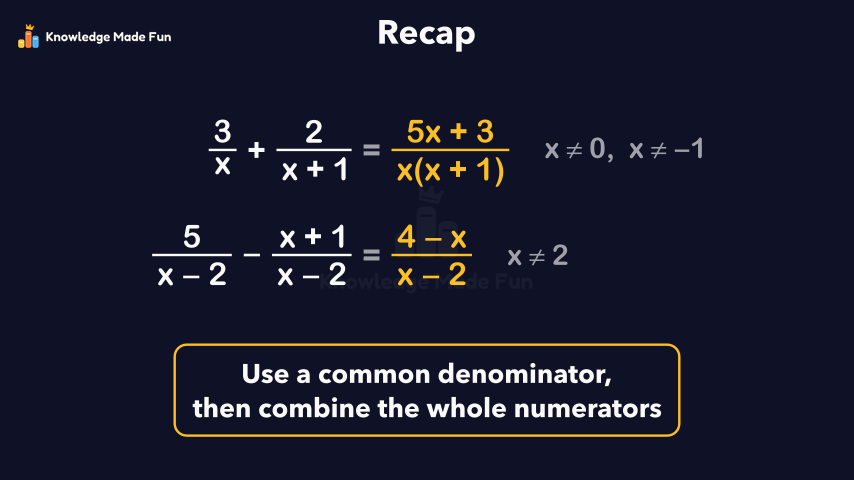 2 min 11 s
Adding and Subtracting Rational Expressions
Grade 11 · 2 min 11 s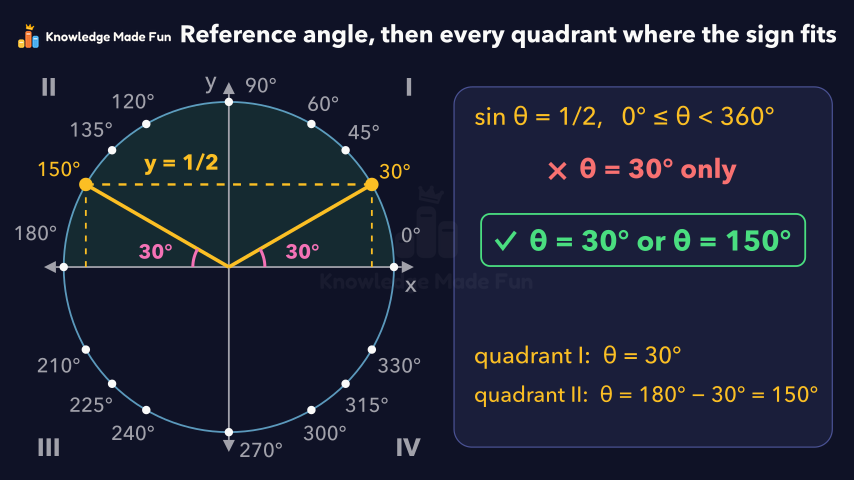 2 min 3 s
Angles in Standard Position and Reference Angles
Grade 11 · 2 min 3 s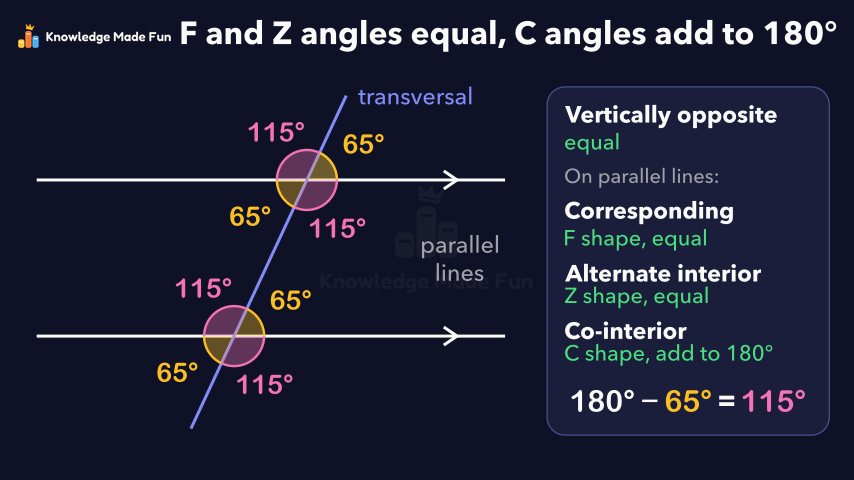 1 min 58 s
Angles made by parallel lines and a transversal
Grade 11 · 1 min 58 s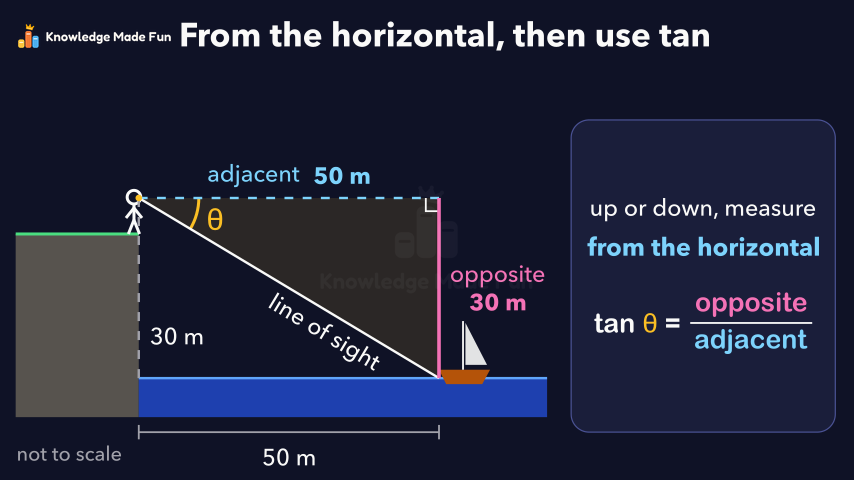 2 min 12 s
Angles of Elevation and Depression: Measuring What You Cannot Reach
Grade 10 · 2 min 12 s 1 min 58 s
Choosing the best average: mean, median or mode
Grade 8 · 1 min 58 s
- All Grade 11 Pre Calculus lessons
- Create a free account to watch three lessons a day, no payment and no card.