Lesson · Grade 11 · Pre Calculus
Adding and Subtracting Rational Expressions
- Grade 11
- Pre Calculus
- 2 min 11 s
- British Columbia
- BC11-MA-71
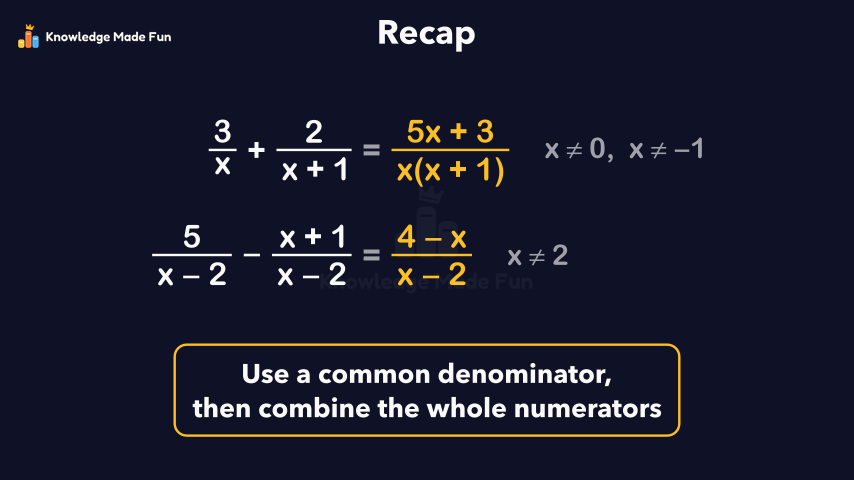
Just as 1/2 + 1/3 needs a common denominator, the video adds 3/x + 2/(x + 1) one step at a time to get (5x + 3)/(x(x + 1)), notes that x ≠ 0 and x ≠ −1, and checks the result at x = 1. It then subtracts 5/(x − 2) − (x + 1)/(x − 2) to get (4 − x)/(x − 2), shows with x = 3 why the minus sign must apply to the whole second numerator, and ends on a one-line recap.
Anyone can watch two lessons on the website without an account. Signing in is free, no payment and no card, and opens three a day; Plus has no limit.
Loading
In one sentence
The question this lesson answers
How do we add 3 over x and 2 over x plus 1?
Each is a rational expression: a fraction with a polynomial on top and on the bottom.
Transcript
What the lesson says
How do we add 3 over x and 2 over x plus 1?
Each is a rational expression: a fraction with a polynomial on top and on the bottom.
Add them just like fractions. To add one half and one third, we need a common denominator: one bottom number for both.
2 and 3 both go into 6, so one half is 3 sixths, one third is 2 sixths, and the sum is 5 sixths.
Here the denominators are x and x plus 1, so a common denominator is x times the bracket x plus 1.
Multiply the first fraction, top and bottom, by x plus 1, and the second by x. Their values stay the same.
Now add the numerators, the top parts, and keep the common denominator.
3 times the bracket x plus 1 is 3x plus 3. Add 2x to get 5x plus 3.
A denominator can never be 0, so x cannot be 0 or negative 1.
Check with x equals 1. The question gives 3 plus 1, which is 4. The answer gives 8 over 2, which is also 4.
Subtracting works the same way: 5 over x minus 2, take away x plus 1 over x minus 2.
The denominators already match, so subtract the whole second numerator, in brackets.
The minus sign applies to both terms in the brackets: 5 minus x minus 1.
5 minus 1 is 4, so the answer is 4 minus x over x minus 2, and x cannot be 2.
A common mistake is to subtract only the x, giving 6 minus x. At x equals 3 that gives 3, but the true answer is 1.
To add or subtract rational expressions, use a common denominator, then combine the whole numerators.
Curriculum
Where this fits
- British Columbia, Grade 11
Pre Calculus 11, Algebra: rational expressions and equationsBC11-MA-71
Previous: Simplifying Rational Expressions and Their Non-Permissible ValuesNext: Solving a Rational Equation and Rejecting an Extraneous Root
The outcomes and strands follow the British Columbia curriculum.
Keep going
 2 min 20 s
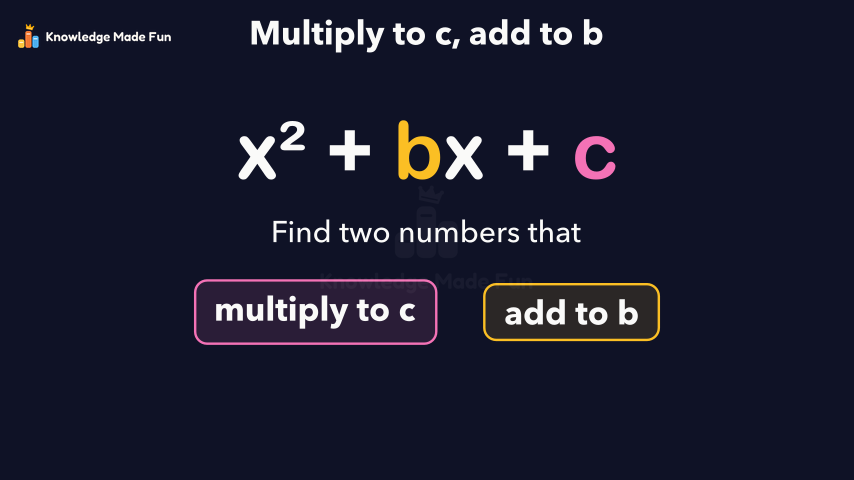
Factoring a Trinomial: Multiply to c, Add to b
Grade 10 · 2 min 20 s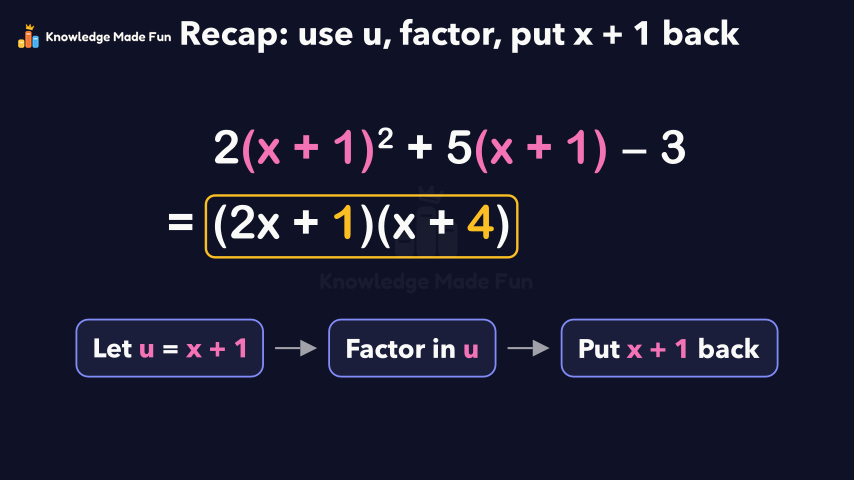 1 min 58 s
Factoring by Substitution
Grade 11 · 1 min 58 s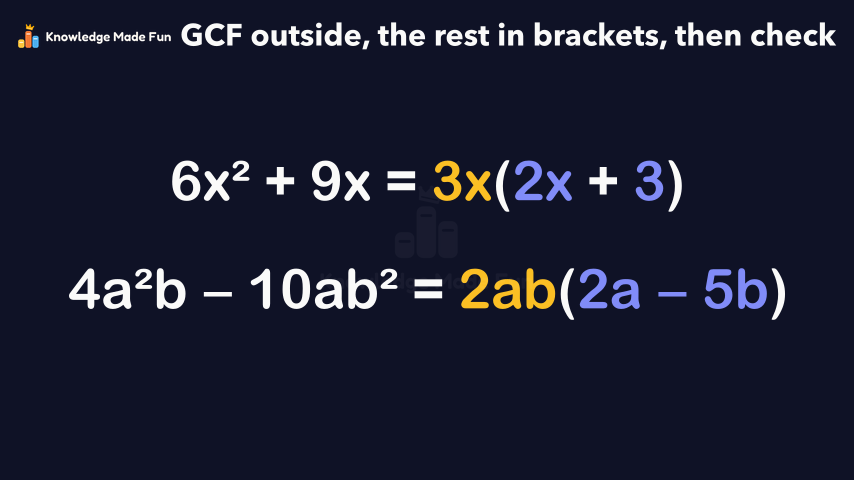 2 min 12 s
Factoring Out the Greatest Common Factor
Grade 10 · 2 min 12 s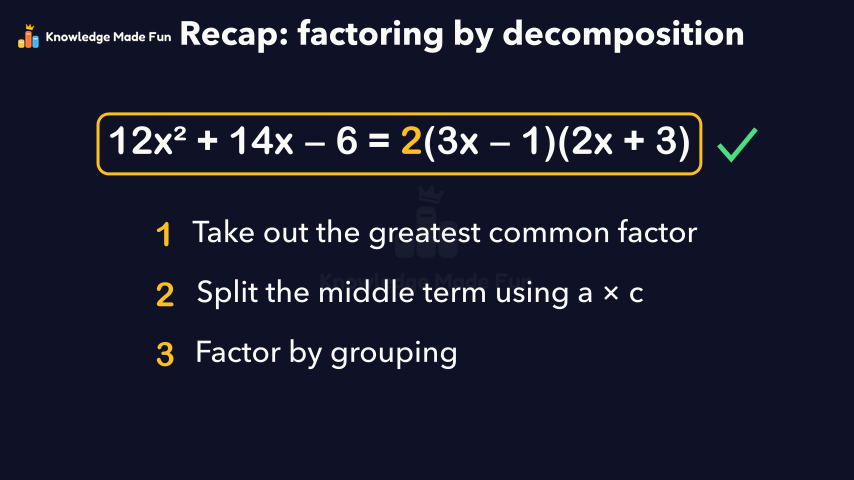 2 min 1 s
Factoring Trinomials by Decomposition
Grade 11 · 2 min 1 s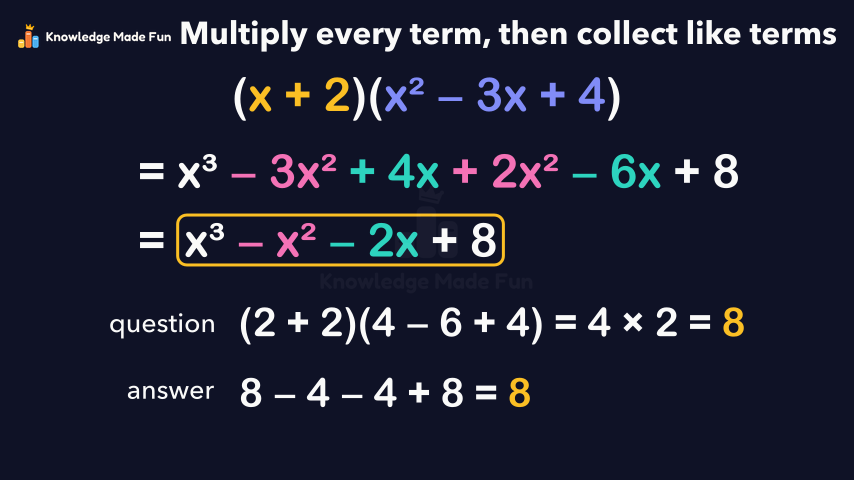 2 min 18 s
Multiplying a binomial by a trinomial
Grade 10 · 2 min 18 s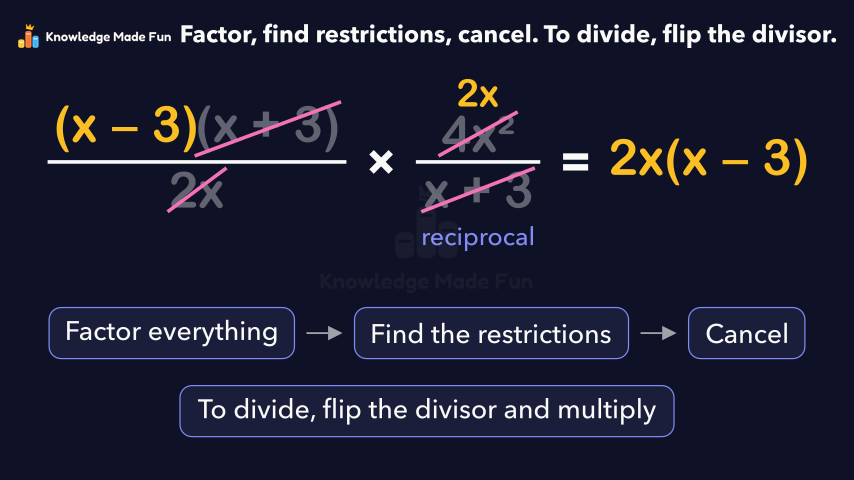 2 min 9 s
Multiplying and Dividing Rational Expressions
Grade 11 · 2 min 9 s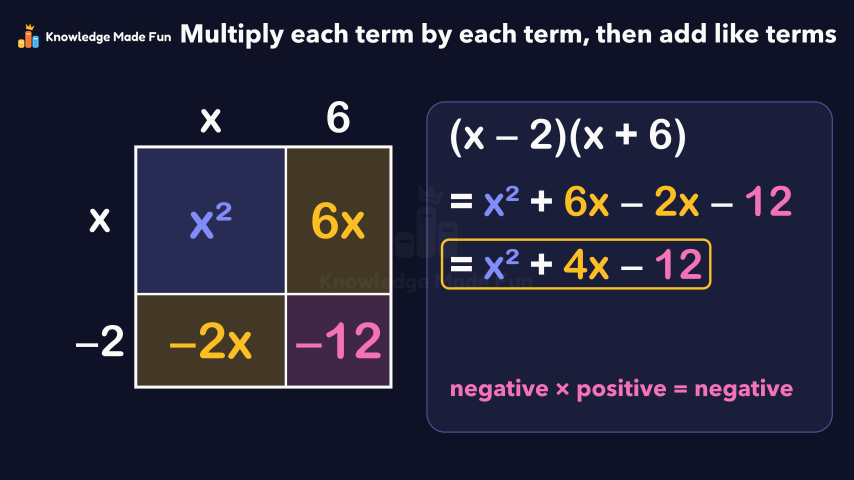 2 min 17 s
Multiplying Two Binomials with an Area Model
Grade 10 · 2 min 17 s 2 min 6 s
Simplifying Rational Expressions and Their Non-Permissible Values
Grade 11 · 2 min 6 s
- All Grade 11 Pre Calculus lessons
- Create a free account to watch three lessons a day, no payment and no card.