Lesson · Grade 11 · Pre Calculus
Solving a Rational Equation and Rejecting an Extraneous Root
- Grade 11
- Pre Calculus
- 2 min 13 s
- British Columbia
- BC11-MA-72
The video solves x²/(x − 3) = 9/(x − 3) step by step. It finds the restriction x ≠ 3 first, multiplies both sides by x − 3 to get x² = 9 and x = 3 or x = −3, rejects x = 3 as an extraneous root, warns against finding restrictions after solving or never, and checks that x = −3 gives 9/(−6) on both sides. A graph of each side then shows the curves crossing at (−3, −1.5) and both sides undefined at x = 3, and it ends on the recap "Find the restrictions first, then reject extraneous roots."
Concept: Solving a rational equation and rejecting extraneous roots
Anyone can watch two lessons on the website without an account. Signing in is free, no payment and no card, and opens three a day; Plus has no limit.
Loading
In one sentence
The question this lesson answers
Let's solve x squared over x minus 3 equals 9 over x minus 3.
This is a rational equation: it has the variable in a denominator, the bottom of a fraction.
Transcript
What the lesson says
Let's solve x squared over x minus 3 equals 9 over x minus 3.
This is a rational equation: it has the variable in a denominator, the bottom of a fraction.
Step one: find the restrictions first, the values of x that would make a denominator zero.
x minus 3 is zero when x is 3, so 3 is a non-permissible value: x cannot equal 3.
Step two: multiply both sides by x minus 3 to clear the denominators.
The x minus 3 cancels on each side, which leaves x squared equals 9.
Take the square root of both sides to get two roots, or solutions: x equals 3 or x equals negative 3.
Step three: compare each root with the restriction. x equals 3 is not allowed, so we reject it.
It is an extraneous root: the working produces it, but it does not solve the original equation.
A common mistake is finding the restrictions after solving, or never. Then x equals 3 can slip through as an answer.
Now check x equals negative 3 in the original equation.
On the left, negative 3 squared is 9, and negative 3 minus 3 is negative 6: 9 over negative 6.
On the right, 9 over negative 3 minus 3 is also 9 over negative 6. Both sides match.
Here is a graph of each side: the left side in pink, the right side in indigo.
The curves cross at x equals negative 3, where both sides equal negative 1.5.
At x equals 3, both sides are undefined, so neither curve has a point there.
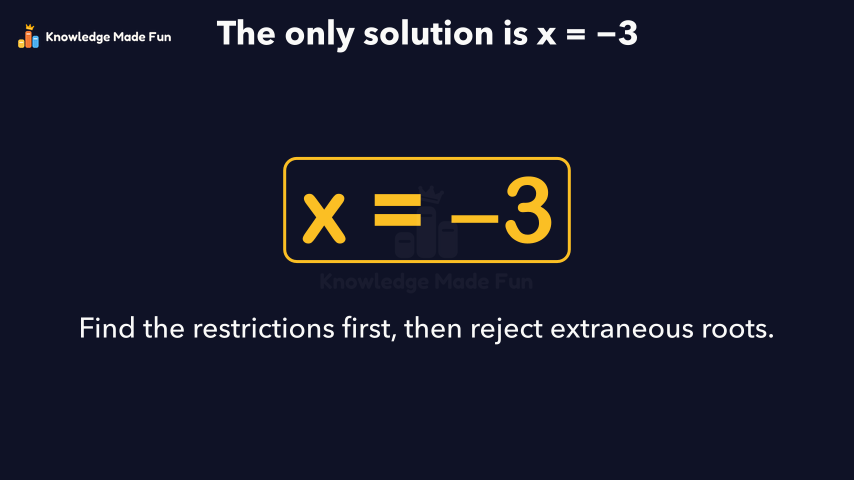
So the only solution is x equals negative 3. Find the restrictions first, then reject extraneous roots.
Curriculum
Where this fits
- British Columbia, Grade 11
Pre Calculus 11, Algebra: rational expressions and equationsBC11-MA-72
Previous: Adding and Subtracting Rational ExpressionsNext: Factoring by Substitution
The outcomes and strands follow the British Columbia curriculum.
Keep going
 2 min 11 s
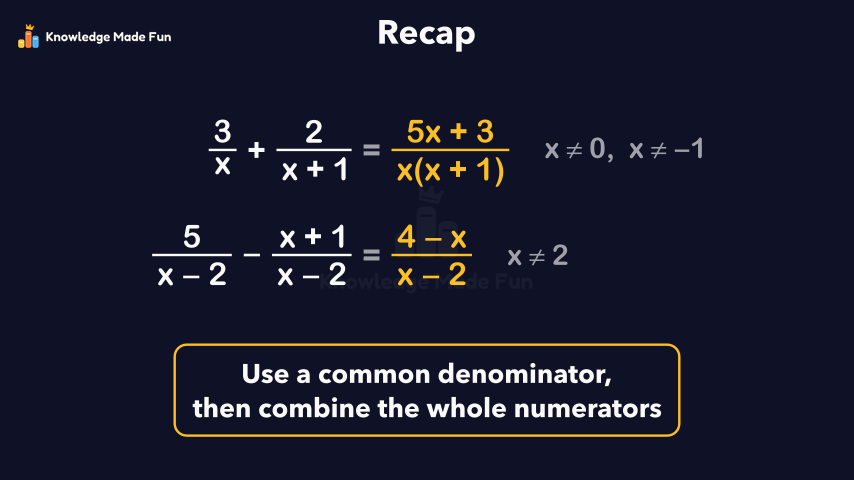
Adding and Subtracting Rational Expressions
Grade 11 · 2 min 11 s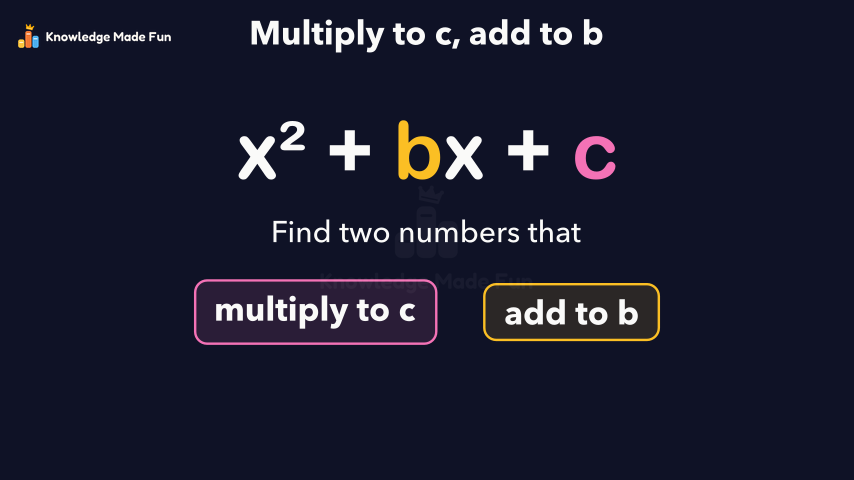 2 min 20 s
Factoring a Trinomial: Multiply to c, Add to b
Grade 10 · 2 min 20 s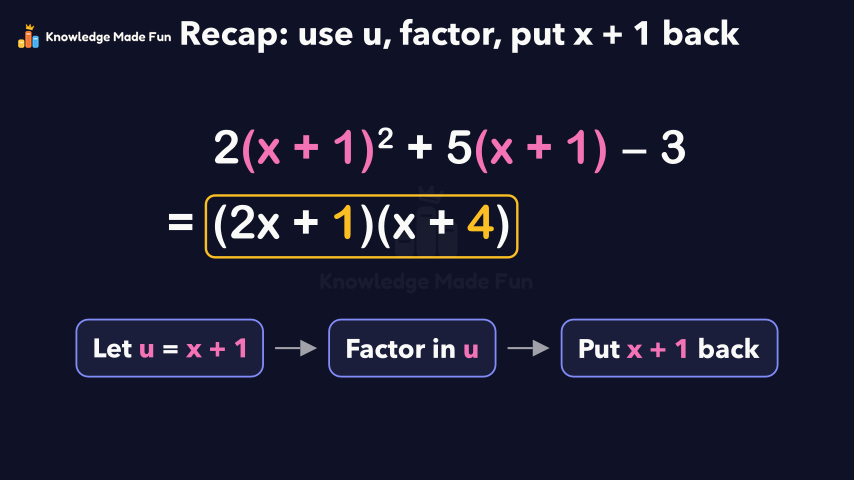 1 min 58 s
Factoring by Substitution
Grade 11 · 1 min 58 s 2 min 12 s
Factoring Out the Greatest Common Factor
Grade 10 · 2 min 12 s 2 min 1 s
Factoring Trinomials by Decomposition
Grade 11 · 2 min 1 s 2 min 18 s
Multiplying a binomial by a trinomial
Grade 10 · 2 min 18 s 2 min 9 s
Multiplying and Dividing Rational Expressions
Grade 11 · 2 min 9 s 2 min 17 s
Multiplying Two Binomials with an Area Model
Grade 10 · 2 min 17 s
- All Grade 11 Pre Calculus lessons
- Create a free account to watch three lessons a day, no payment and no card.