Lesson · Grade 5 · Mathematics
Probability as a Fraction
- Grade 5
- Mathematics
- 1 min 17 s
- British Columbia
- BC5-MA-36
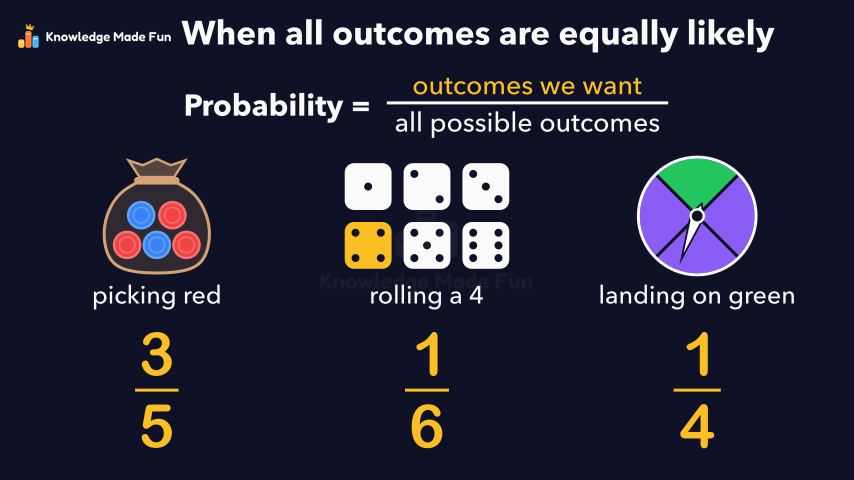
A bag of 3 red and 2 blue counters shows how to count all the possible outcomes and the outcomes we want, so the probability of picking red is 3/5. The same rule then gives 1/6 for rolling a 4 on a fair die and 1/4 for landing on green on a spinner with 4 equal parts.
Anyone can watch two lessons on the website without an account. Signing in is free, no payment and no card, and opens three a day; Plus has no limit.
Loading
In one sentence
The question this lesson answers
A bag holds 5 counters: 3 red and 2 blue.
If we pick one counter without looking, how likely is it to be red?
Transcript
What the lesson says
A bag holds 5 counters: 3 red and 2 blue.
If we pick one counter without looking, how likely is it to be red?
Each counter is equally likely to be picked.
There are 5 counters, so there are 5 possible outcomes.
3 of them are red, and those are the outcomes we want.
Check: 3 red and 2 blue make 5 counters.
So the probability of picking red is 3 out of 5, or three fifths.
The top number counts the outcomes we want.
The bottom number counts all the possible outcomes.
A fair die has 6 faces, and only 1 of them is a 4.
So the probability of rolling a 4 is 1 out of 6.
This spinner has 4 equal parts, and 1 of them is green.
So the probability of landing on green is 1 out of 4.
When all outcomes are equally likely, probability is the outcomes we want over all the possible outcomes.
Curriculum
Where this fits
- British Columbia, Grade 5
Mathematics, Data and probability: probability experiments, single events or outcomesBC5-MA-36
Previous: Double bar graphs with a scaleNext: Experimental and Theoretical Probability: Flip a Coin, Roll a Die
The outcomes and strands follow the British Columbia curriculum.
Keep going
 1 min 23 s
All the Outcomes of Two Spins: Tables and Tree Diagrams
Grade 7 · 1 min 23 s 1 min 47 s
Bias in a Survey: Leading Questions and Unfair Samples
Grade 9 · 1 min 47 s 1 min
Block Graphs: Which Row Is Longer?
Grade 1 · 1 min 1 min 58 s
Choosing the best average: mean, median or mode
Grade 8 · 1 min 58 s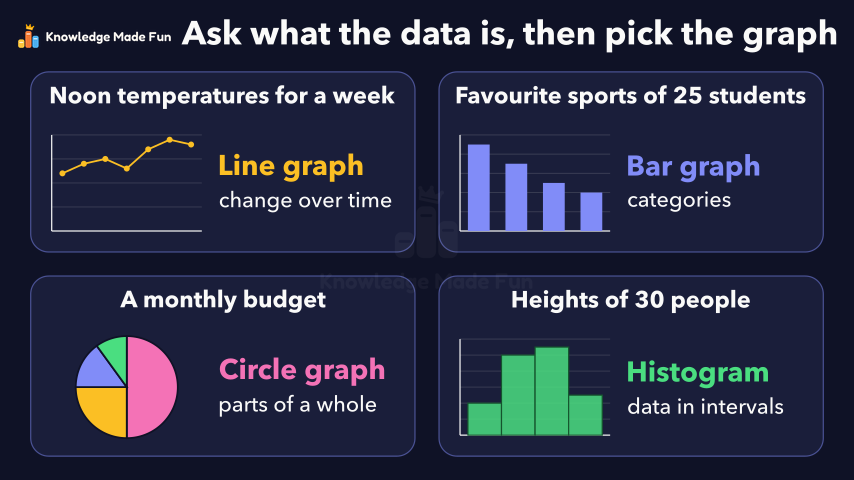 1 min 56 s
Choosing the right graph for the data
Grade 10 · 1 min 56 s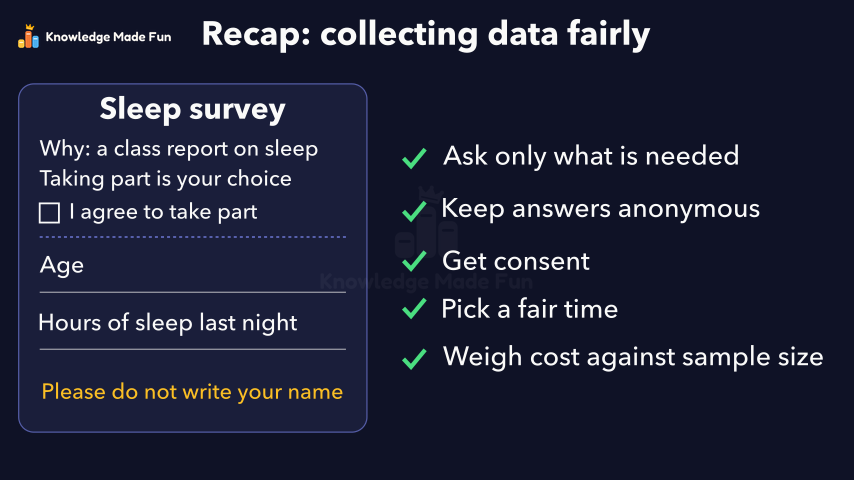 1 min 50 s
Collecting Data Fairly: Privacy, Consent, Timing and Cost
Grade 9 · 1 min 50 s 55 s
Could It Snow Tomorrow? Likely or Unlikely
Kindergarten · 55 s 1 min 27 s
Double bar graphs with a scale
Grade 5 · 1 min 27 s
- All Grade 5 Mathematics lessons
- Teachers: the maths worksheets for Grade 5 are in the dashboard, each with a worked example and a proven answer key.
- Try the graph paper, free for everyone, no account needed.
- Create a free account to watch three lessons a day, no payment and no card.