Lesson · Grade 9 · Mathematics
Multiplying and Dividing Powers with the Same Base
- Grade 9
- Mathematics
- 2 min 7 s
- British Columbia
- BC9-MA-07
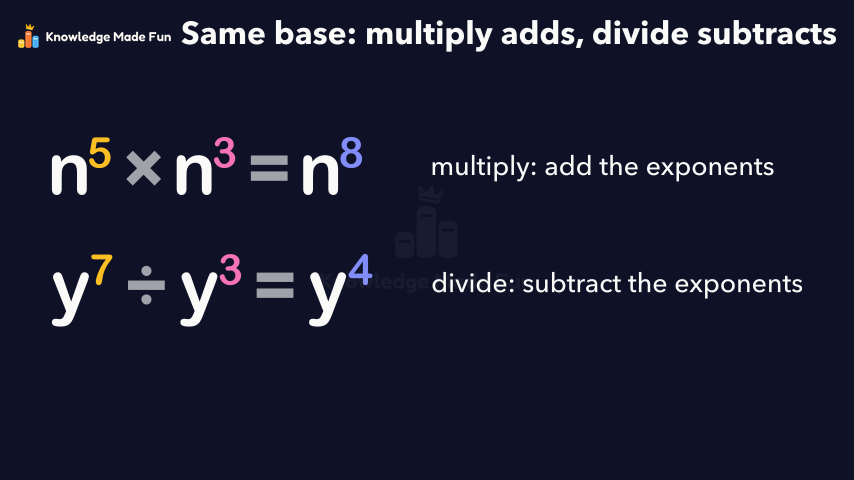
Writing n⁵ × n³ out as eight n's shows why we keep the base and add the exponents to get n⁸, and a check with numbers confirms 2³ × 2² = 8 × 4 = 2⁵ = 32. Cancelling three pairs in y⁷ ÷ y³ leaves y⁴, so dividing subtracts the exponents. The video then shows two common mistakes: multiplying the exponents (n¹⁵) and using the law with different bases (2³ × 3² is 72, not 6⁵ = 7776).
Anyone can watch two lessons on the website without an account. Signing in is free, no payment and no card, and opens three a day; Plus has no limit.
Loading
In one sentence
The question this lesson answers
How do we multiply n to the power of 5 by n to the power of 3?
In n to the power of 5, n is the base and 5 is the exponent. The whole thing is a power.
Transcript
What the lesson says
How do we multiply n to the power of 5 by n to the power of 3?
In n to the power of 5, n is the base and 5 is the exponent. The whole thing is a power.
The exponent counts how many times the base is a factor: n to the power of 5 is five n's, and n to the power of 3 is three.
Count them: 1, 2, 3, 4, 5, 6, 7, 8. That makes n to the power of 8.
This is an exponent law: to multiply powers with the same base, keep the base and add the exponents. 5 plus 3 is 8.
Check with numbers: 2 to the power of 3 times 2 to the power of 2 is 8 times 4, or 32. Adding the exponents gives 2 to the power of 5, also 32.
Now divide y to the power of 7 by y to the power of 3: seven y's on top, three y's on the bottom.
Since y divided by y is 1 when y is not zero, we cancel three pairs: 1, 2, 3.
Four y's are left on top, so the answer is y to the power of 4.
To divide powers with the same base, keep the base and subtract the exponents. 7 minus 3 is 4.
A common mistake is to multiply the exponents, 5 times 3, and get n to the power of 15. We add them: 5 plus 3 is 8.
The law needs the same base: 2 to the power of 3 times 3 to the power of 2 is 72, not 6 to the power of 5, which is 7776.
Recap: with the same base, multiplying powers adds the exponents, and dividing powers subtracts them.
Curriculum
Where this fits
- British Columbia, Grade 9
Mathematics, Number: exponents and exponent laws with whole-number exponentsBC9-MA-07
Previous: Why (−3)² Is Not the Same as −3²Next: Power of a power, and power of a product or quotient
The outcomes and strands follow the British Columbia curriculum.
Keep going
 1 min 26 s
15.2 − 7.85
Grade 4 · 1 min 26 s 1 min 37 s
2.4 × 1.3
Grade 7 · 1 min 37 s 1 min 4 s
3 × 7 = 7 × 3: Equal Groups, Skip Counting and Arrays
Grade 4 · 1 min 4 s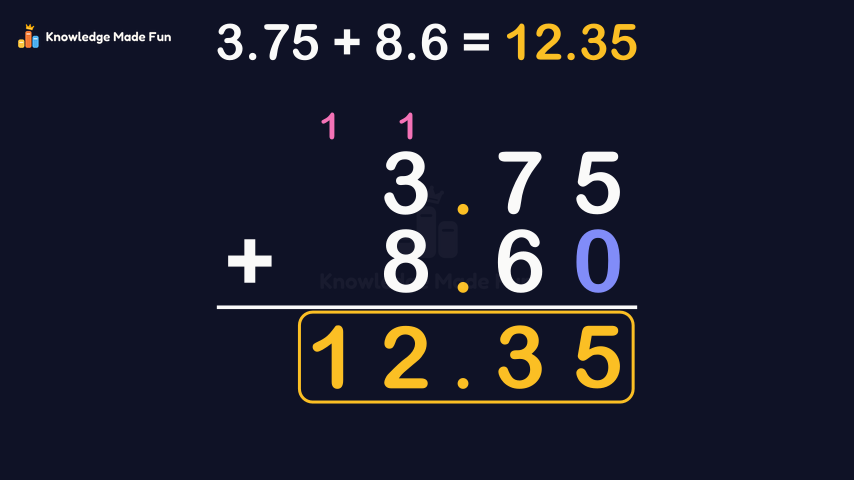 59 s
3.75 + 8.6
Grade 4 · 59 s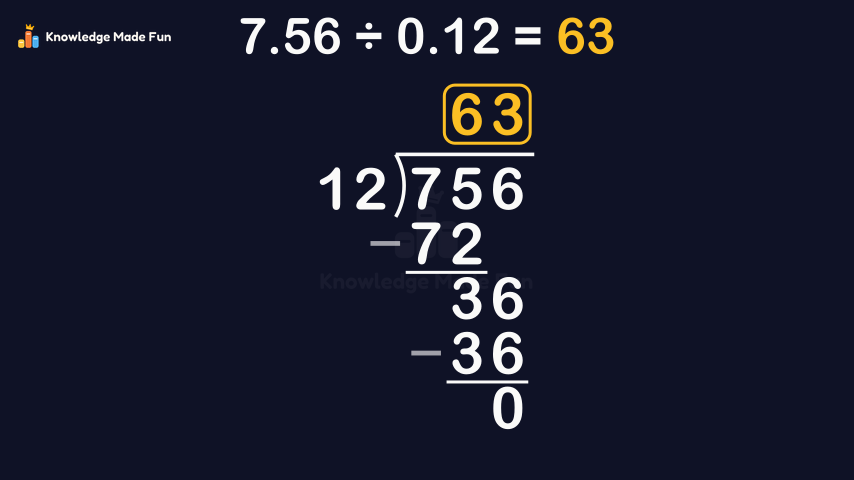 1 min 32 s
7.56 ÷ 0.12
Grade 7 · 1 min 32 s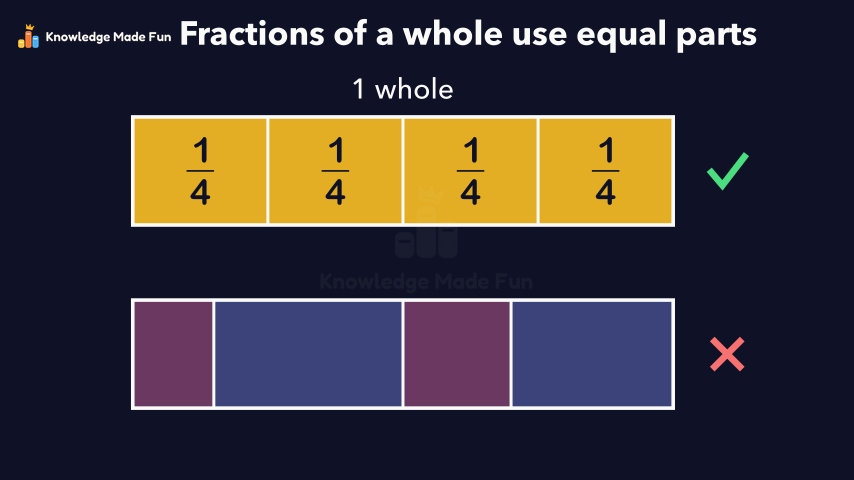 56 s
A Fraction Is Equal Parts of One Whole
Grade 3 · 56 s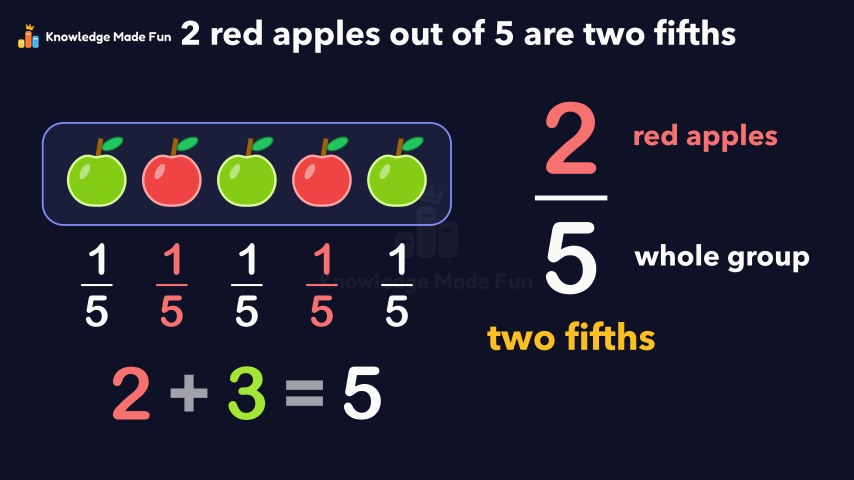 57 s
A Fraction of a Group
Grade 3 · 57 s 1 min 23 s
Adding and subtracting are related
Grade 1 · 1 min 23 s
- All Grade 9 Mathematics lessons
- Try the graph paper, free for everyone, no account needed.
- Create a free account to watch three lessons a day, no payment and no card.