Lesson · Grade 8 · Mathematics
Is the Game Fair? Checking with Theoretical Probability
- Grade 8
- Mathematics
- 1 min 54 s
- British Columbia
- BC8-MA-42
A spinner with one red part and two blue parts is spun twice: Player A wins if the colours match and Player B if they are different. A 3 by 3 table of nine equally likely outcomes shows that P(match) = 1/9 + 4/9 = 5/9 and P(different) = 4/9, so the game is not fair, and two colours did not mean a 50-50 chance.
Anyone can watch two lessons on the website without an account. Signing in is free, no payment and no card, and opens three a day; Plus has no limit.
Loading
In one sentence
The question this lesson answers
This spinner has three equal parts: one red and two blue.
Spin it twice. Player A wins if the colours match. Player B wins if they are different.
Transcript
What the lesson says
This spinner has three equal parts: one red and two blue.
Spin it twice. Player A wins if the colours match. Player B wins if they are different.
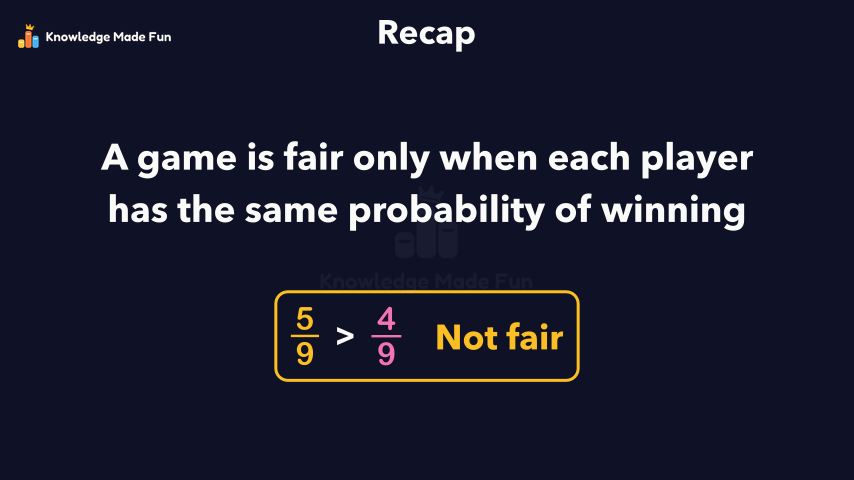
A game is fair when each player has the same probability of winning.
A common mistake is to think two colours means fifty-fifty. Let us check.
An outcome is one possible result. Theoretical probability is the number of favourable outcomes divided by the total, when all outcomes are equally likely.
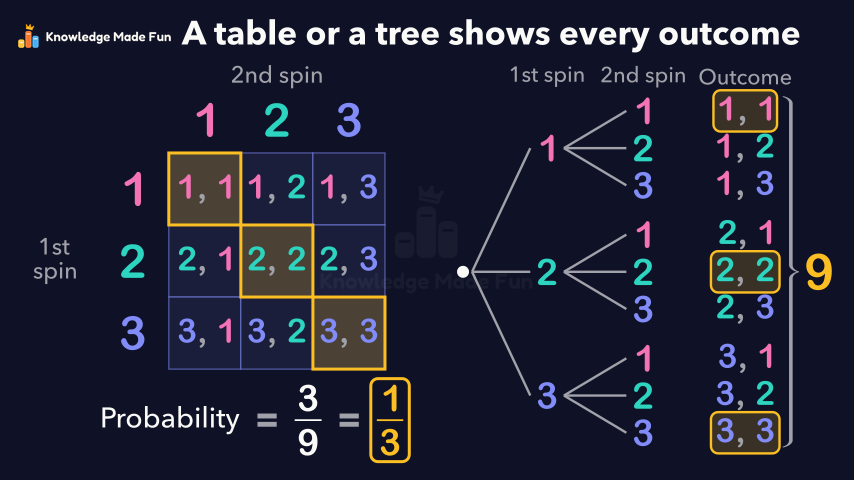
Make a table: first spin down the side, second spin across the top. Three times three gives nine outcomes.
The spins are independent events: the first does not change the second. So all nine outcomes are equally likely, one ninth each.
Player A wins with red, red. That is one outcome, so one ninth.
Player A also wins with blue, blue. Count them: one, two, three, four. That is four ninths.
So the probability of a match is one ninth plus four ninths, which is five ninths.
Player B wins when the colours are different: one, two, three, four outcomes, so four ninths.
Check: five ninths plus four ninths makes nine ninths, which is one.
Five ninths is more than four ninths, so Player A is more likely to win. The game is not fair.
Two colours did not mean fifty-fifty: blue covers two of the three parts.
Remember: a game is fair only when each player has the same probability of winning. This one is not.
Curriculum
Where this fits
- British Columbia, Grade 8
Mathematics, Data and probability: theoretical probability with two independent eventsBC8-MA-42
Previous: Two independent events: multiply the probabilities
The outcomes and strands follow the British Columbia curriculum.
Keep going
 1 min 23 s
All the Outcomes of Two Spins: Tables and Tree Diagrams
Grade 7 · 1 min 23 s 1 min 47 s
Bias in a Survey: Leading Questions and Unfair Samples
Grade 9 · 1 min 47 s 1 min
Block Graphs: Which Row Is Longer?
Grade 1 · 1 min 1 min 58 s
Choosing the best average: mean, median or mode
Grade 8 · 1 min 58 s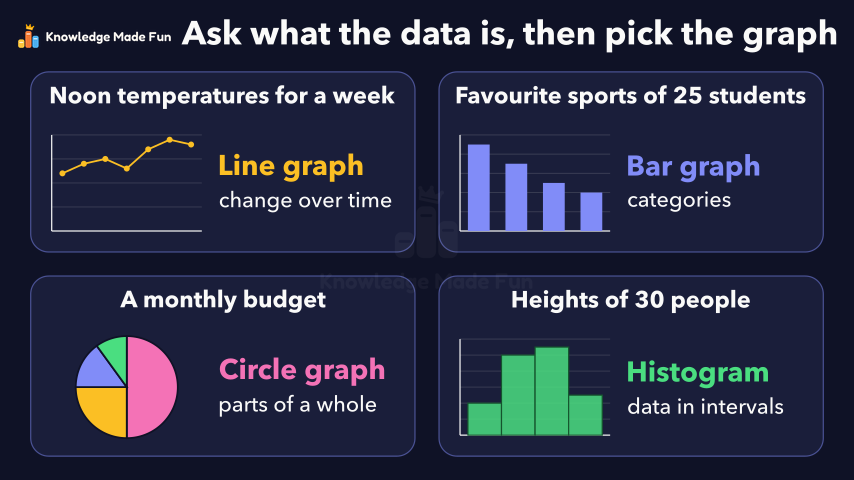 1 min 56 s
Choosing the right graph for the data
Grade 10 · 1 min 56 s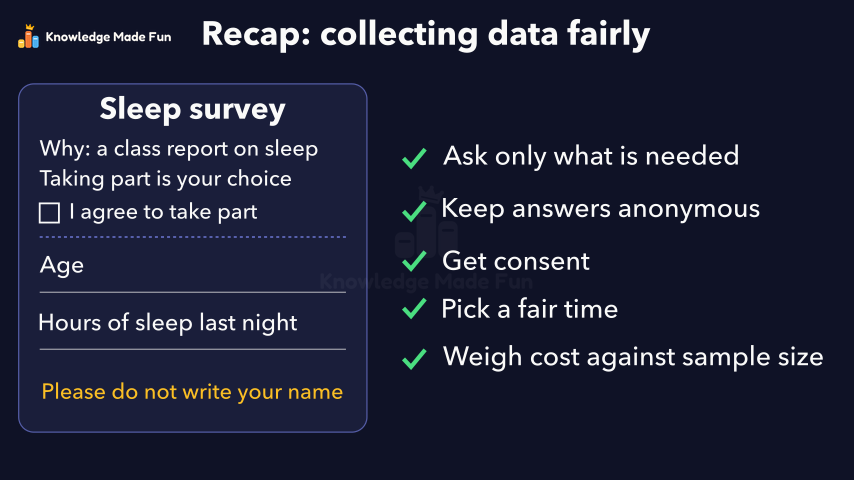 1 min 50 s
Collecting Data Fairly: Privacy, Consent, Timing and Cost
Grade 9 · 1 min 50 s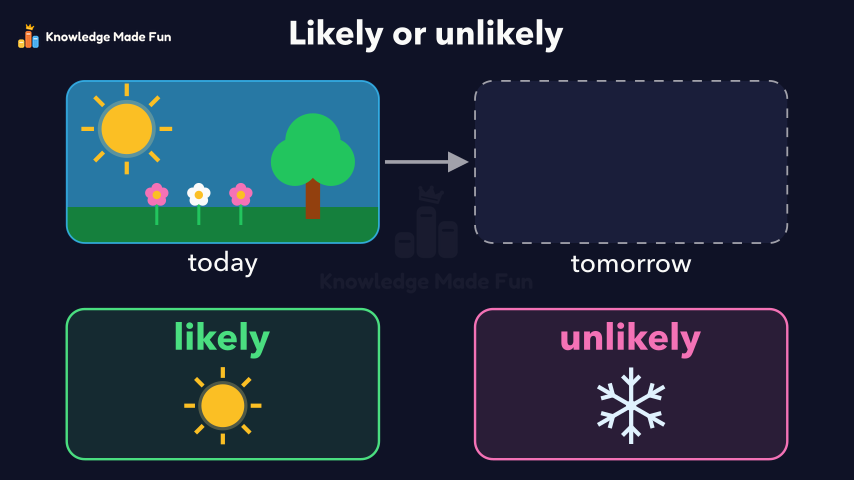 55 s
Could It Snow Tomorrow? Likely or Unlikely
Kindergarten · 55 s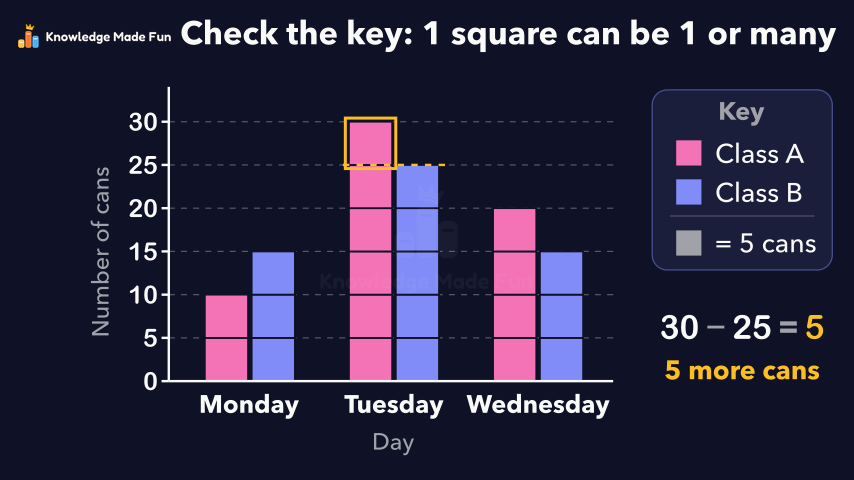 1 min 27 s
Double bar graphs with a scale
Grade 5 · 1 min 27 s
- All Grade 8 Mathematics lessons
- Try the graph paper, free for everyone, no account needed.
- Create a free account to watch three lessons a day, no payment and no card.