Lesson · Grade 6 · Mathematics
Equivalent ratios: multiply or divide both numbers by the same number
- Grade 6
- Mathematics
- 1 min 11 s
- British Columbia
- BC6-MA-15
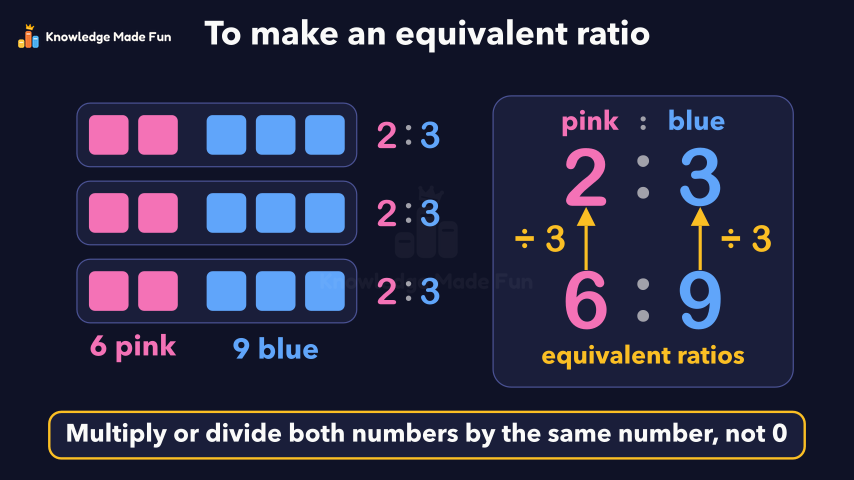
A tile pattern with 2 pink tiles for every 3 blue tiles gives the ratio 2:3, and repeating it to make 3 rows gives 6:9, with arrows showing that both numbers were multiplied by 3 (2 × 3 = 6, 3 × 3 = 9). Every row still holds 2 pink and 3 blue tiles, so the two ratios are equivalent, and dividing both numbers by 3 (6 ÷ 3 = 2, 9 ÷ 3 = 3) takes 6:9 back to 2:3 before the video ends on the rule: multiply or divide both numbers by the same number, not 0.
Concept: Equivalent ratios
Anyone can watch two lessons on the website without an account. Signing in is free, no payment and no card, and opens three a day; Plus has no limit.
Loading
In one sentence
The question this lesson answers
What are equivalent ratios, and how do we make them?
A tile pattern has 2 pink tiles for every 3 blue tiles.
Transcript
What the lesson says
What are equivalent ratios, and how do we make them?
A tile pattern has 2 pink tiles for every 3 blue tiles.
So the ratio of pink to blue is 2 to 3.
Now repeat the pattern to make 3 rows.
Now there are 6 pink tiles and 9 blue tiles.
So the ratio of pink to blue is now 6 to 9.
Both numbers were multiplied by 3.
2 times 3 is 6, and 3 times 3 is 9.
Each row still has 2 pink tiles and 3 blue tiles.
So 2 to 3 and 6 to 9 are equivalent ratios.
We can also divide both numbers by 3 to go back.
6 divided by 3 is 2, and 9 divided by 3 is 3.
So 6 to 9 goes back to 2 to 3.
To make an equivalent ratio, multiply or divide both numbers by the same number, but not zero.
Curriculum
Where this fits
- British Columbia, Grade 6
Mathematics, Number: introduction to ratiosBC6-MA-15
Previous: What a ratio is: part to part and part to wholeNext: What a Percent Is: Parts of a Hundred
The outcomes and strands follow the British Columbia curriculum.
Keep going
 1 min 26 s
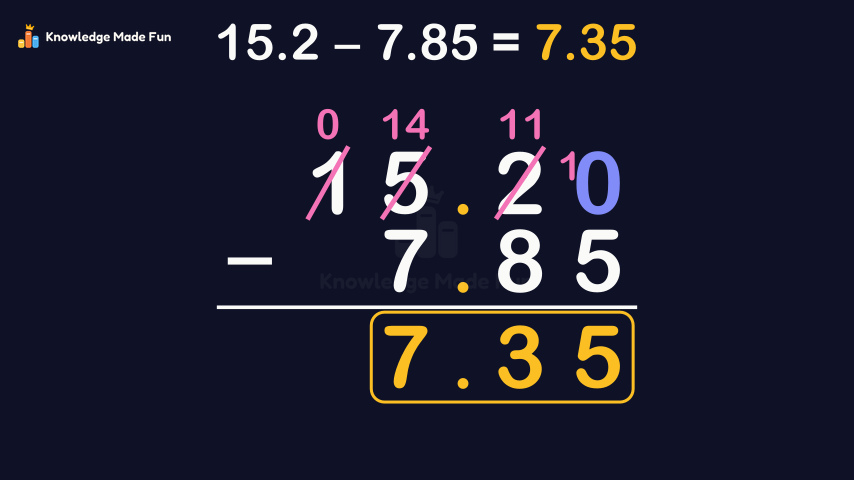
15.2 − 7.85
Grade 4 · 1 min 26 s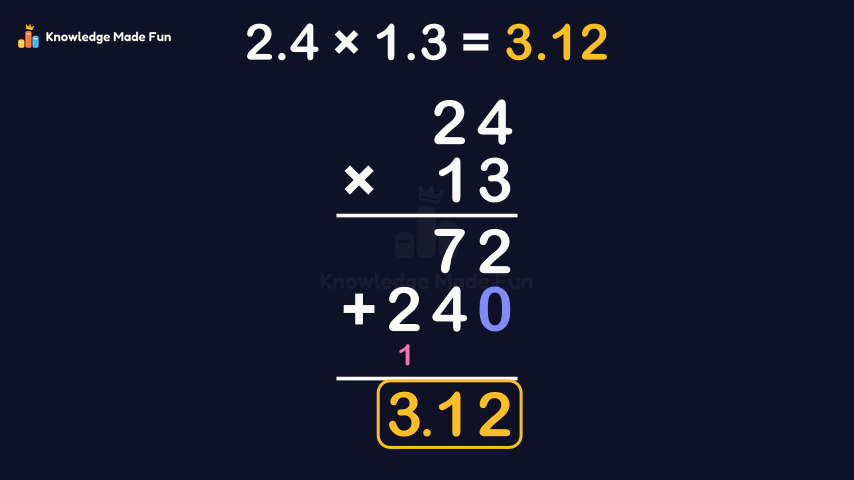 1 min 37 s
2.4 × 1.3
Grade 7 · 1 min 37 s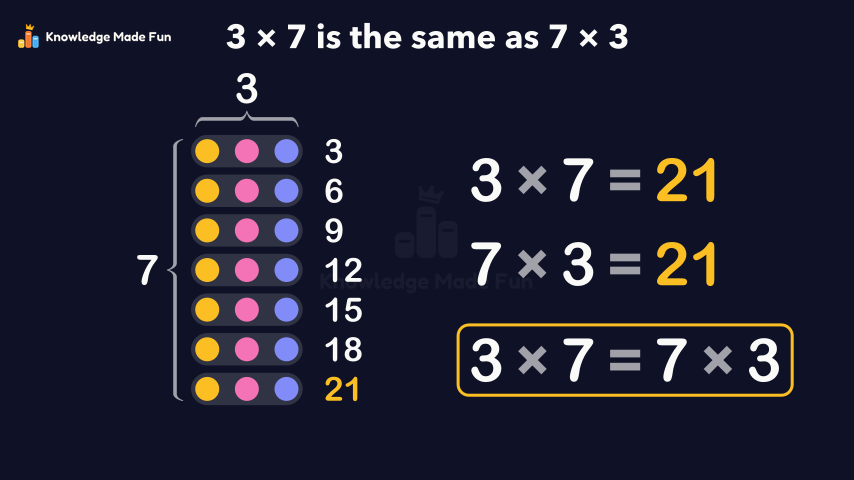 1 min 4 s
3 × 7 = 7 × 3: Equal Groups, Skip Counting and Arrays
Grade 4 · 1 min 4 s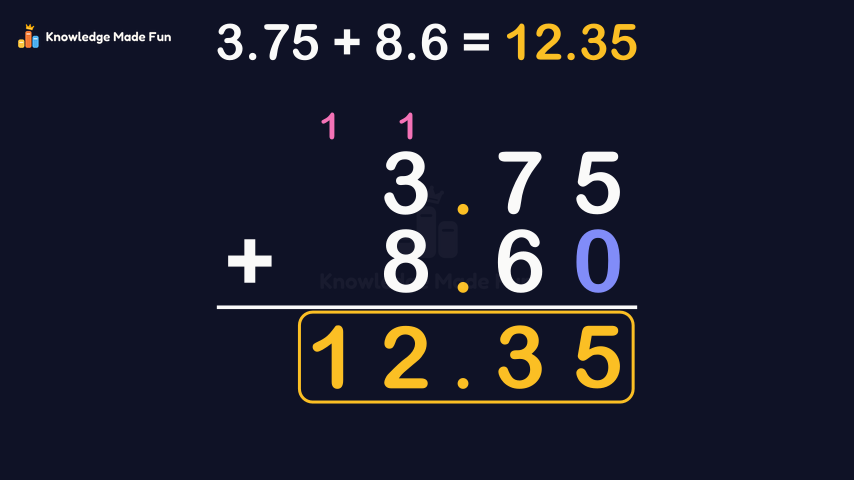 59 s
3.75 + 8.6
Grade 4 · 59 s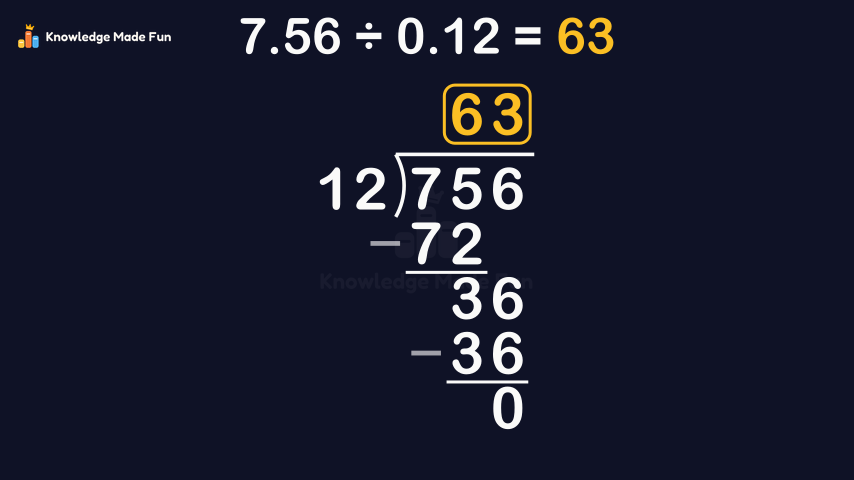 1 min 32 s
7.56 ÷ 0.12
Grade 7 · 1 min 32 s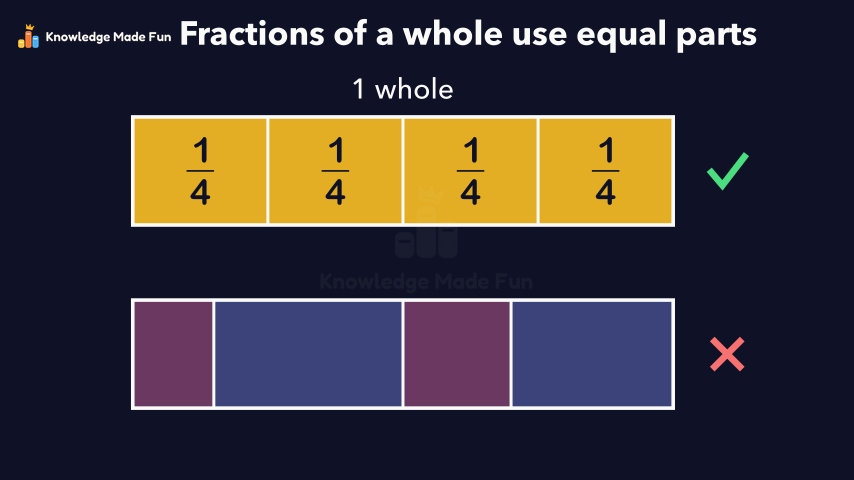 56 s
A Fraction Is Equal Parts of One Whole
Grade 3 · 56 s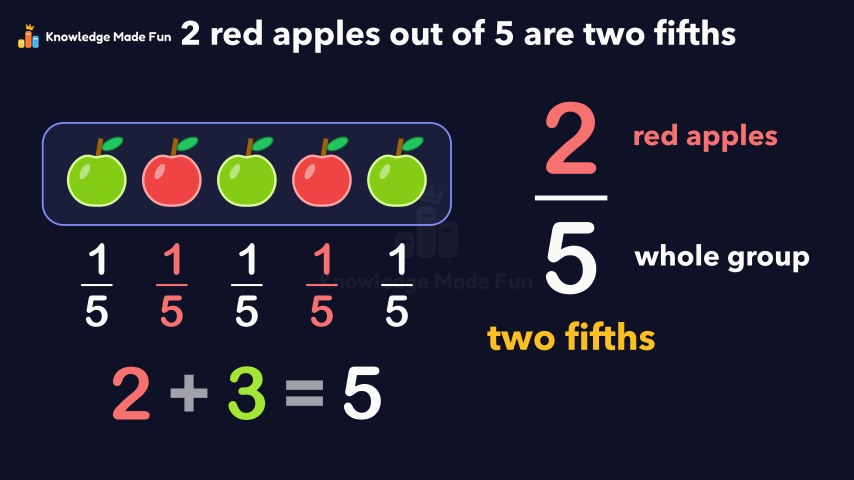 57 s
A Fraction of a Group
Grade 3 · 57 s 1 min 23 s
Adding and subtracting are related
Grade 1 · 1 min 23 s
- All Grade 6 Mathematics lessons
- Teachers: the maths worksheets for Grade 6 are in the dashboard, each with a worked example and a proven answer key.
- Try the graph paper, free for everyone, no account needed.
- Create a free account to watch three lessons a day, no payment and no card.