Lesson · Grade 4 · Mathematics
Division facts from multiplication facts
- Grade 4
- Mathematics
- 57 s
- British Columbia
- BC4-MA-17
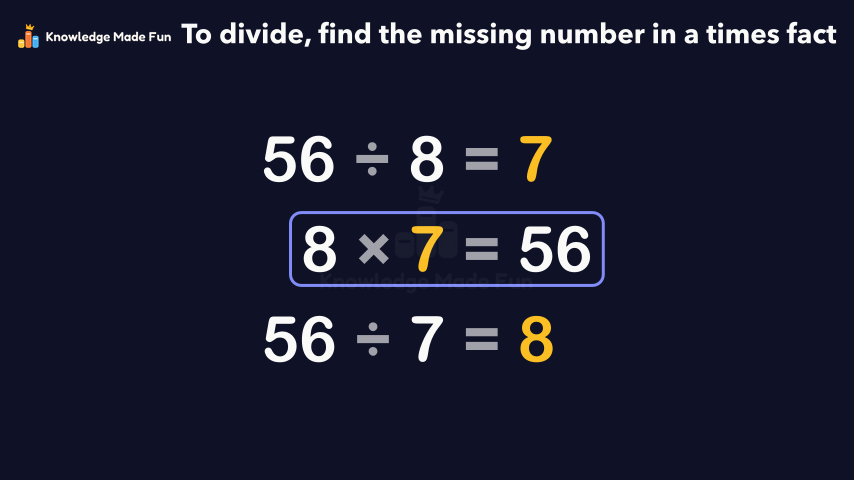
To find 56 ÷ 8, the video shares 56 dots into 8 equal rows and turns the question into 8 × ? = 56, so the known fact 8 × 7 = 56 gives 7 in each row. It then reads the same fact the other way, 7 columns of 8, to get 56 ÷ 7 = 8, and ends with the recap "To divide, find the missing number in a times fact."
Anyone can watch two lessons on the website without an account. Signing in is free, no payment and no card, and opens three a day; Plus has no limit.
Loading
In one sentence
The question this lesson answers
What is 56 divided by 8?
Picture 56 dots shared out into 8 equal rows.
Transcript
What the lesson says
What is 56 divided by 8?
Picture 56 dots shared out into 8 equal rows.
56 divided by 8 asks how many dots are in each row.
We do not need to count, because division undoes multiplication.
So ask: 8 times what number makes 56?
You know that 8 times 7 is 56.
So each row has 7 dots.
So 56 divided by 8 is 7.
The same times fact gives us a second division too.
This time, share the 56 dots into 7 equal columns.
Each column has 8 dots, so 56 divided by 7 is 8.
To divide, turn it into a times fact with a missing number.
Curriculum
Where this fits
- British Columbia, Grade 4
Mathematics, Number: multiplication and division facts to 100 (introductory computational strategies)BC4-MA-17
Previous: 3 × 7 = 7 × 3: Equal Groups, Skip Counting and Arrays
- British Columbia, Grade 5
Mathematics, Number: multiplication and division facts to 100 (emerging computational fluency)BC5-MA-21
- British Columbia, Grade 6
Mathematics, Number: multiplication and division facts to 100 (developing computational fluency)BC6-MA-05
Previous: Break a number apart to multiplyNext: Order of Operations: Brackets, Then Divide, Then Subtract
- British Columbia, Grade 7
Mathematics, Number: multiplication and division facts to 100BC7-MA-05
Previous: Break a number apart to multiplyNext: What Are Integers? Numbers Below Zero
This lesson is also listed in Grade 5, Grade 6 and Grade 7.
The outcomes and strands follow the British Columbia curriculum.
Keep going
 1 min 26 s
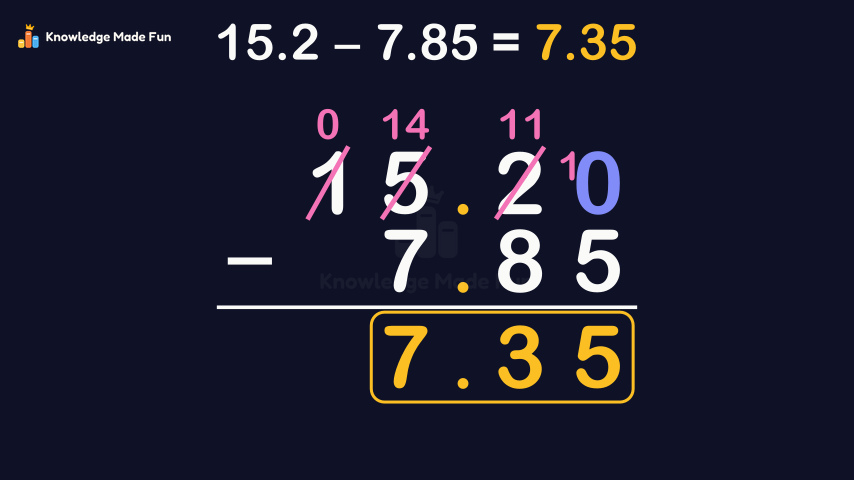
15.2 − 7.85
Grade 4 · 1 min 26 s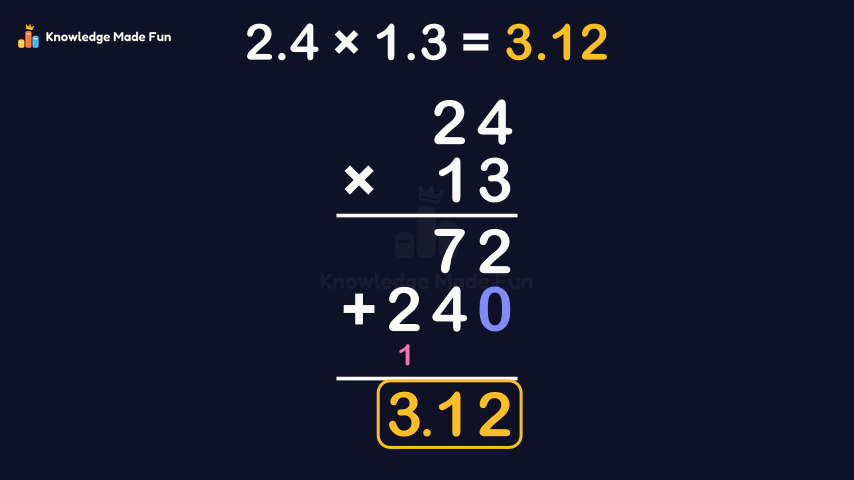 1 min 37 s
2.4 × 1.3
Grade 7 · 1 min 37 s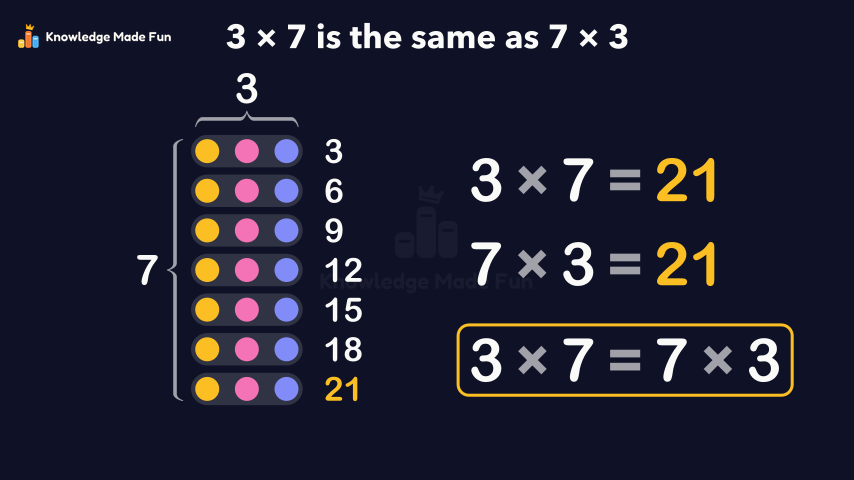 1 min 4 s
3 × 7 = 7 × 3: Equal Groups, Skip Counting and Arrays
Grade 4 · 1 min 4 s 59 s
3.75 + 8.6
Grade 4 · 59 s 1 min 32 s
7.56 ÷ 0.12
Grade 7 · 1 min 32 s 56 s
A Fraction Is Equal Parts of One Whole
Grade 3 · 56 s 57 s
A Fraction of a Group
Grade 3 · 57 s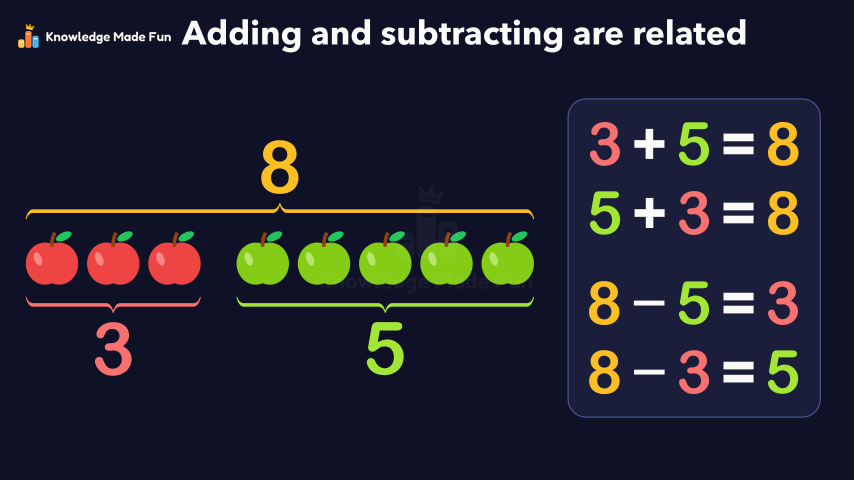 1 min 23 s
Adding and subtracting are related
Grade 1 · 1 min 23 s
- All Grade 4 Mathematics lessons
- Teachers: the maths worksheets for Grade 4 are in the dashboard, each with a worked example and a proven answer key.
- Try the graph paper, free for everyone, no account needed.
- Create a free account to watch three lessons a day, no payment and no card.