Lesson · Grade 6 · Science
Where our solar system sits in the Milky Way
- Grade 6
- Science
- 1 min 19 s
- British Columbia
- BC6-SC-18
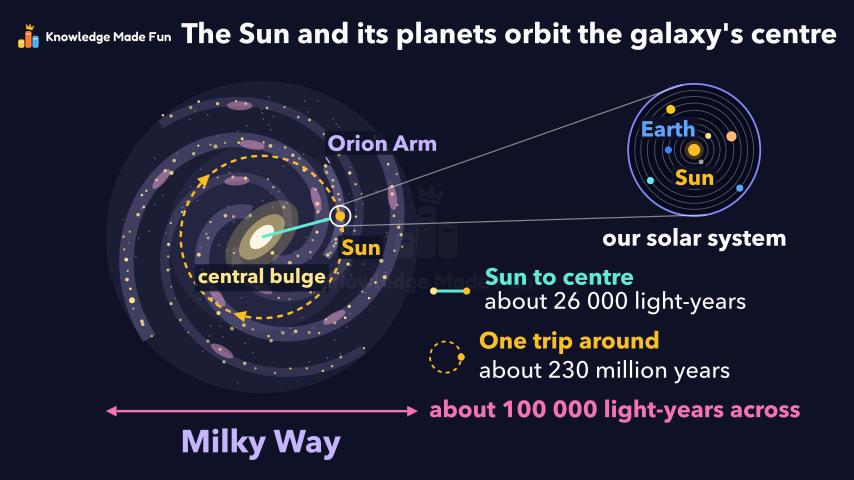
A labelled top-down drawing of the Milky Way builds up step by step: its stars, gas and dust, spiral arms and central bulge, its width of about 100 000 light-years, and the Sun in the Orion Arm about halfway out, about 26 000 light-years from the centre. A zoom-in shows that the planets travel with the Sun, and then the whole solar system sweeps once around the centre, kept on its path by gravity, with one trip taking about 230 million years.
Anyone can watch two lessons on the website without an account. Signing in is free, no payment and no card, and opens three a day; Plus has no limit.
Loading
In one sentence
The question this lesson answers
Where in space is our solar system?
Our solar system is inside a huge galaxy called the Milky Way.
Transcript
What the lesson says
Where in space is our solar system?
Our solar system is inside a huge galaxy called the Milky Way.
It holds hundreds of billions of stars, along with clouds of gas and dust.
Seen from above, it would look like a spiral with long, curved arms.
It is about 100,000 light-years across.
One light-year is how far light travels in one year.
At its centre is a bright bulge, crowded with stars.
Our Sun sits in a small arm called the Orion Arm, about halfway out from the centre.
That is about 26,000 light-years from the centre.
The Sun's planets, including Earth, travel along with it.
Together, they move in a giant orbit around the centre of the galaxy.
The pull of the galaxy's gravity keeps the solar system on this path.
One trip around the centre takes about 230 million years.
So the Sun and its planets travel together around the centre of our galaxy, the Milky Way.
Curriculum
Where this fits
- British Columbia, Grade 6
Science, Earth science: the position, motion, and components of our solar system in our galaxyBC6-SC-18
Previous: Our Solar System: The Sun and Everything That Orbits ItNext: What Causes the Northern Lights?
The outcomes and strands follow the British Columbia curriculum.
Keep going
 1 min 43 s
Absolute dating: radioactive decay is a clock for rocks
Grade 7 · 1 min 43 s 1 min 19 s
Climate Change and Living Things: Move, Change, or Die Out
Grade 7 · 1 min 19 s 1 min 14 s
Day and Night: Earth Spins on Its Axis
Grade 4 · 1 min 14 s 1 min 50 s
Dynamic equilibrium: balanced but always changing
Grade 9 · 1 min 50 s 1 min 11 s
Earth Materials: From Boulders to Clay
Grade 5 · 1 min 11 s 1 min 11 s
Erosion and Deposition: How Wind, Water and Ice Move Land
Grade 3 · 1 min 11 s 1 min 53 s
From quarks to galaxies: how the universe's matter formed
Grade 10 · 1 min 53 s 47 s
Hot, Warm, Cool and Cold: What Do We Wear?
Kindergarten · 47 s
- All Grade 6 Science lessons
- Create a free account to watch three lessons a day, no payment and no card.