Lesson · Grade 7 · Science
Sustainable practices: what works
- Grade 7
- Science
- 1 min 34 s
- British Columbia
- BC7-SC-43
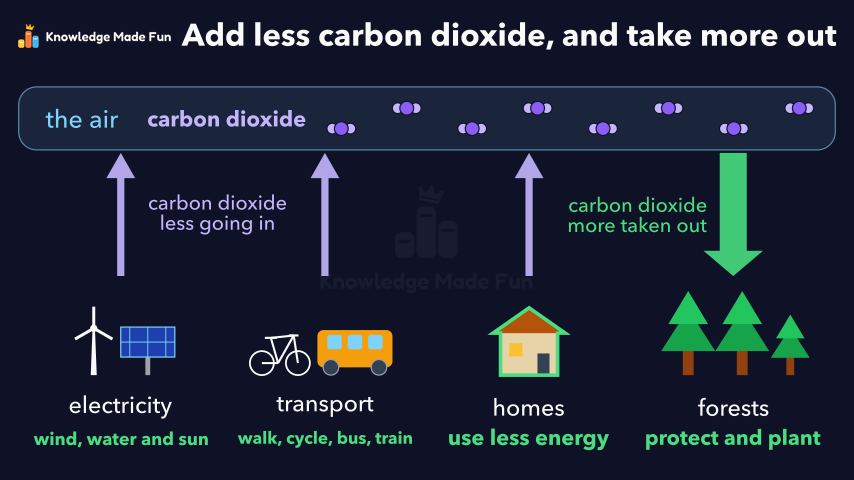
The scene draws the air as a band across the top with carbon dioxide molecules, and four places on the ground beneath it: a power station, a car, a house and a forest, with thick purple arrows carrying carbon dioxide up into the air and a thin green arrow coming back out through the trees. One sustainable practice is then applied to each place in turn (clean electricity from wind, water and sun; walking, cycling and shared transport; using less energy at home; protecting forests and planting trees), and each change shrinks an arrow going in or grows the arrow coming out, ending on the recap that what works is adding less carbon dioxide and taking more out.
Anyone can watch two lessons on the website without an account. Signing in is free, no payment and no card, and opens three a day; Plus has no limit.
Loading
In one sentence
The question this lesson answers
People are warming Earth by adding carbon dioxide to the air. Which sustainable practices really work?
Most of it comes from burning coal, oil and gas, for example to make electricity, to travel, and to heat homes.
Transcript
What the lesson says
People are warming Earth by adding carbon dioxide to the air. Which sustainable practices really work?
Most of it comes from burning coal, oil and gas, for example to make electricity, to travel, and to heat homes.
Trees take some carbon dioxide back out of the air, but many forests have been cut down.
A sustainable practice works if it shrinks the carbon dioxide going in, or grows the amount coming out.
First, make electricity from wind, water and sunlight instead of coal and gas.
Clean electricity adds almost no carbon dioxide, so this arrow shrinks a lot.
Next, walk, cycle, or share a bus or train instead of driving alone.
Less fuel is burned, so less carbon dioxide goes in.
At home, insulate well, switch things off, and choose efficient lights and appliances.
Using less energy means less fuel is burned, so this arrow shrinks too.
Finally, protect the forests we have, and plant new trees.
More trees take more carbon dioxide out of the air, so this arrow grows.
Put together, less carbon dioxide goes in and more comes out, so the rise in the air slows down.
What works is simple: add less carbon dioxide to the air, and take more of it out.
Curriculum
Where this fits
- British Columbia, Grade 7
Science, Earth science: evidence of climate change over geological time and the recent impacts of humansBC7-SC-43
Previous: Climate Change and Living Things: Move, Change, or Die Out
The outcomes and strands follow the British Columbia curriculum.
Keep going
 1 min 43 s
Absolute dating: radioactive decay is a clock for rocks
Grade 7 · 1 min 43 s 1 min 19 s
Climate Change and Living Things: Move, Change, or Die Out
Grade 7 · 1 min 19 s 1 min 14 s
Day and Night: Earth Spins on Its Axis
Grade 4 · 1 min 14 s 1 min 50 s
Dynamic equilibrium: balanced but always changing
Grade 9 · 1 min 50 s 1 min 11 s
Earth Materials: From Boulders to Clay
Grade 5 · 1 min 11 s 1 min 11 s
Erosion and Deposition: How Wind, Water and Ice Move Land
Grade 3 · 1 min 11 s 1 min 53 s
From quarks to galaxies: how the universe's matter formed
Grade 10 · 1 min 53 s 47 s
Hot, Warm, Cool and Cold: What Do We Wear?
Kindergarten · 47 s
- All Grade 7 Science lessons
- Create a free account to watch three lessons a day, no payment and no card.