Lesson · Grade 8 · Science
Reflection: The Law of Reflection and Mirror Images
- Grade 8
- Science
- 1 min 48 s
- British Columbia
- BC8-SC-33
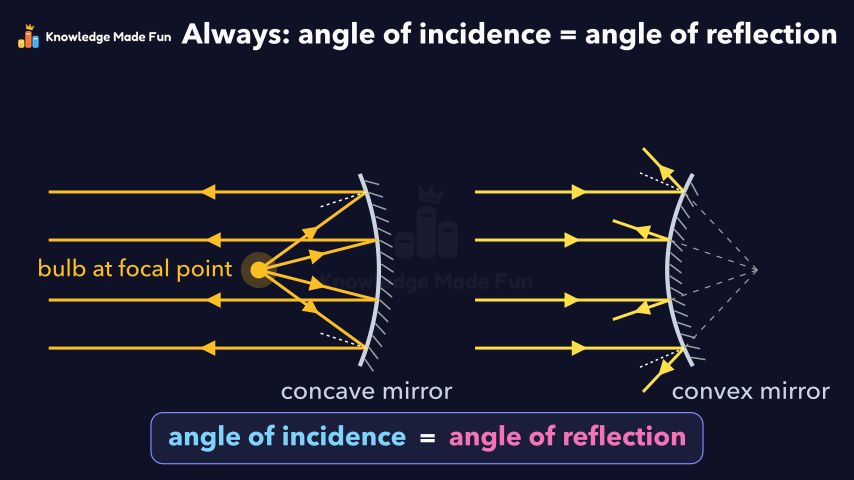
A labelled ray diagram with the normal drawn shows that the angle of incidence equals the angle of reflection. Smooth surfaces send light one way and rough ones scatter it, but rough surfaces still reflect light. The video then shows that a plane mirror's image is upright, the same size and as far behind the mirror as the object is in front. It ends with a concave mirror focusing light (and a flashlight beam) and a convex mirror spreading rays out for a wide view.
Anyone can watch two lessons on the website without an account. Signing in is free, no payment and no card, and opens three a day; Plus has no limit.
Loading
In one sentence
The question this lesson answers
When light hits a mirror, which way does it bounce?
The ray of light coming in is called the incident ray.
Transcript
What the lesson says
When light hits a mirror, which way does it bounce?
The ray of light coming in is called the incident ray.
Where it hits, we draw the normal, a line at 90 degrees to the mirror.
The angle between the incident ray and the normal is the angle of incidence.
The ray going out is the reflected ray, at the angle of reflection.
The law of reflection: these two angles are always equal.
A smooth surface, like a mirror, reflects parallel rays all one way.
A rough surface, like paper, has bumps facing many ways, so it scatters light every way.
So rough surfaces do reflect light, and every ray still obeys the law.
Now stand a plane mirror, a flat one, upright with an object in front.
Light from the object reflects into your eye. Your brain traces it straight back to an image behind the mirror.
The image is upright, the same size, and as far behind the mirror as the object is in front.
If the object is 1.5 metres in front, its image is 1.5 metres behind.
A concave mirror caves inward. Parallel rays reflect and meet at one point, the focal point.
A flashlight does the reverse: a bulb at the focal point sends out a straight beam.
A convex mirror bulges outward. It spreads rays apart, giving a wide view, like safety mirrors in shops.
Every surface, flat or curved, smooth or rough: the angle of incidence equals the angle of reflection.
Curriculum
Where this fits
- British Columbia, Grade 8
Science, Physics: light: behavioursBC8-SC-33
Previous: Light: A Wave and a ParticleNext: Refraction: why light bends in water and glass
The outcomes and strands follow the British Columbia curriculum.
Keep going
 1 min 51 s
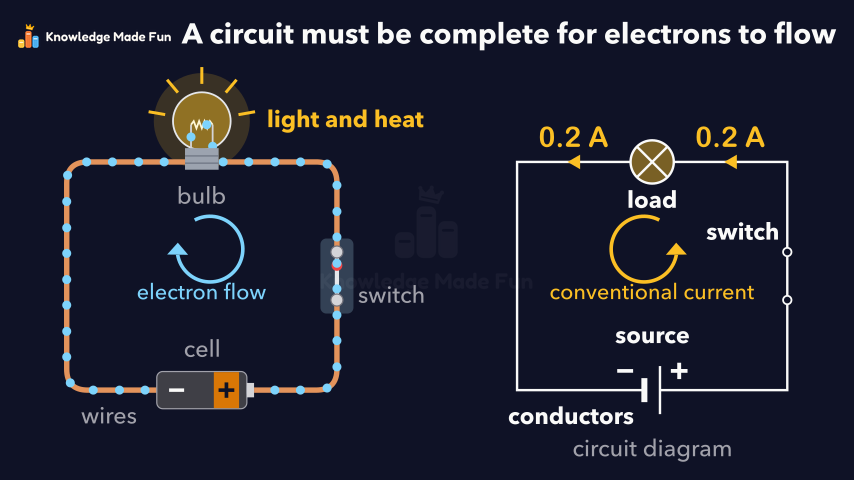
A Complete Circuit: Source, Load, Conductors and Switch
Grade 9 · 1 min 51 s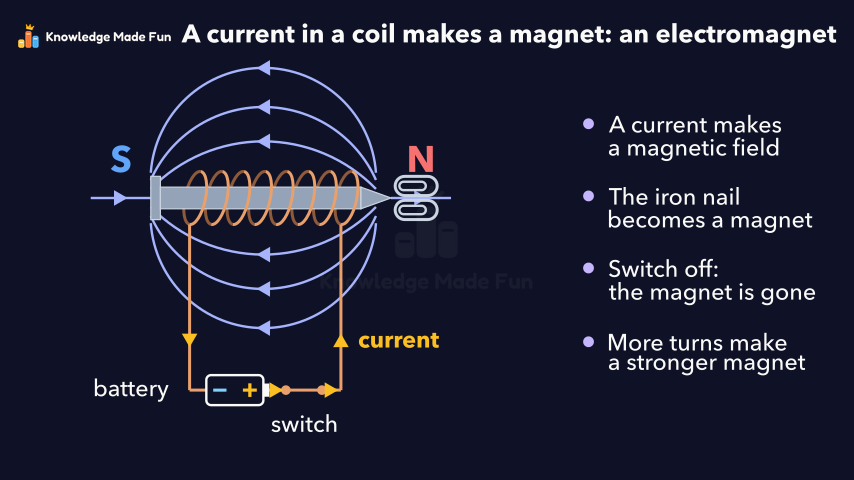 1 min 18 s
A current makes a magnet: the electromagnet
Grade 7 · 1 min 18 s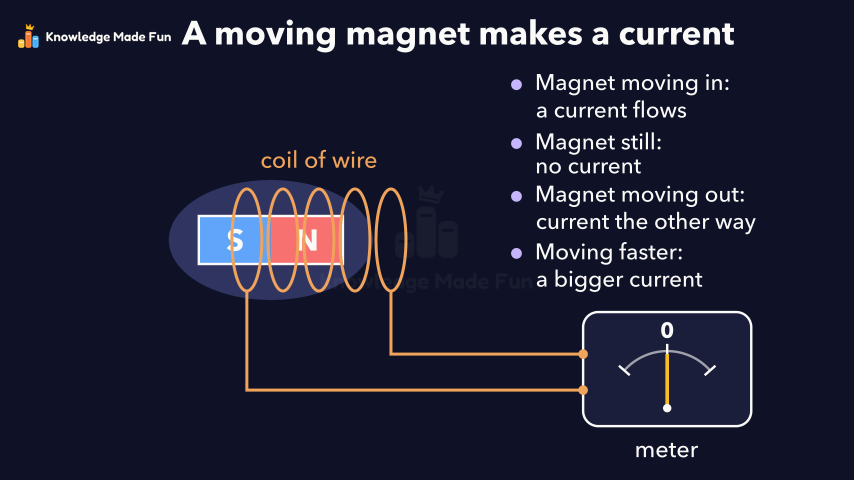 1 min 12 s
A Moving Magnet Makes a Current
Grade 7 · 1 min 12 s 54 s
A Push or a Pull Makes Things Move
Kindergarten · 54 s 1 min 48 s
AC and DC: Two Ways Current Can Flow
Grade 9 · 1 min 48 s 1 min 3 s
Air Resistance: Why a Flat Sheet Falls Slower
Grade 2 · 1 min 3 s 1 min 40 s
Alpha, Beta and Gamma Radiation
Grade 10 · 1 min 40 s 1 min 6 s
Balanced and Unbalanced Forces in Sport and Play
Grade 6 · 1 min 6 s
- All Grade 8 Science lessons
- Create a free account to watch three lessons a day, no payment and no card.