Lesson · Grade 8 · Science
Light as a Wave: Wavelength, Frequency and Amplitude
- Grade 8
- Science
- 1 min 50 s
- British Columbia
- BC8-SC-31
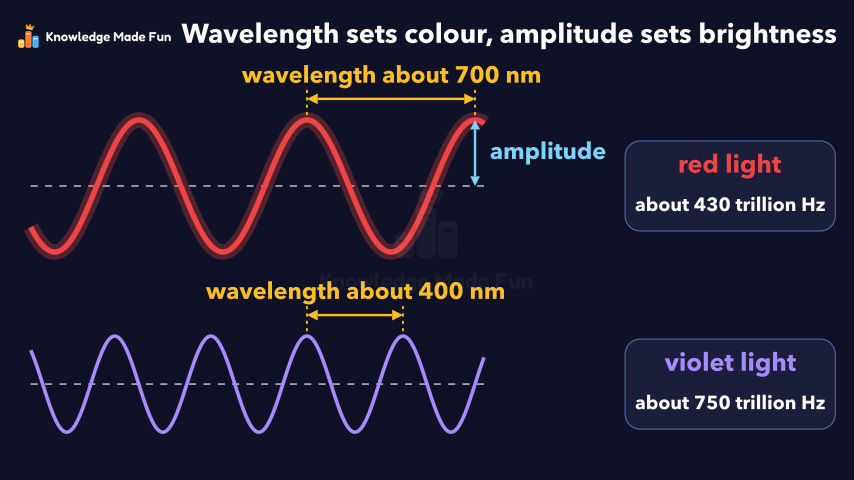
One labelled light wave builds up step by step: rest line, crest, trough, wavelength from crest to crest and amplitude from the rest line to a crest, with frequency shown as waves passing a fixed point each second, in hertz. Red (about 700 nm) and violet (about 400 nm) waves then travel side by side at the same speed to show that wavelength sets the colour and a shorter wavelength means a higher frequency, and a growing amplitude shows that amplitude sets the brightness.
Anyone can watch two lessons on the website without an account. Signing in is free, no payment and no card, and opens three a day; Plus has no limit.
Loading
In one sentence
The question this lesson answers
Light travels as a wave. So how do we describe a wave of light?
The dashed line through the middle is the rest line.
Transcript
What the lesson says
Light travels as a wave. So how do we describe a wave of light?
The dashed line through the middle is the rest line.
Each highest point of the wave is a crest, and each lowest point is a trough.
The wavelength is the length of one whole wave, from one crest to the next crest.
The amplitude is the height of a crest above the rest line.
Amplitude and wavelength are not the same. Wavelength is measured along the wave, and amplitude is measured up from the rest line.
Frequency is the number of waves that pass a fixed point each second. Here it is slowed right down.
Frequency is measured in hertz. One hertz means one wave per second.
For light, the wavelength sets the colour. This red light has a wavelength of about 700 nanometres.
A nanometre is one millionth of a millimetre.
Violet light has a shorter wavelength, about 400 nanometres.
In empty space, all colours of light travel at the same speed.
More violet waves pass in the same time, so a shorter wavelength means a higher frequency.
Real light has far more waves each second. Red light is about 430 trillion hertz, and violet light is about 750 trillion hertz.
Amplitude sets the brightness. A bigger amplitude means brighter light of the same colour.
Wavelength sets the colour of light, and amplitude sets its brightness.
Curriculum
Where this fits
- British Columbia, Grade 8
Science, Physics: light: propertiesBC8-SC-31
Previous: Helpful and Harmful Effects of Electromagnetic RadiationNext: Light: A Wave and a Particle
The outcomes and strands follow the British Columbia curriculum.
Keep going
 1 min 51 s
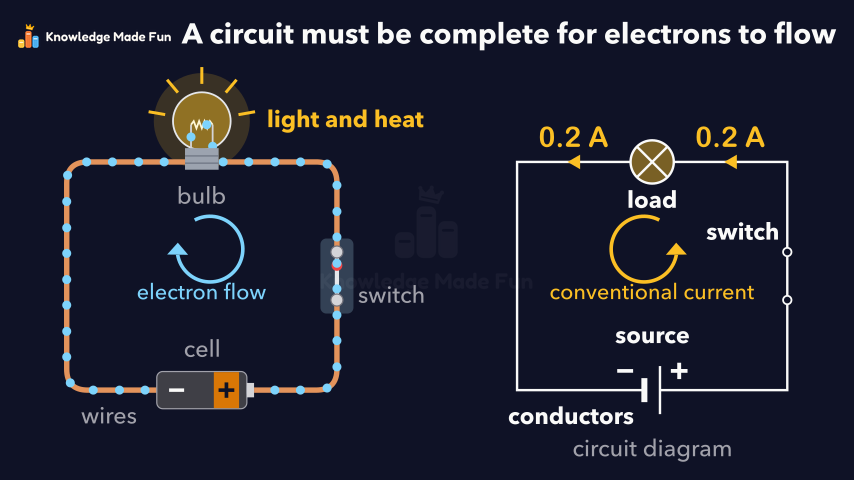
A Complete Circuit: Source, Load, Conductors and Switch
Grade 9 · 1 min 51 s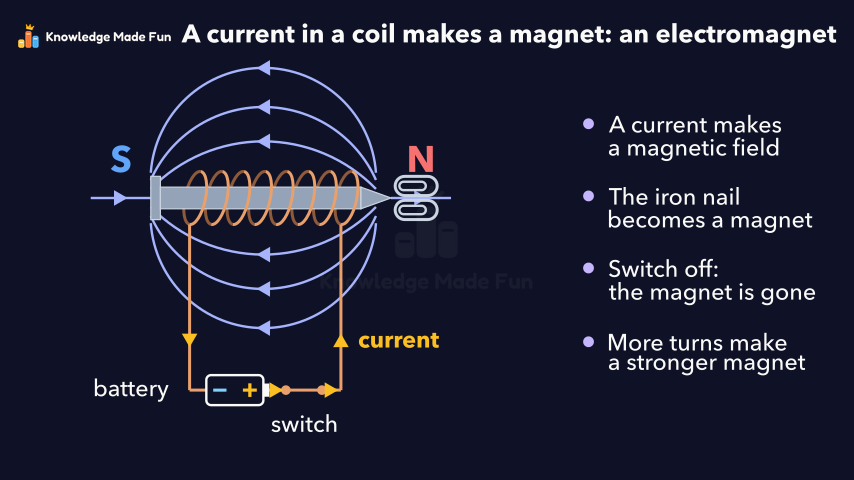 1 min 18 s
A current makes a magnet: the electromagnet
Grade 7 · 1 min 18 s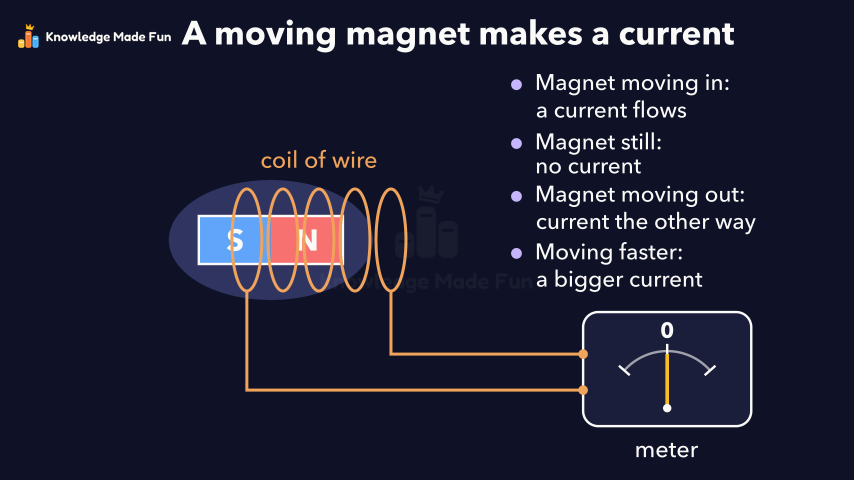 1 min 12 s
A Moving Magnet Makes a Current
Grade 7 · 1 min 12 s 54 s
A Push or a Pull Makes Things Move
Kindergarten · 54 s 1 min 48 s
AC and DC: Two Ways Current Can Flow
Grade 9 · 1 min 48 s 1 min 3 s
Air Resistance: Why a Flat Sheet Falls Slower
Grade 2 · 1 min 3 s 1 min 40 s
Alpha, Beta and Gamma Radiation
Grade 10 · 1 min 40 s 1 min 6 s
Balanced and Unbalanced Forces in Sport and Play
Grade 6 · 1 min 6 s
- All Grade 8 Science lessons
- Create a free account to watch three lessons a day, no payment and no card.