Lesson · Grade 10 · Foundations of Mathematics and Pre Calculus
Writing a Prime Factorization with Powers
- Grade 10
- Foundations of Mathematics and Pre Calculus
- 2 min 22 s
- British Columbia
- BC10-MA-04
A factor tree splits 360 into 36 × 10 and on down until every branch ends in a circled prime. The primes are collected as 2 × 2 × 2 × 3 × 3 × 5, checked as 8 × 9 × 5 = 360, and written with powers as 2³ × 3², with the base and exponent labelled, times 5. A second tree that starts from 8 × 45 gives the same primes, showing that each whole number has only one prime factorization, and the video ends on the common mistake of leaving the composite 9 in the answer.
Anyone can watch two lessons on the website without an account. Signing in is free, no payment and no card, and opens three a day; Plus has no limit.
Loading
In one sentence
The question this lesson answers
Let us write 360 as a product of primes, called its prime factorization.
A prime number, such as 2, 3, 5 or 7, has exactly two factors: 1 and itself.
Transcript
What the lesson says
Let us write 360 as a product of primes, called its prime factorization.
A prime number, such as 2, 3, 5 or 7, has exactly two factors: 1 and itself.
A factor tree splits a number into two factors. 360 is 36 times 10.
36 is 6 times 6, and 10 is 2 times 5. 2 and 5 are prime, so circle them.
6 is composite: it has more than two factors. Split each 6 into 2 times 3.
Every branch now ends in a prime. Collect them: 2, 2, 2, 3, 3 and 5.
Check: the twos make 8, the threes make 9, and 8 times 9 times 5 is 360.
A power is short for a repeated factor: 2 times 2 times 2 is 2 to the power 3, or 2 cubed.
2 is the base. The exponent, 3, counts how many twos are multiplied.
3 times 3 is 3 to the power 2, or 3 squared. 5 is used once, so it stays 5.
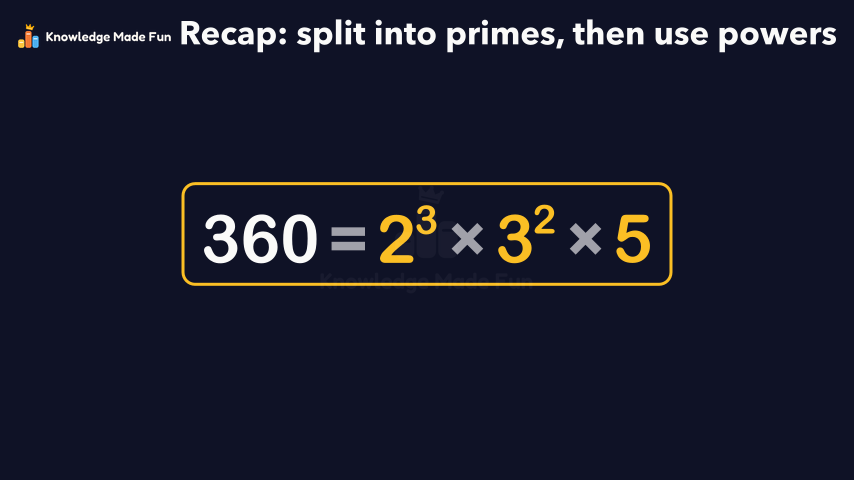
So the prime factorization of 360 is 2 cubed times 3 squared times 5.
Now start with a different pair: 360 is also 8 times 45.
8 is 2 times 4, and 4 is 2 times 2. 45 is 9 times 5, and 9 is 3 times 3.
The primes are the same: three twos, two threes and one five.
Every whole number above 1 has only one prime factorization, apart from the order.
A common mistake is to stop at 9 and write 2 cubed times 9 times 5.
But 9 is composite: 9 is 3 times 3. Keep splitting until all are prime.
Recap: split into primes, then write repeats as powers: 2 cubed times 3 squared times 5.
Curriculum
Where this fits
- British Columbia, Grade 10
Foundations of Mathematics and Pre Calculus 10, Number: prime factorizationBC10-MA-04
Previous: Evaluating Powers with the Order of OperationsNext: Finding All the Factors of 72 with Factor Pairs
The outcomes and strands follow the British Columbia curriculum.
Keep going
 1 min 26 s
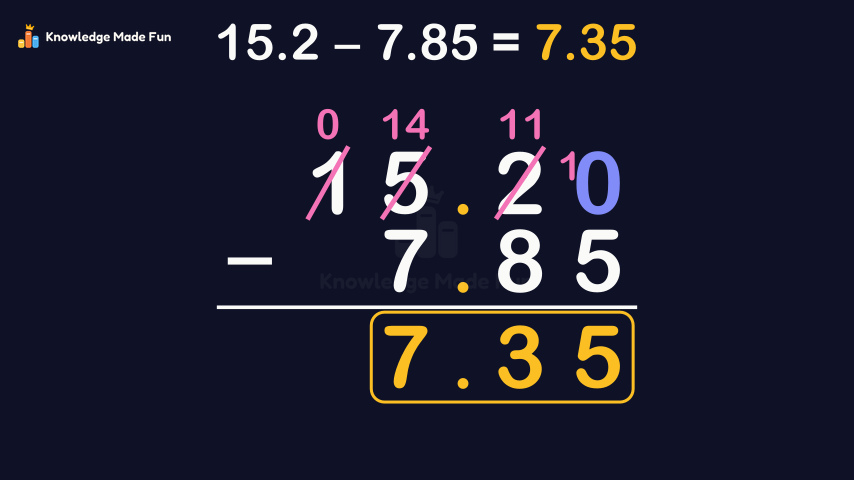
15.2 − 7.85
Grade 4 · 1 min 26 s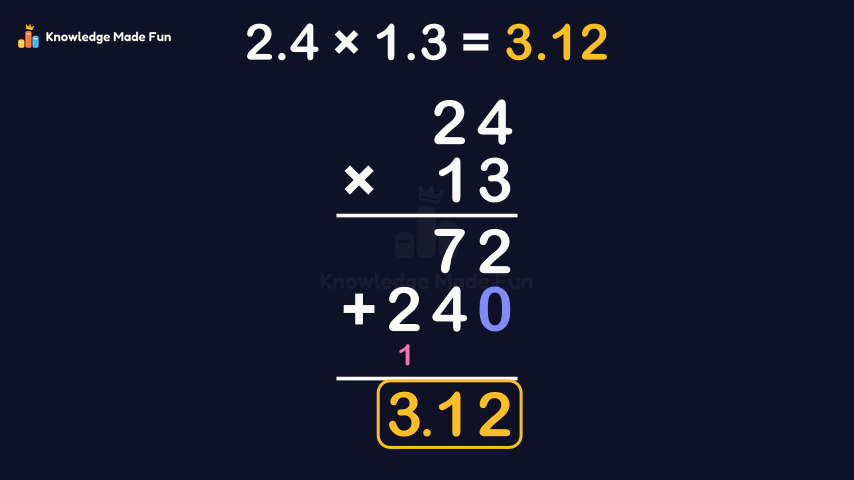 1 min 37 s
2.4 × 1.3
Grade 7 · 1 min 37 s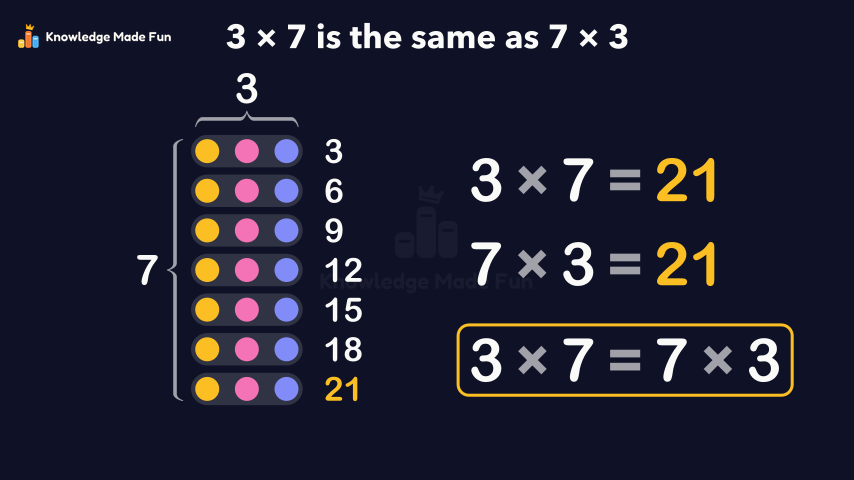 1 min 4 s
3 × 7 = 7 × 3: Equal Groups, Skip Counting and Arrays
Grade 4 · 1 min 4 s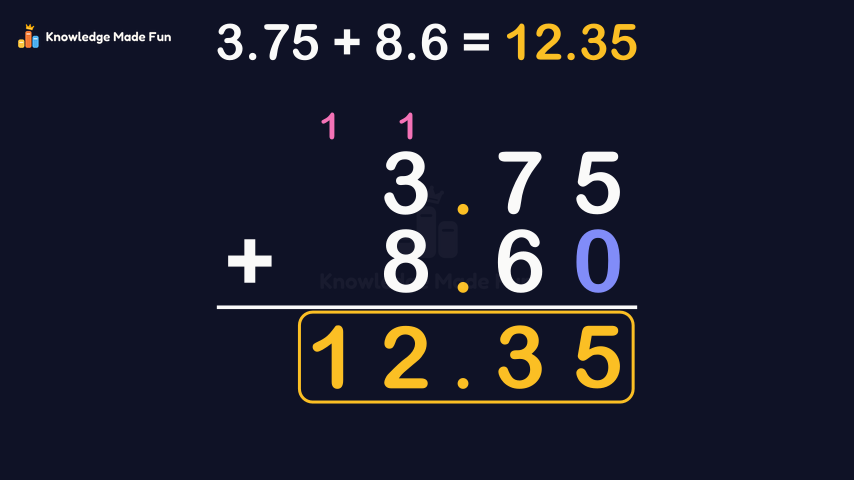 59 s
3.75 + 8.6
Grade 4 · 59 s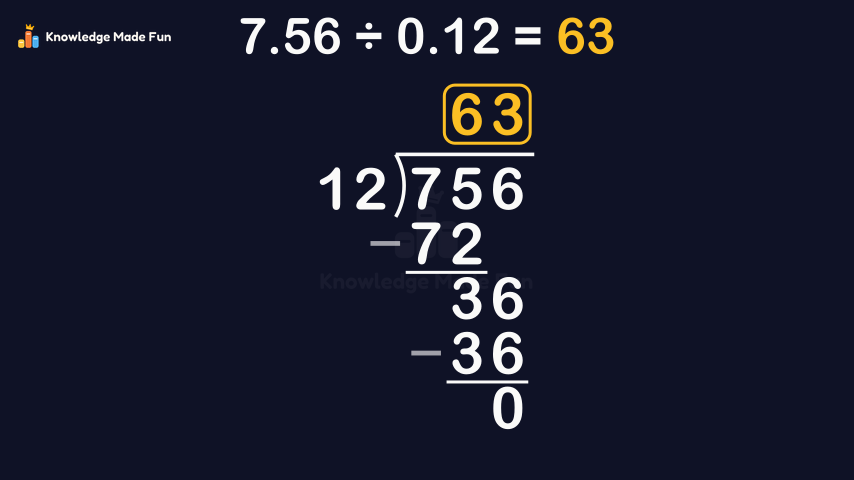 1 min 32 s
7.56 ÷ 0.12
Grade 7 · 1 min 32 s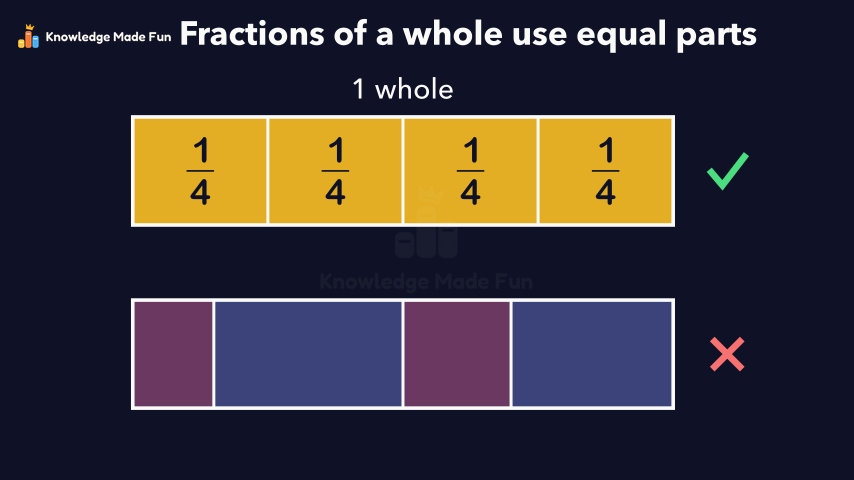 56 s
A Fraction Is Equal Parts of One Whole
Grade 3 · 56 s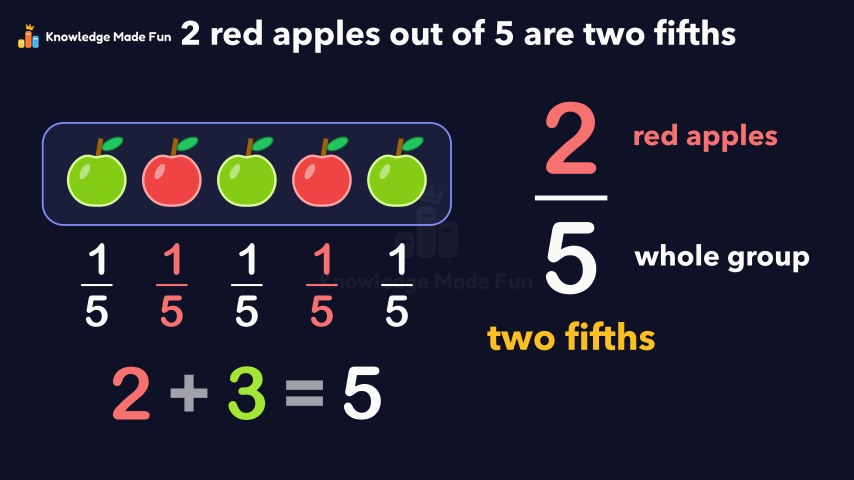 57 s
A Fraction of a Group
Grade 3 · 57 s 1 min 23 s
Adding and subtracting are related
Grade 1 · 1 min 23 s
- All Grade 10 Foundations of Mathematics and Pre Calculus lessons
- Create a free account to watch three lessons a day, no payment and no card.