Lesson · Grade 11 · Pre Calculus
Vertex form: how a, p and q shape a parabola
- Grade 11
- Pre Calculus
- 2 min 26 s
- British Columbia
- BC11-MA-74
Starting from y = x², the video builds y = 2(x − 3)² − 4 one step at a time on one graph: p = 3 slides it right (with the check that x − 3 moves it right, not left), q = −4 slides it down, and a = 2 makes it narrower, checked at the point (4, −2). It then reads off the vertex (3, −4), the axis of symmetry x = 3, that it opens up and the range y ≥ −4, and shows with a ball's height h = −5(t − 2)² + 21 that a negative a flips the parabola, so the ball's highest point is 21 m after 2 s.
Anyone can watch two lessons on the website without an account. Signing in is free, no payment and no card, and opens three a day; Plus has no limit.
Loading
In one sentence
The question this lesson answers
Vertex form is y equals a times the square of x minus p, plus q. How do a, p and q each change the graph?
Start with y equals x squared. Its graph is a parabola, with its turning point, the vertex, at zero, zero.
Transcript
What the lesson says
Vertex form is y equals a times the square of x minus p, plus q. How do a, p and q each change the graph?
Start with y equals x squared. Its graph is a parabola, with its turning point, the vertex, at zero, zero.
Write x minus 3 in place of x, so p is 3. The parabola slides 3 units right, and the vertex moves to 3, zero.
Careful: x minus 3 moves it right, not left. Check: when x is 3, y is 3 minus 3, squared, which is zero.
Now subtract 4, so q is minus 4. The parabola slides 4 units down, and the vertex moves to 3, minus 4.
Then multiply by 2, so a is 2. Every height above the vertex doubles, so it is narrower than y equals x squared, shown dashed.
Check: when x is 4, y is 2 times 1 squared, minus 4, which is minus 2. That is 2 above the vertex, not 1.
The vertex is always p, q: here 3, minus 4. The line x equals 3 is the axis of symmetry, splitting the parabola into mirror halves.
Since a is positive, it opens up. Its range, all the y values it reaches, is y greater than or equal to minus 4.
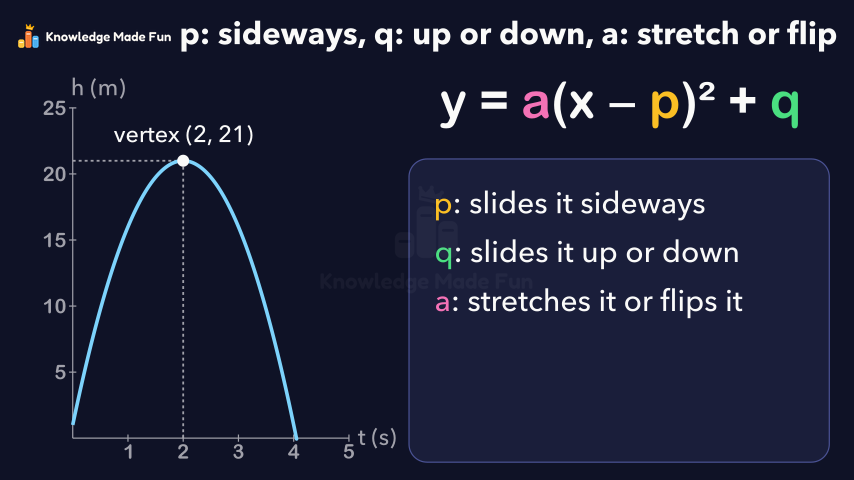
A ball is thrown upward. Its height in metres after t seconds is h equals minus 5 times the square of t minus 2, plus 21.
Here a is minus 5. With plus 5 it would open up, but a negative a flips the parabola, so it opens down.
The vertex, 2, 21, is the highest point: 21 metres after 2 seconds. Check: at t equals 2, h is minus 5 times zero, plus 21, which is 21.
So p slides a parabola sideways, q slides it up or down, and a stretches it or flips it.
Curriculum
Where this fits
- British Columbia, Grade 11
Pre Calculus 11, Quadratics: quadratic functions and equationsBC11-MA-74
Previous: The Parts of a Parabola: Vertex, Axis of Symmetry and InterceptsNext: Completing the Square: From Standard Form to Vertex Form
The outcomes and strands follow the British Columbia curriculum.
Keep going
 2 min 24 s
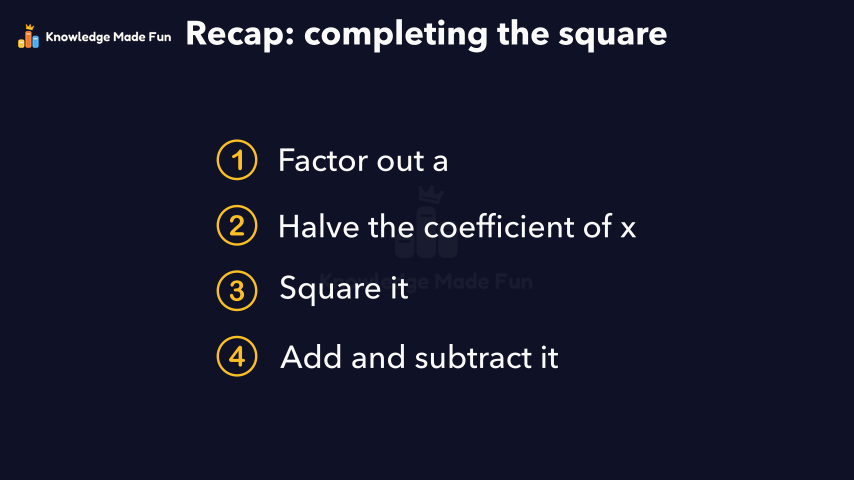
Completing the Square: From Standard Form to Vertex Form
Grade 11 · 2 min 24 s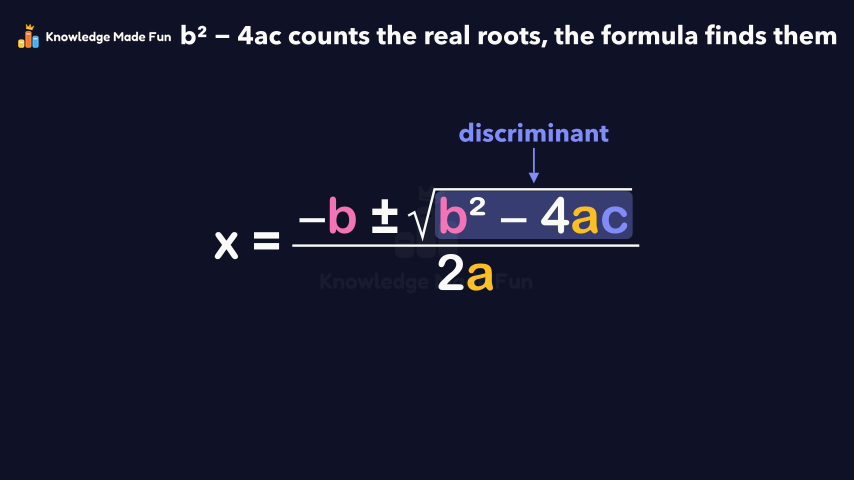 2 min 17 s
The quadratic formula and the discriminant
Grade 11 · 2 min 17 s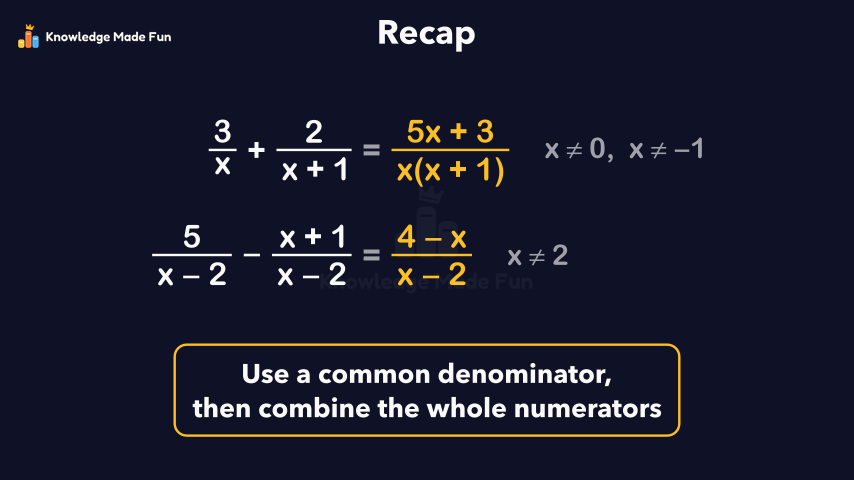 2 min 11 s
Adding and Subtracting Rational Expressions
Grade 11 · 2 min 11 s 2 min 3 s
Angles in Standard Position and Reference Angles
Grade 11 · 2 min 3 s 1 min 58 s
Angles made by parallel lines and a transversal
Grade 11 · 1 min 58 s 2 min 12 s
Angles of Elevation and Depression: Measuring What You Cannot Reach
Grade 10 · 2 min 12 s 1 min 58 s
Choosing the best average: mean, median or mode
Grade 8 · 1 min 58 s 2 min 7 s
Compound interest: earning interest on interest
Grade 11 · 2 min 7 s
- All Grade 11 Pre Calculus lessons
- Create a free account to watch three lessons a day, no payment and no card.