Lesson · Grade 11 · Foundations of Mathematics
Compound interest: earning interest on interest
- Grade 11
- Foundations of Mathematics
- 2 min 7 s
- British Columbia
- BC11-MA-37
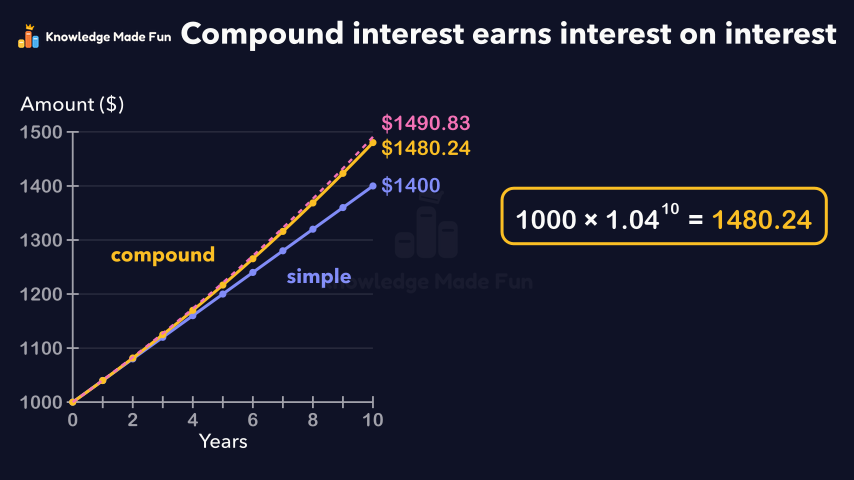
Using $1000 saved at 4% a year for 10 years, the video shows simple interest adding the same $40 a year as a straight line up to $1400. Compound interest multiplies by 1.04 every year as a curve that bends upward to 1000 × 1.04^10 = $1480.24, or $1490.83 compounded monthly, and the video warns that 4% × 10 = 40% is simple interest, not compound.
Anyone can watch two lessons on the website without an account. Signing in is free, no payment and no card, and opens three a day; Plus has no limit.
Loading
In one sentence
The question this lesson answers
You save 1000 dollars at 4 percent a year. How much do you have after 10 years?
The principal is the 1000 dollars you start with. Interest is what the bank pays you to use your money.
Transcript
What the lesson says
You save 1000 dollars at 4 percent a year. How much do you have after 10 years?
The principal is the 1000 dollars you start with. Interest is what the bank pays you to use your money.
Simple interest pays 4 percent of the principal only: 40 dollars every year.
After 10 years you have 1000 plus 10 times 40, which is 1400 dollars. On the graph, that is a straight line.
Compound interest adds each year's interest to the money in the account, so the interest earns interest too.
Adding 4 percent means multiplying by 1.04. Year 1: 1000 times 1.04 is 1040 dollars. Year 2: 1040 times 1.04 is 1081 dollars and 60 cents.
So year 2 earns 41 dollars and 60 cents: 40 dollars, plus 1 dollar 60, which is 4 percent of last year's 40.
Ten years means multiplying by 1.04 ten times: 1000 times 1.04 to the power of 10 is 1480 dollars and 24 cents.
On the graph it is a curve that bends upward, because each year's interest is bigger than the last.
Compounded monthly, the bank adds 4 percent divided by 12 every month, 120 times. You get 1490 dollars and 83 cents.
A common mistake: 4 percent times 10 years is 40 percent, so 1000 times 1.4 is 1400. That is simple interest, not compound.
Compound interest earns interest on interest: 1000 dollars at 4 percent for 10 years becomes 1480 dollars and 24 cents.
Curriculum
Where this fits
- British Columbia, Grade 11
Foundations of Mathematics 11, Financial literacy: financial literacy: compound interest, investments and loansBC11-MA-37
- British Columbia, Grade 11
Pre Calculus 11, Financial literacy: financial literacy: compound interest, investments, loansBC11-MA-83
- British Columbia, Grade 11
Workplace Mathematics 11, Financial literacy: financial literacy: personal investments, loans, and budgetingBC11-MA-86
- British Columbia, Grade 12
Apprenticeship Mathematics 12, Financial literacy: financial literacy: business investments and loansBC12-MA-018
- British Columbia, Grade 12
Foundations of Mathematics 12, Financial literacy: financial planningBC12-MA-119
This lesson is also listed in Grade 12.
The outcomes and strands follow the British Columbia curriculum.
Keep going
 2 min
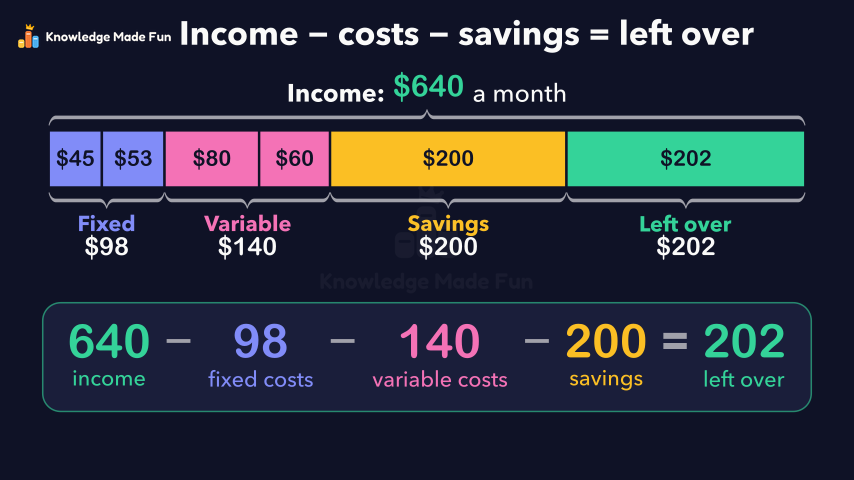
A Monthly Budget: Income, Fixed Costs and Variable Costs
Grade 9 · 2 min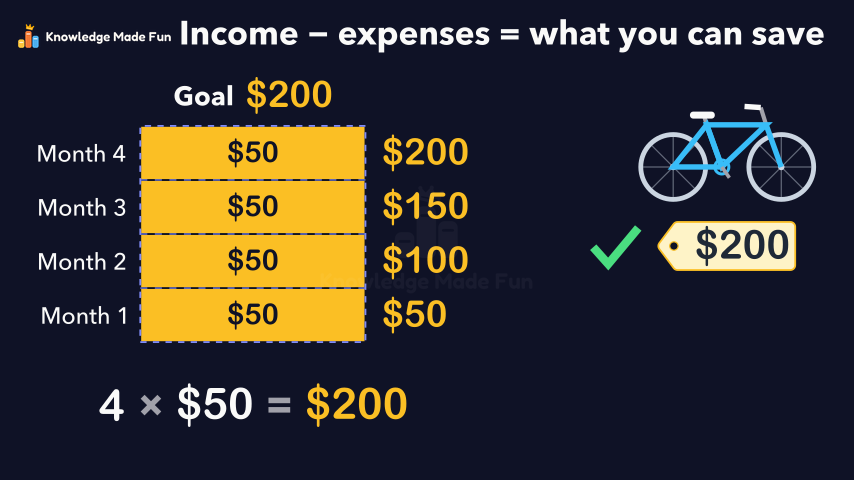 1 min 13 s
A Simple Budget: Income, Expenses and a Savings Goal
Grade 5 · 1 min 13 s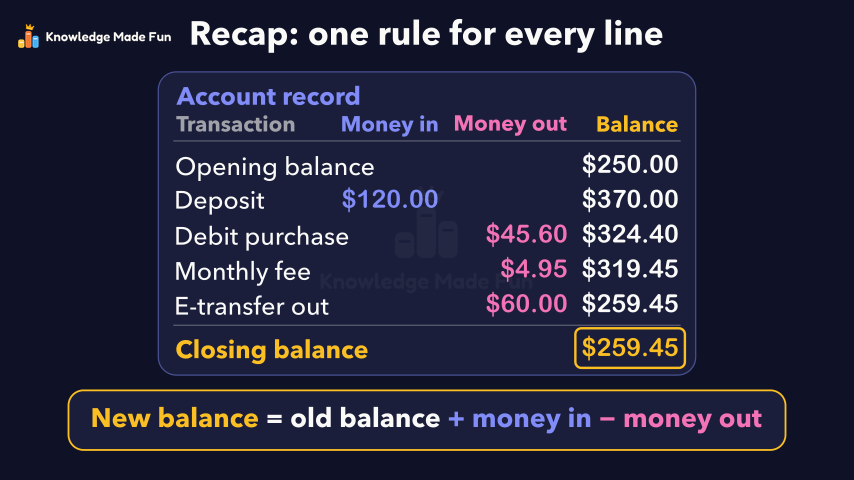 1 min 55 s
Bank Accounts: Deposits, Withdrawals, Fees and the Balance
Grade 9 · 1 min 55 s 2 min 22 s
Best buy: comparing unit prices
Grade 8 · 2 min 22 s 1 min 3 s
Coins and What Each One Is Worth
Grade 1 · 1 min 3 s 1 min 9 s
Coins: Size, Colour and Pictures
Kindergarten · 1 min 9 s 1 min 12 s
Counting Bills and Coins to 100 Dollars
Grade 3 · 1 min 12 s 1 min 9 s
Counting Coins to 100 Cents
Grade 2 · 1 min 9 s
- All Grade 11 Foundations of Mathematics lessons
- Create a free account to watch three lessons a day, no payment and no card.