Lesson · Grade 5 · Mathematics
A Simple Budget: Income, Expenses and a Savings Goal
- Grade 5
- Mathematics
- 1 min 13 s
- British Columbia
- BC5-MA-39
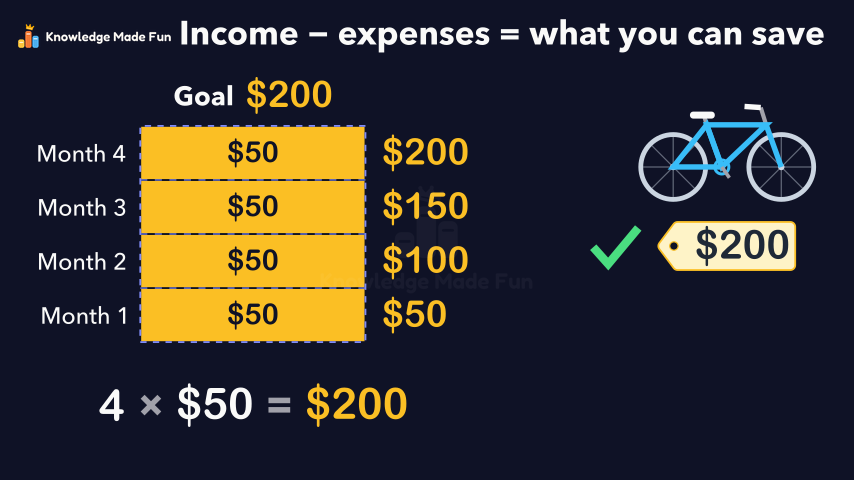
A bar stands for a month's $120 income and splits into the expenses (a movie $15, snacks $30 and bus fares $25, which add to $70) and the $50 left over, which can be saved; adding $70 and $50 makes $120 again to check it. That $50 then stacks up one block a month toward a $200 bike ($50, $100, $150, $200), and 4 × $50 = $200 shows it takes 4 months, ending on the recap "Income − expenses = what you can save".
Anyone can watch two lessons on the website without an account. Signing in is free, no payment and no card, and opens three a day; Plus has no limit.
Loading
In one sentence
The question this lesson answers
How long will it take to save for a bike that costs 200 dollars?
A budget is a plan for your money.
Transcript
What the lesson says
How long will it take to save for a bike that costs 200 dollars?
A budget is a plan for your money.
Income is money coming in, and you earn 120 dollars a month.
Expenses are money going out: a movie, snacks and bus fares.
The movie costs 15 dollars, the snacks 30 dollars and the bus fares 25 dollars.
Add them up: 15 plus 30 plus 25 is 70 dollars.
The money that is left can be saved.
Take the expenses from the income: 120 minus 70 leaves 50 dollars.
Check: 70 plus 50 makes 120 again.
Your savings goal is 200 dollars for the bike.
Save 50 dollars each month and count up: 50, 100, 150, 200.
4 times 50 dollars is 200 dollars, so it takes 4 months.
Income minus expenses is the money you can save for a goal.
Curriculum
Where this fits
- British Columbia, Grade 5
Mathematics, Financial literacy: financial literacy: monetary calculations, including making change with amounts to 1000 dollars and developing simple financial plansBC5-MA-39
The outcomes and strands follow the British Columbia curriculum.
Keep going
 2 min
A Monthly Budget: Income, Fixed Costs and Variable Costs
Grade 9 · 2 min 1 min 55 s
Bank Accounts: Deposits, Withdrawals, Fees and the Balance
Grade 9 · 1 min 55 s 2 min 22 s
Best buy: comparing unit prices
Grade 8 · 2 min 22 s 1 min 3 s
Coins and What Each One Is Worth
Grade 1 · 1 min 3 s 1 min 9 s
Coins: Size, Colour and Pictures
Kindergarten · 1 min 9 s 2 min 7 s
Compound interest: earning interest on interest
Grade 11 · 2 min 7 s 1 min 12 s
Counting Bills and Coins to 100 Dollars
Grade 3 · 1 min 12 s 1 min 9 s
Counting Coins to 100 Cents
Grade 2 · 1 min 9 s
- All Grade 5 Mathematics lessons
- Teachers: the maths worksheets for Grade 5 are in the dashboard, each with a worked example and a proven answer key.
- Try the graph paper, free for everyone, no account needed.
- Create a free account to watch three lessons a day, no payment and no card.