Lesson · Grade 9 · Mathematics
A Monthly Budget: Income, Fixed Costs and Variable Costs
- Grade 9
- Mathematics
- 2 min
- British Columbia
- BC9-MA-33
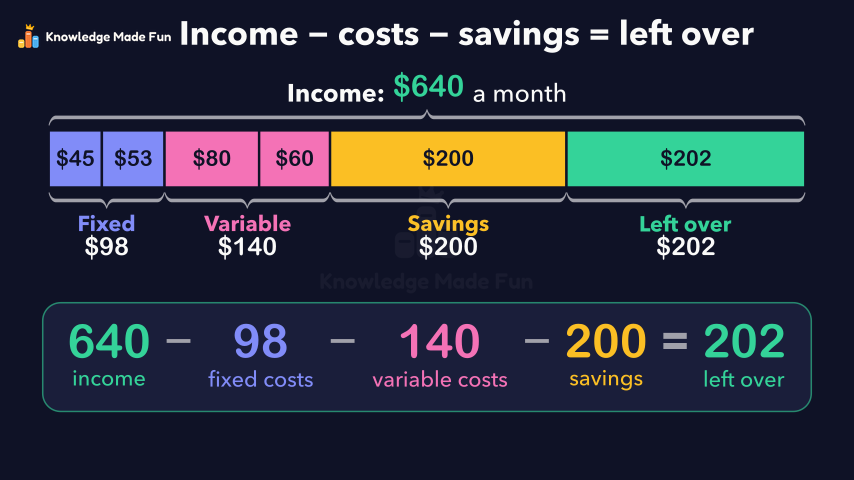
A $640 monthly income from a part-time job is shown as one bar split to scale. The parts are fixed costs (phone $45 and bus pass $53, total $98), variable costs (food out $80 and fun $60, total $140), a $200 savings goal and the $202 left over, with every sum worked out and checked (45 + 53 + 80 + 60 + 200 = 438, 640 − 438 = 202, 438 + 202 = 640). It warns against saving only what is left at the end of the month and ends on the one-line recap: income − costs − savings = left over.
Anyone can watch two lessons on the website without an account. Signing in is free, no payment and no card, and opens three a day; Plus has no limit.
Loading
In one sentence
The question this lesson answers
A part-time job pays you 640 dollars a month. How can you plan where all of it goes?
Money that comes in is called income. This whole bar is your income: 640 dollars a month.
Transcript
What the lesson says
A part-time job pays you 640 dollars a month. How can you plan where all of it goes?
Money that comes in is called income. This whole bar is your income: 640 dollars a month.
A budget is a plan for your income. It sets money aside for fixed costs, variable costs and savings.
Fixed costs stay the same every month. Your phone plan is 45 dollars and your bus pass is 53 dollars.
So the fixed costs are 45 plus 53, which is 98 dollars.
Variable costs can change from month to month. This month, you plan food out at 80 dollars and fun at 60 dollars.
So the variable costs are 80 plus 60, which is 140 dollars.
Savings is money you keep for later. Your goal is 200 dollars a month, so put it in the plan like a bill.
Now add up the total going out: 45 plus 53 plus 80 plus 60 plus 200 is 438 dollars.
Take that away from your income: 640 minus 438 leaves 202 dollars left over.
Check it: 438 plus 202 is 640, the whole income.
A common mistake is to save only whatever is left at the end of the month. By then, that money has often been spent.
Instead, set your savings aside at the start of the month, like a bill, and spend from the rest.
In one line: income minus costs minus savings is what is left over. Here, 640 minus 98 minus 140 minus 200 leaves 202 dollars.
Curriculum
Where this fits
- British Columbia, Grade 9
Mathematics, Financial literacy: financial literacy: simple budgets and transactionsBC9-MA-33
Previous: Simple Interest: I = PrtNext: Save First or Borrow? The True Cost of a $600 Bike
The outcomes and strands follow the British Columbia curriculum.
Keep going
 1 min 13 s
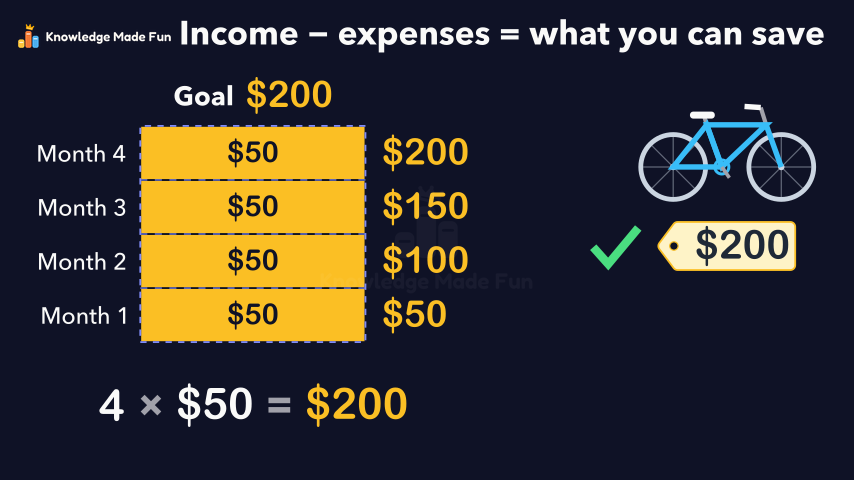
A Simple Budget: Income, Expenses and a Savings Goal
Grade 5 · 1 min 13 s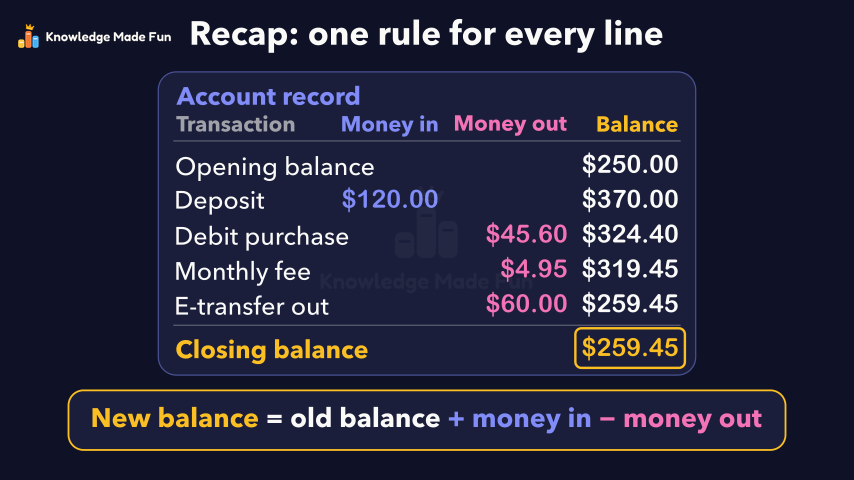 1 min 55 s
Bank Accounts: Deposits, Withdrawals, Fees and the Balance
Grade 9 · 1 min 55 s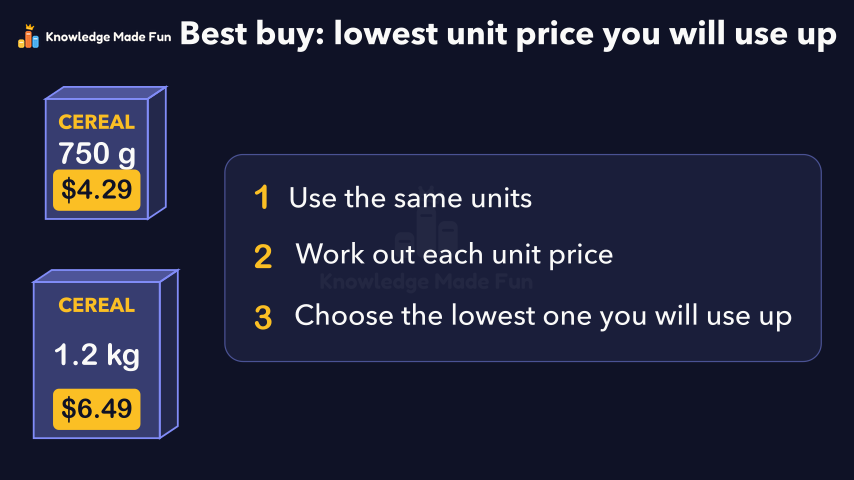 2 min 22 s
Best buy: comparing unit prices
Grade 8 · 2 min 22 s 1 min 3 s
Coins and What Each One Is Worth
Grade 1 · 1 min 3 s 1 min 9 s
Coins: Size, Colour and Pictures
Kindergarten · 1 min 9 s 2 min 7 s
Compound interest: earning interest on interest
Grade 11 · 2 min 7 s 1 min 12 s
Counting Bills and Coins to 100 Dollars
Grade 3 · 1 min 12 s 1 min 9 s
Counting Coins to 100 Cents
Grade 2 · 1 min 9 s
- All Grade 9 Mathematics lessons
- Try the graph paper, free for everyone, no account needed.
- Create a free account to watch three lessons a day, no payment and no card.