Lesson · Grade 9 · Mathematics
Bank Accounts: Deposits, Withdrawals, Fees and the Balance
- Grade 9
- Mathematics
- 1 min 55 s
- British Columbia
- BC9-MA-31
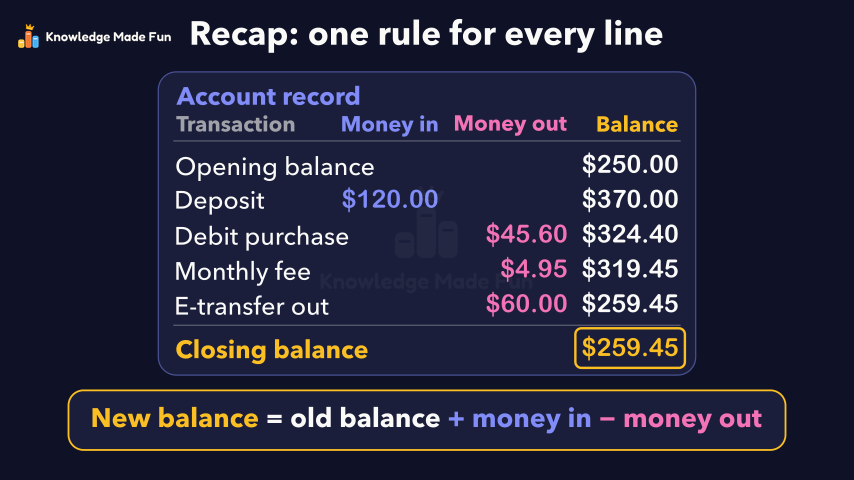
An account record starts with an opening balance of $250.00. A $120.00 deposit, a $45.60 debit purchase, a $4.95 monthly fee and a $60.00 e-transfer each get a line, and the panel works out the new balance each time ($370.00, $324.40, $319.45) until the closing balance of $259.45, which is then checked as $250 + $120 − $110.55. It then shows two common mistakes, forgetting the fee ($264.40, $4.95 too much) and adding a withdrawal, and ends on the rule for every line: new balance = old balance + money in − money out.
Anyone can watch two lessons on the website without an account. Signing in is free, no payment and no card, and opens three a day; Plus has no limit.
Loading
In one sentence
The question this lesson answers
An account starts the month with $250. Four transactions follow. How much is left at the end?
A transaction is money going in or out of the account. Each one gets a line in the account record.
Transcript
What the lesson says
An account starts the month with $250. Four transactions follow. How much is left at the end?
A transaction is money going in or out of the account. Each one gets a line in the account record.
The balance is the money in the account after each line. The first line is the opening balance.
First, a deposit of $120: money put into the account. Money in is added, giving $370.
Next, a debit purchase of $45.60. Paying by debit card is a withdrawal, money out, so subtract it: $324.40.
Then the bank charges a monthly fee of $4.95. A fee is money out too, leaving $319.45.
Last, a $60 e-transfer: money sent electronically to another account. Subtract it to get $259.45, the closing balance.
Check: $250 plus $120, minus the money out, $110.55, is $259.45. It matches.
A common mistake is forgetting the fee. That gives $264.40, which is $4.95 too much.
Another common mistake is adding a withdrawal. Money out is always subtracted, never added.
So on every line, the new balance is the old balance, plus money in, minus money out.
Curriculum
Where this fits
- British Columbia, Grade 9
Mathematics, Financial literacy: financial literacy: simple budgets and transactionsBC9-MA-31
The outcomes and strands follow the British Columbia curriculum.
Keep going
 2 min
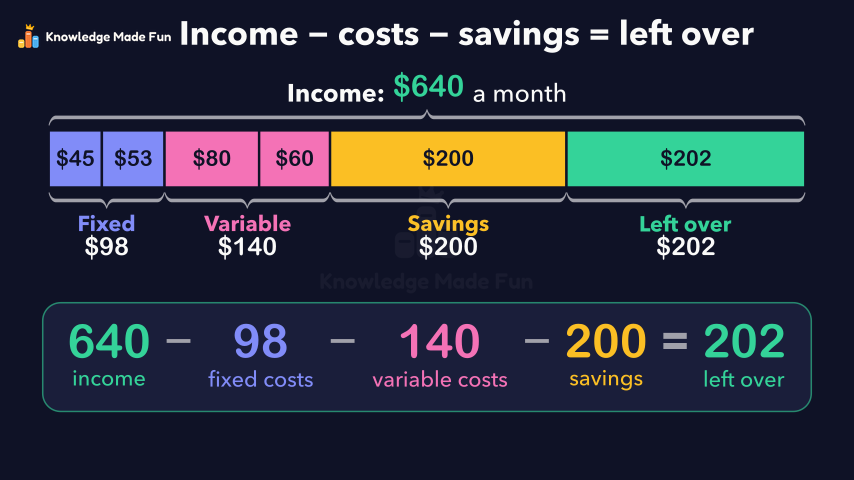
A Monthly Budget: Income, Fixed Costs and Variable Costs
Grade 9 · 2 min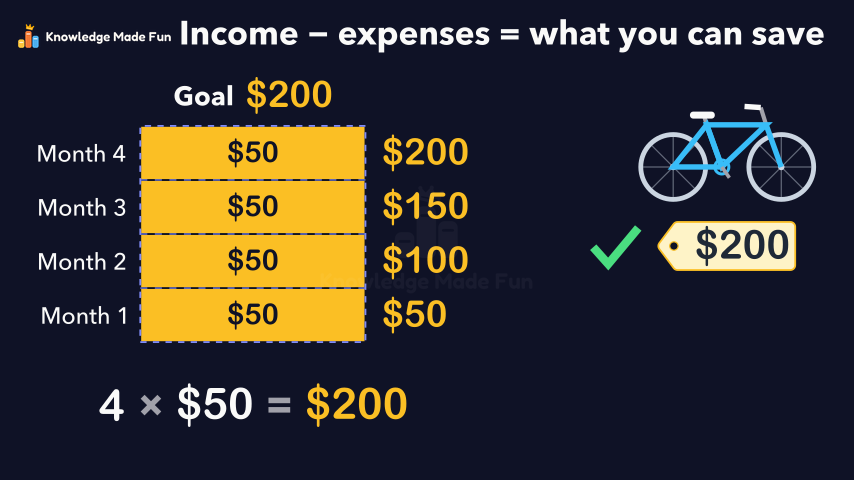 1 min 13 s
A Simple Budget: Income, Expenses and a Savings Goal
Grade 5 · 1 min 13 s 2 min 22 s
Best buy: comparing unit prices
Grade 8 · 2 min 22 s 1 min 3 s
Coins and What Each One Is Worth
Grade 1 · 1 min 3 s 1 min 9 s
Coins: Size, Colour and Pictures
Kindergarten · 1 min 9 s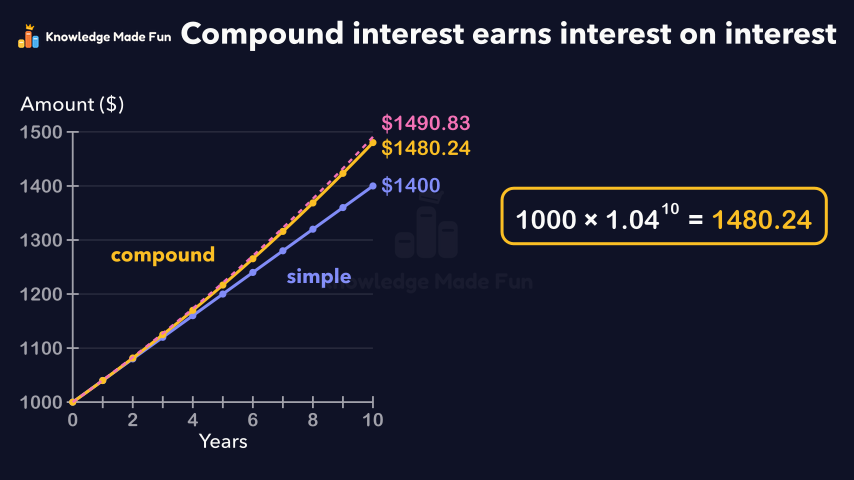 2 min 7 s
Compound interest: earning interest on interest
Grade 11 · 2 min 7 s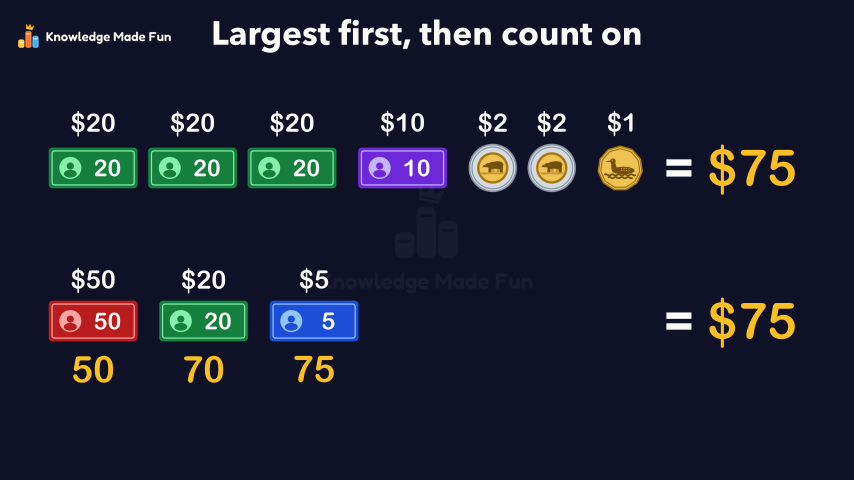 1 min 12 s
Counting Bills and Coins to 100 Dollars
Grade 3 · 1 min 12 s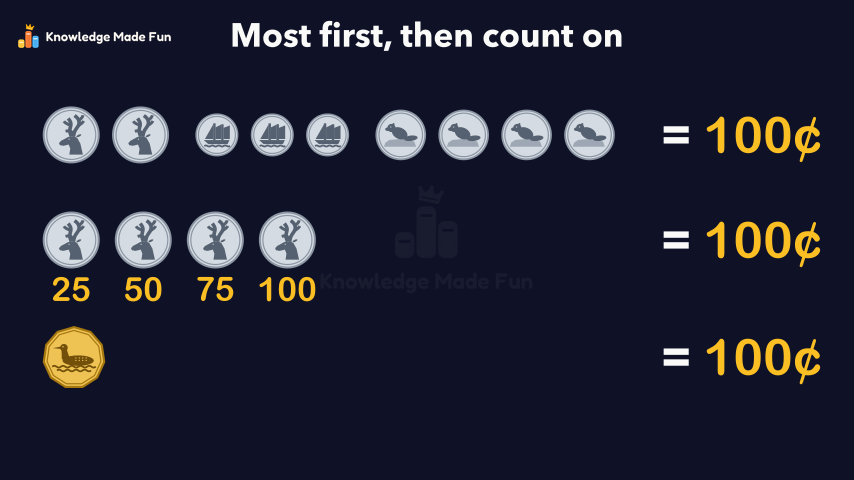 1 min 9 s
Counting Coins to 100 Cents
Grade 2 · 1 min 9 s
- All Grade 9 Mathematics lessons
- Try the graph paper, free for everyone, no account needed.
- Create a free account to watch three lessons a day, no payment and no card.