Lesson · Grade 11 · Foundations of Mathematics
Regular Payments: How a Loan Shrinks and Savings Grow
- Grade 11
- Foundations of Mathematics
- 2 min 20 s
- British Columbia
- BC11-MA-38
A $20 000 loan at 6% compounded monthly, with 60 payments of $386.66, is worked out in a spreadsheet month by month. The interest is paid first ($100.00 in month 1), so only $286.66 comes off the balance, not the whole payment, and a chart of all 60 payments shows the interest share shrinking to under $2 and about $3 200 of interest in total, with a 25-year mortgage following the same pattern. Running the same rule the other way, $200 deposited each month grows to a future value of $32 775.87 after 10 years from $24 000 put in, because interest earns interest.
Anyone can watch two lessons on the website without an account. Signing in is free, no payment and no card, and opens three a day; Plus has no limit.
Loading
In one sentence
The question this lesson answers
You borrow $20,000 at 6% a year, and repay 60 monthly payments of $386.66. Where does each one go?
Compounded monthly means interest is charged each month: 6% divided by 12, or 0.5%.
Transcript
What the lesson says
You borrow $20,000 at 6% a year, and repay 60 monthly payments of $386.66. Where does each one go?
Compounded monthly means interest is charged each month: 6% divided by 12, or 0.5%.
A common mistake is thinking the whole payment comes off the balance, the amount you still owe.
Interest is paid first: in month 1, 0.5% of $20,000 is $100.
Only the rest, $286.66, pays off principal, the money you borrowed.
So you still owe $19,713.34: $100 more than the mistake says.
Each month the balance is smaller, so less interest is charged and more comes off.
This table, each payment split into interest and principal, is called an amortization schedule.
Over the 60 payments, interest shrinks and principal grows. In the last one, under $2 is interest.
Altogether the 60 payments come to $23,199.60, so about $3,200 is interest.
A 25-year mortgage works the same way: at 6%, about 78% of its first payment is interest.
Savings work the other way: deposit $200 at the end of each month, at the same rate.
In month 2, the $200 earns $1, and the next $200 makes $401.
Then interest earns interest too. This is compound interest, so growth speeds up.
After 10 years, $24,000 of deposits grows to $32,775.87, the future value. The difference is interest.
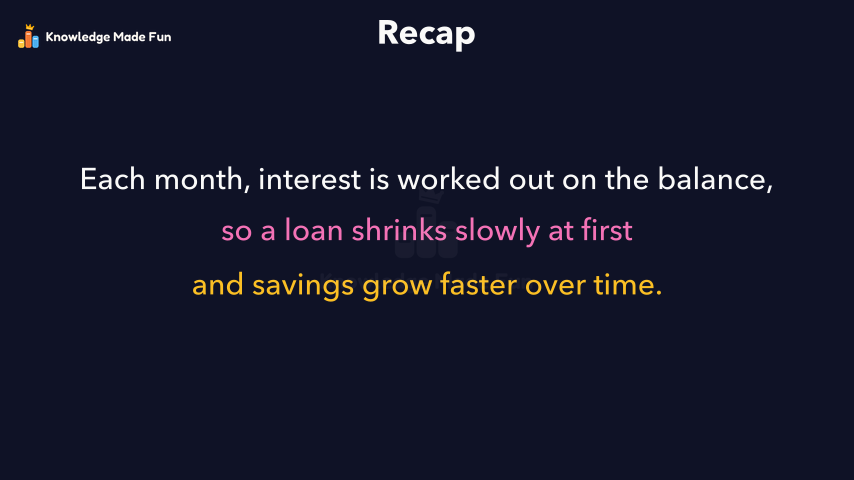
Recap: each month, interest is worked out on the balance, so a loan shrinks slowly at first and savings grow faster over time.
Curriculum
Where this fits
- British Columbia, Grade 11
Foundations of Mathematics 11, Financial literacy: financial literacy: compound interest, investments and loansBC11-MA-38
Previous: Compound interest: earning interest on interestNext: Lease or Buy a Car? Compare the Full Cost
- British Columbia, Grade 11
Pre Calculus 11, Financial literacy: financial literacy: compound interest, investments, loansBC11-MA-84
Previous: Compound interest: earning interest on interestNext: Lease or Buy a Car? Compare the Full Cost
- British Columbia, Grade 11
Workplace Mathematics 11, Financial literacy: financial literacy: personal investments, loans, and budgetingBC11-MA-88
Previous: Compound interest: earning interest on interestNext: Lease or Buy a Car? Compare the Full Cost
The outcomes and strands follow the British Columbia curriculum.
Keep going
 2 min
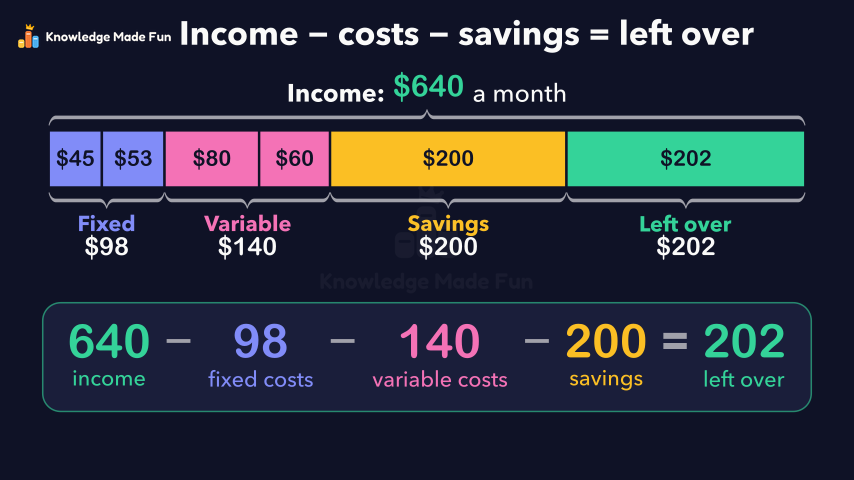
A Monthly Budget: Income, Fixed Costs and Variable Costs
Grade 9 · 2 min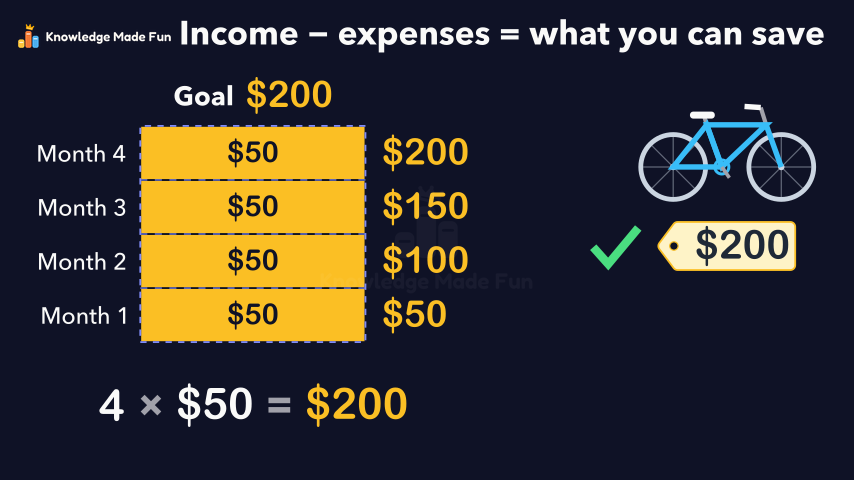 1 min 13 s
A Simple Budget: Income, Expenses and a Savings Goal
Grade 5 · 1 min 13 s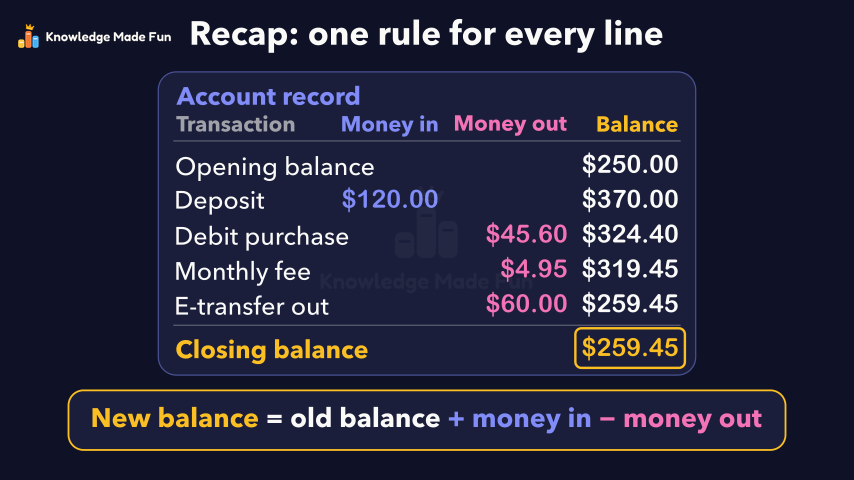 1 min 55 s
Bank Accounts: Deposits, Withdrawals, Fees and the Balance
Grade 9 · 1 min 55 s 2 min 22 s
Best buy: comparing unit prices
Grade 8 · 2 min 22 s 1 min 3 s
Coins and What Each One Is Worth
Grade 1 · 1 min 3 s 1 min 9 s
Coins: Size, Colour and Pictures
Kindergarten · 1 min 9 s 2 min 7 s
Compound interest: earning interest on interest
Grade 11 · 2 min 7 s 1 min 12 s
Counting Bills and Coins to 100 Dollars
Grade 3 · 1 min 12 s
- All Grade 11 Foundations of Mathematics lessons
- Create a free account to watch three lessons a day, no payment and no card.