Lesson · Grade 11 · Foundations of Mathematics
The Parts of a Parabola: Vertex, Axis of Symmetry and Intercepts
- Grade 11
- Foundations of Mathematics
- 2 min 8 s
- British Columbia
- BC11-MA-27
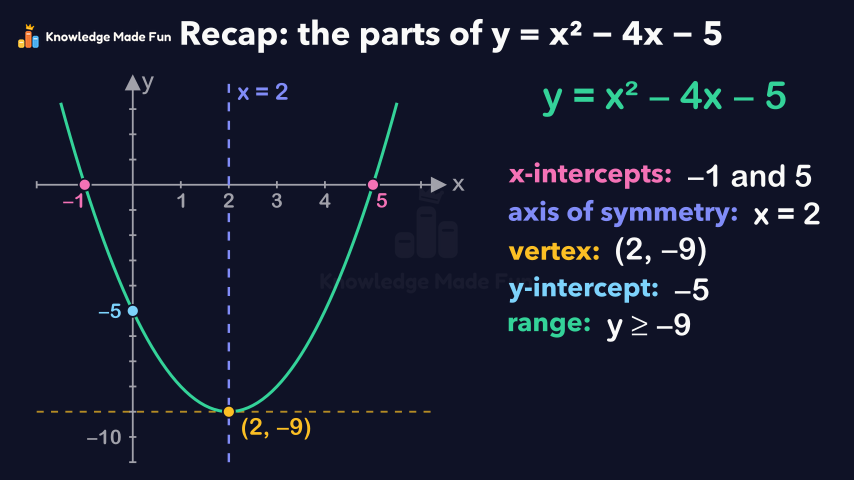
Using the graph of y = x² − 4x − 5, the video reads off and checks each part of a parabola: the x-intercepts −1 and 5 (the roots of x² − 4x − 5 = 0), the axis of symmetry x = 2 halfway between them, the vertex (2, −9), the y-intercept −5 and the range y ≥ −9. It folds the graph along x = 2 to show the symmetry, warns against mixing up the y-intercept with the vertex or giving the axis as a point, and ends on a one-line recap of every part.
Anyone can watch two lessons on the website without an account. Signing in is free, no payment and no card, and opens three a day; Plus has no limit.
Loading
In one sentence
The question this lesson answers
A quadratic function like y equals x squared minus 4x minus 5 has a U-shaped graph called a parabola. What are its parts?
The x-intercepts are where the graph crosses the x-axis: x equals minus 1 and x equals 5.
Transcript
What the lesson says
A quadratic function like y equals x squared minus 4x minus 5 has a U-shaped graph called a parabola. What are its parts?
The x-intercepts are where the graph crosses the x-axis: x equals minus 1 and x equals 5.
There y is 0, so they are the roots, or solutions, of x squared minus 4x minus 5 equals 0.
Factoring gives x plus 1 times x minus 5 equals 0, so x is minus 1 or 5.
The axis of symmetry is the vertical line halfway between the x-intercepts: minus 1 plus 5 is 4, and 4 divided by 2 is 2, so it is the line x equals 2.
Fold the graph along this line and the two halves match exactly.
The vertex is the turning point. It lies on the axis of symmetry, so its x-coordinate is 2.
Substitute x equals 2: 2 squared minus 4 times 2 minus 5 is 4 minus 8 minus 5, which is minus 9.
The y-intercept is where the graph crosses the y-axis, at x equals 0. There y is 0 minus 0 minus 5, which is minus 5.
The parabola opens upward, so the vertex is its lowest point. The range, the set of all y-values, is y greater than or equal to minus 9.
Two common mistakes: the y-intercept, 0, minus 5, is not the vertex, 2, minus 9. And the axis is the line x equals 2, not a point.
To sum up: x-intercepts minus 1 and 5, axis x equals 2, vertex 2, minus 9, y-intercept minus 5, and range y at least minus 9.
Curriculum
Where this fits
- British Columbia, Grade 11
Foundations of Mathematics 11, Graphical analysis: quadratic functionsBC11-MA-27
Previous: Graphing a Linear Inequality: Boundary Line and Shaded SideNext: Opening Up or Down: Maximum, Minimum and End Behaviour
- British Columbia, Grade 11
Pre Calculus 11, Quadratics: quadratic functions and equationsBC11-MA-73
The outcomes and strands follow the British Columbia curriculum.
Keep going
 2 min 10 s
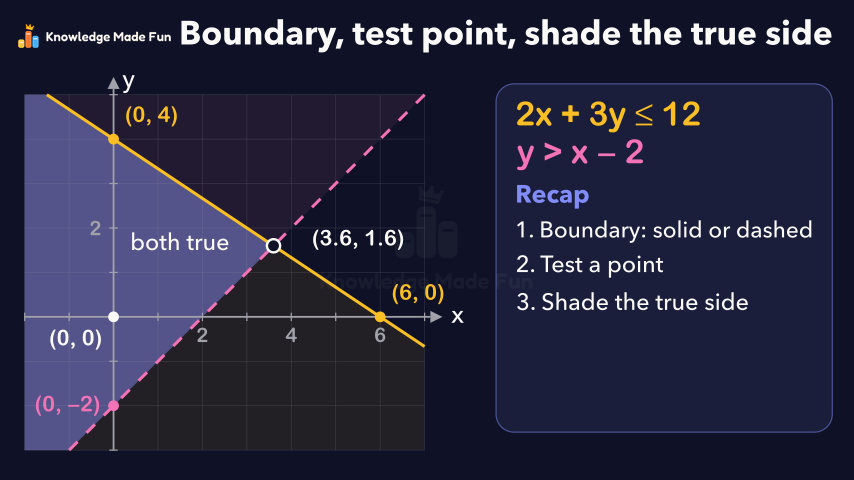
Graphing a Linear Inequality: Boundary Line and Shaded Side
Grade 11 · 2 min 10 s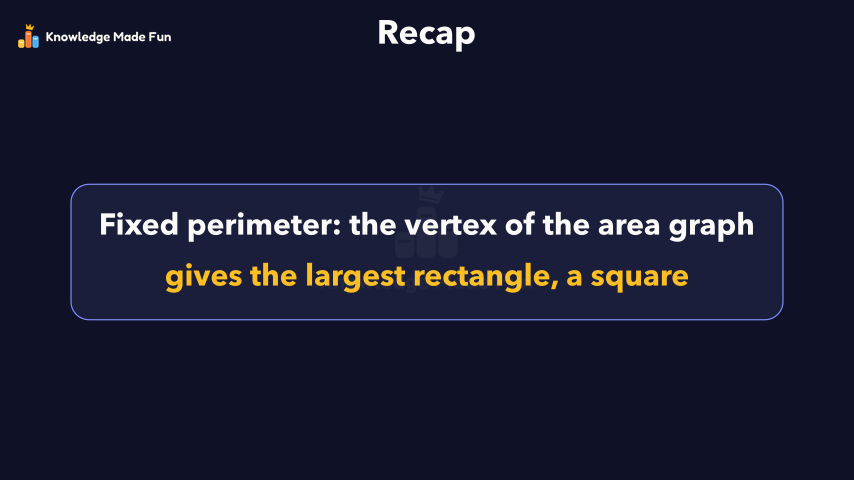 2 min 15 s
Largest Area for a Fixed Perimeter
Grade 11 · 2 min 15 s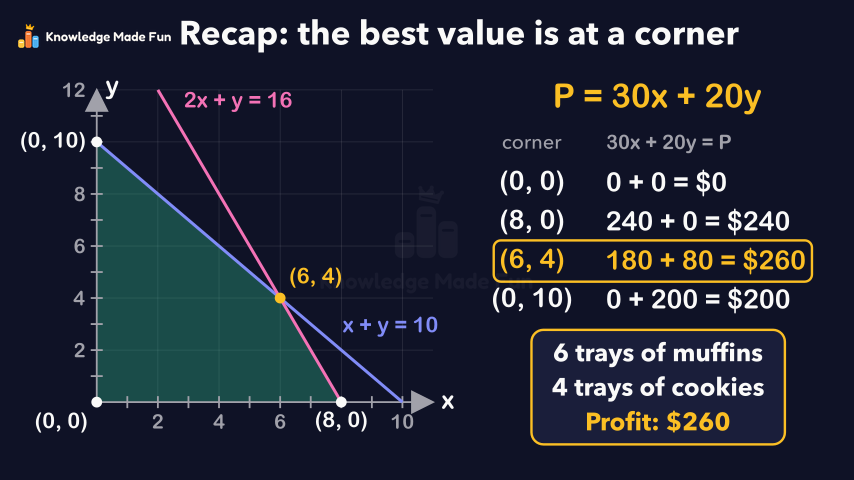 2 min 7 s
Linear programming: the best answer is at a corner
Grade 11 · 2 min 7 s 2 min 2 s
Maximizing the volume of an open box
Grade 11 · 2 min 2 s 2 min 10 s
Opening Up or Down: Maximum, Minimum and End Behaviour
Grade 11 · 2 min 10 s 2 min 11 s
Adding and Subtracting Rational Expressions
Grade 11 · 2 min 11 s 2 min 3 s
Angles in Standard Position and Reference Angles
Grade 11 · 2 min 3 s 1 min 58 s
Angles made by parallel lines and a transversal
Grade 11 · 1 min 58 s
- All Grade 11 Foundations of Mathematics lessons
- Create a free account to watch three lessons a day, no payment and no card.