Lesson · Grade 11 · Foundations of Mathematics
Graphing a Linear Inequality: Boundary Line and Shaded Side
- Grade 11
- Foundations of Mathematics
- 2 min 10 s
- British Columbia
- BC11-MA-26
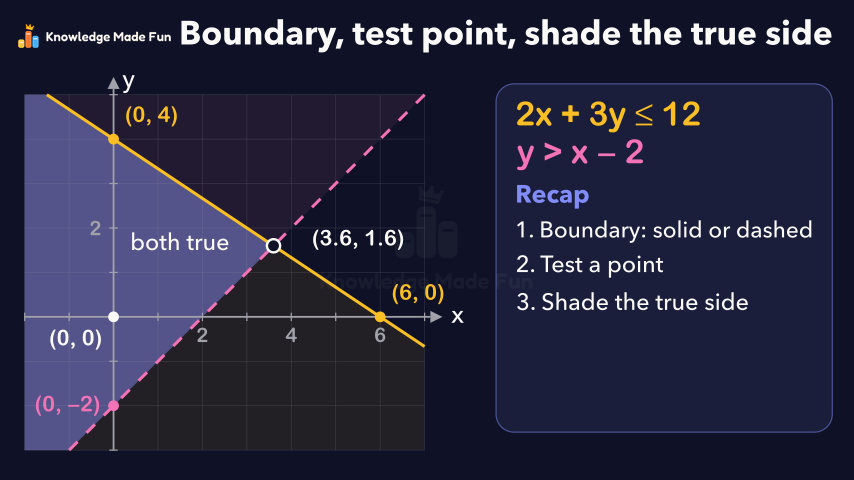
The video graphs 2x + 3y ≤ 12 by finding its intercepts (6, 0) and (0, 4) and its slope of −2/3. It draws a solid boundary line because of "or equal to", then tests (0, 0) to find which side to shade. It then adds y > x − 2 with a dashed line and shows that the solutions of both inequalities lie where the shadings overlap, with a corner at (3.6, 1.6) that is not a solution itself, and ends with a one-line recap: draw the boundary, test a point, shade the true side.
Anyone can watch two lessons on the website without an account. Signing in is free, no payment and no card, and opens three a day; Plus has no limit.
Loading
In one sentence
The question this lesson answers
How do we graph 2x plus 3y is less than or equal to 12?
Its solutions are all the points that make it true: a whole region.
Transcript
What the lesson says
How do we graph 2x plus 3y is less than or equal to 12?
Its solutions are all the points that make it true: a whole region.
Step 1: the boundary line, where both sides are equal.
Intercepts are where the line crosses the axes. Set y to 0: 2x is 12, so x is 6. Set x to 0: 3y is 12, so y is 4.
It runs 6 and drops 4, so its slope, rise over run, is negative 2 thirds.
The or equal to part means points on the line count, so draw it solid.
Step 2: test a point off the line, like 0, 0: 2 times 0 plus 3 times 0 is 0.
0 is less than or equal to 12, true, so shade the origin's side.
Now add y is greater than x minus 2. Its boundary has y-intercept negative 2 and slope 1.
Greater than leaves out the line itself, so draw it dashed.
Test 0, 0: 0 is greater than 0 minus 2, true, so shade the origin's side.
Together they form a system: both are true only where the shadings overlap.
The corner is where the lines cross. Substitute x minus 2 for y in the first equation.
Then 5x equals 18, so x is 3.6 and y is 1.6.
Check in the first equation: 7.2 plus 4.8 is 12.
It sits on the dashed line, so it is not a solution: an open dot.
A common mistake is shading the wrong side. Always test a point, even with software.
To recap: draw the boundary, solid or dashed, test a point, and shade the true side.
Curriculum
Where this fits
- British Columbia, Grade 11
Foundations of Mathematics 11, Graphical analysis: linear inequalitiesBC11-MA-26
Next: The Parts of a Parabola: Vertex, Axis of Symmetry and Intercepts
The outcomes and strands follow the British Columbia curriculum.
Keep going
 2 min 15 s
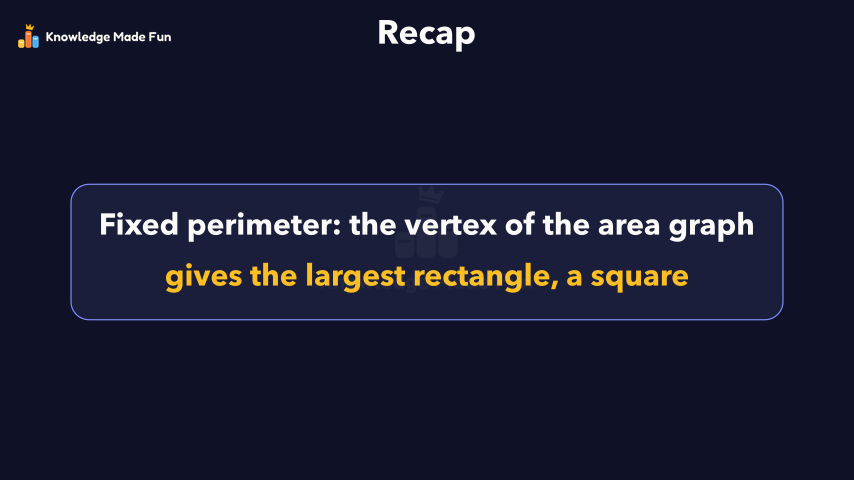
Largest Area for a Fixed Perimeter
Grade 11 · 2 min 15 s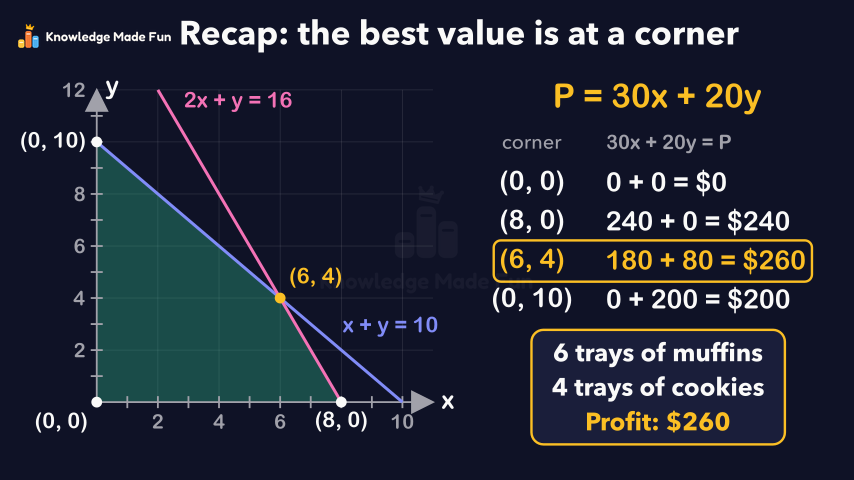 2 min 7 s
Linear programming: the best answer is at a corner
Grade 11 · 2 min 7 s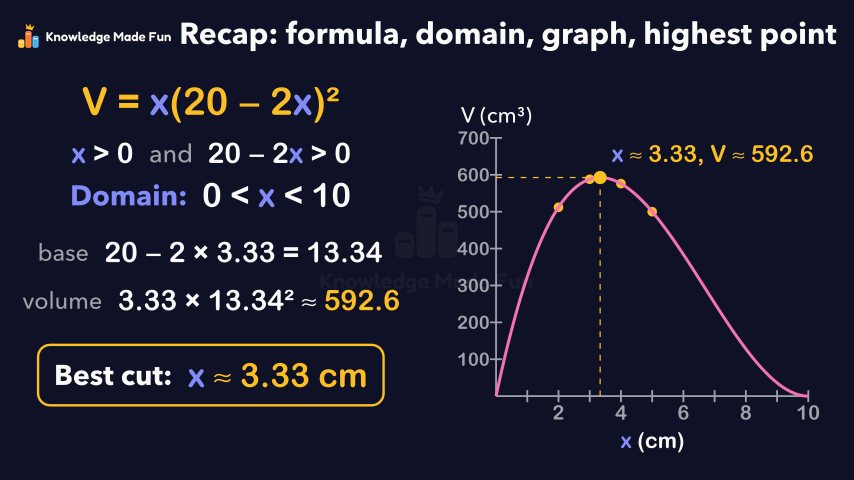 2 min 2 s
Maximizing the volume of an open box
Grade 11 · 2 min 2 s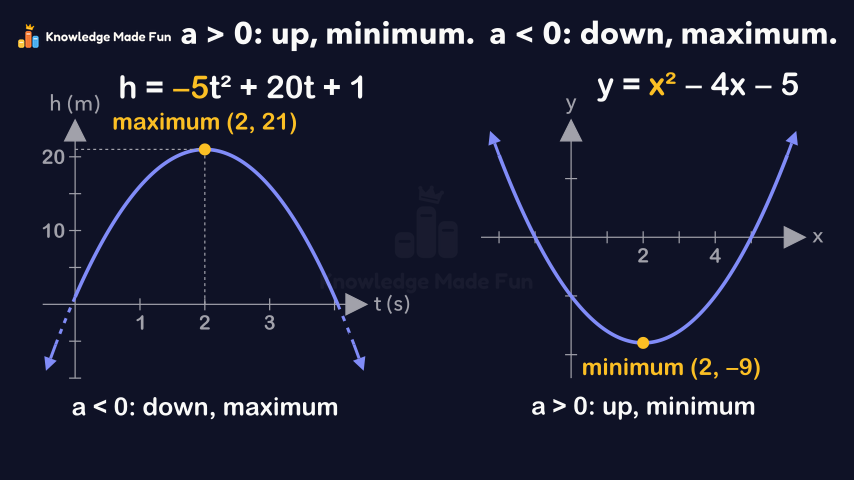 2 min 10 s
Opening Up or Down: Maximum, Minimum and End Behaviour
Grade 11 · 2 min 10 s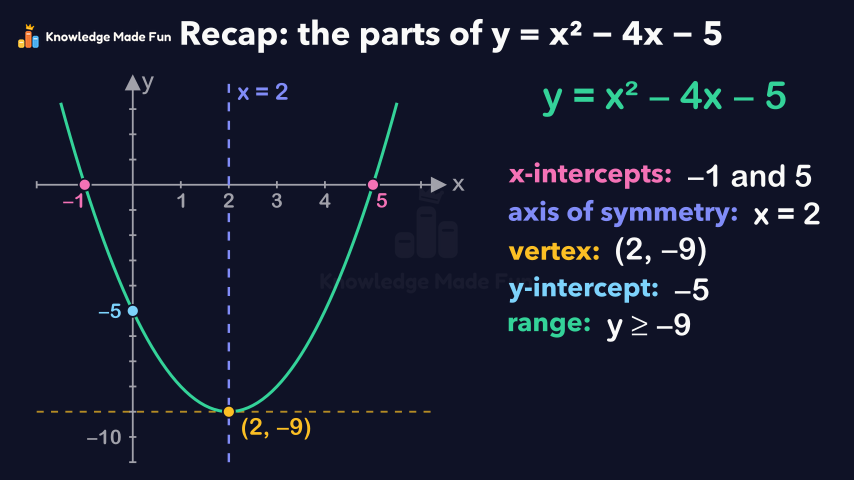 2 min 8 s
The Parts of a Parabola: Vertex, Axis of Symmetry and Intercepts
Grade 11 · 2 min 8 s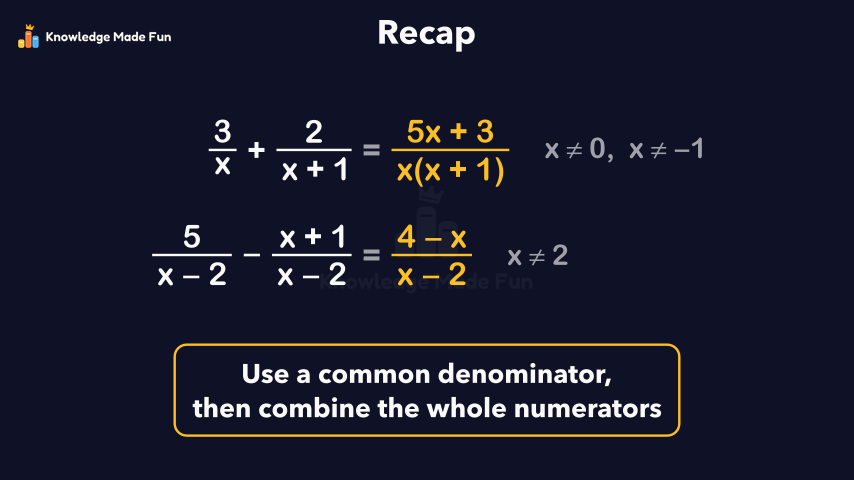 2 min 11 s
Adding and Subtracting Rational Expressions
Grade 11 · 2 min 11 s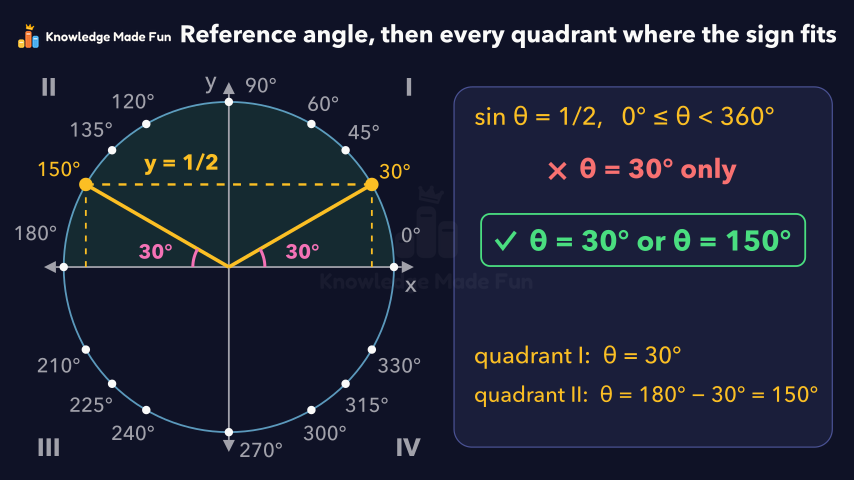 2 min 3 s
Angles in Standard Position and Reference Angles
Grade 11 · 2 min 3 s 1 min 58 s
Angles made by parallel lines and a transversal
Grade 11 · 1 min 58 s
- All Grade 11 Foundations of Mathematics lessons
- Create a free account to watch three lessons a day, no payment and no card.