Lesson · Grade 11 · Foundations of Mathematics
Opening Up or Down: Maximum, Minimum and End Behaviour
- Grade 11
- Foundations of Mathematics
- 2 min 10 s
- British Columbia
- BC11-MA-28
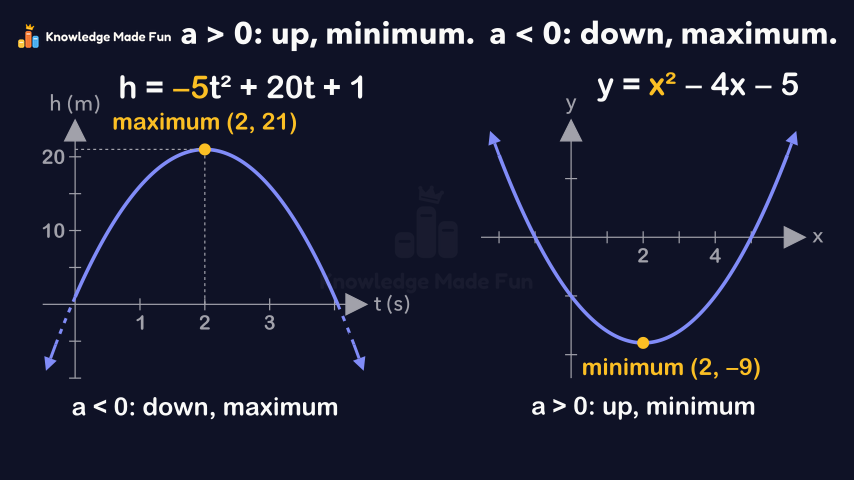
The sign of the leading coefficient a decides how a parabola opens: a ball's height h = −5t² + 20t + 1 opens down, so its vertex (2, 21) is a maximum height of 21 m after 2 s, and both ends of the graph head down. By comparison, y = x² − 4x − 5 opens up with a minimum of −9 and both ends heading up, and the video warns against calling the vertex of a downward parabola a minimum.
Anyone can watch two lessons on the website without an account. Signing in is free, no payment and no card, and opens three a day; Plus has no limit.
Loading
In one sentence
The question this lesson answers
A ball's height in metres after t seconds is h equals negative 5 t squared plus 20 t plus 1. Does its graph have a maximum or a minimum?
This is a quadratic function, so its graph is a parabola, a curve that opens up or down.
Transcript
What the lesson says
A ball's height in metres after t seconds is h equals negative 5 t squared plus 20 t plus 1. Does its graph have a maximum or a minimum?
This is a quadratic function, so its graph is a parabola, a curve that opens up or down.
The number in front of t squared is the leading coefficient, a. If a is positive, the parabola opens up. If negative, it opens down.
The turning point is the vertex. Opening up, it is the lowest point, a minimum. Opening down, it is the highest, a maximum.
Here a is negative 5, so the ball's graph opens down, and its vertex is a maximum.
The vertex is at t equals negative b divided by 2 a, which is negative 20 divided by negative 10, or 2.
Put in t equals 2: negative 5 times 4 is negative 20, plus 40, plus 1, which makes 21.
So the vertex is at 2, 21: the ball reaches a maximum height of 21 metres after 2 seconds.
End behaviour is where a graph heads at the far left and far right. Beyond the ball's flight, both ends head down.
Compare y equals x squared minus 4 x minus 5. Here a is 1, which is positive, so it opens up, and both ends head up.
The vertex is at x equals 4 divided by 2, or 2. Then y is 4 minus 8 minus 5, so the minimum is negative 9.
A common mistake is to call the vertex of a downward parabola a minimum. Every other point is lower, so it is a maximum.
So positive a opens up with a minimum, negative a opens down with a maximum, and both ends head the same way.
Curriculum
Where this fits
- British Columbia, Grade 11
Foundations of Mathematics 11, Graphical analysis: quadratic functionsBC11-MA-28
Previous: The Parts of a Parabola: Vertex, Axis of Symmetry and InterceptsNext: Solving a System by Graphing: The Point Both Lines Share
The outcomes and strands follow the British Columbia curriculum.
Keep going
 2 min 10 s
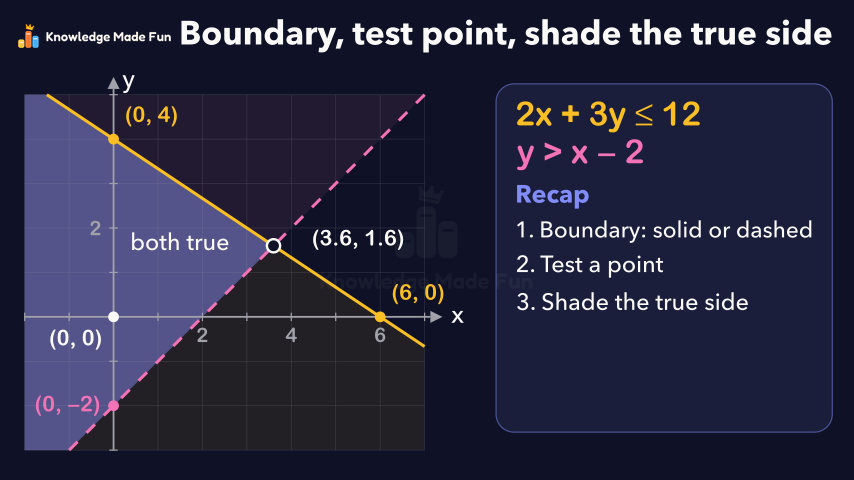
Graphing a Linear Inequality: Boundary Line and Shaded Side
Grade 11 · 2 min 10 s 2 min 15 s
Largest Area for a Fixed Perimeter
Grade 11 · 2 min 15 s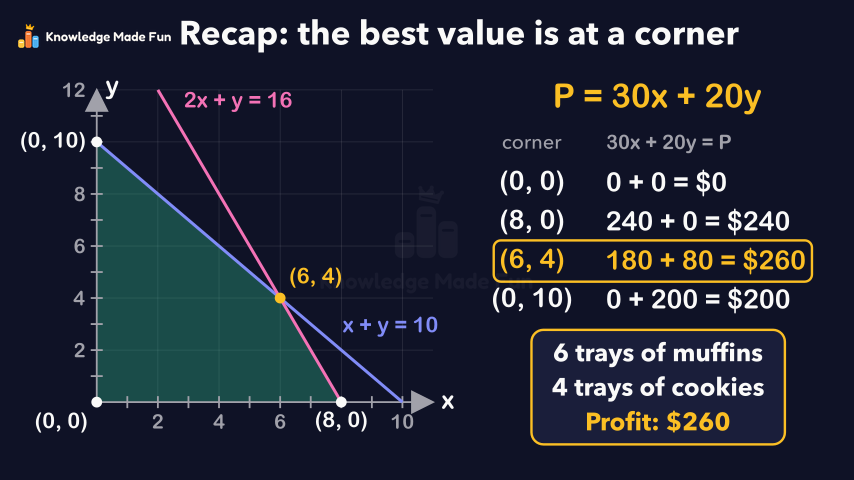 2 min 7 s
Linear programming: the best answer is at a corner
Grade 11 · 2 min 7 s 2 min 2 s
Maximizing the volume of an open box
Grade 11 · 2 min 2 s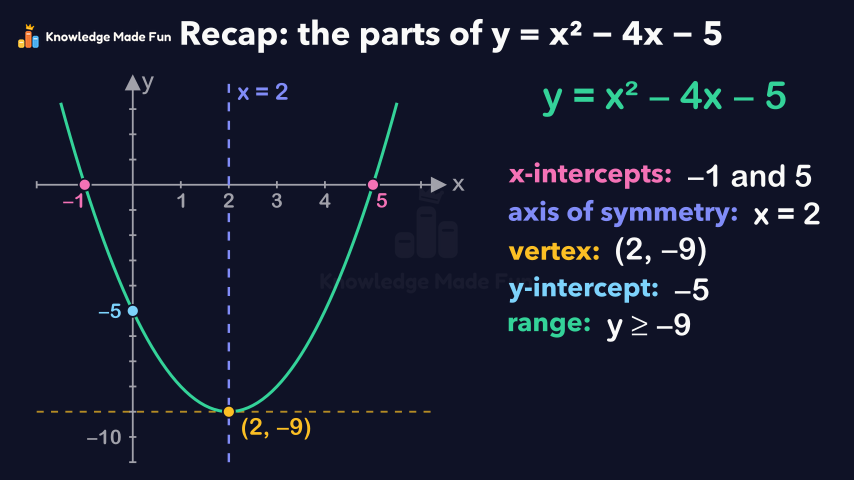 2 min 8 s
The Parts of a Parabola: Vertex, Axis of Symmetry and Intercepts
Grade 11 · 2 min 8 s 2 min 11 s
Adding and Subtracting Rational Expressions
Grade 11 · 2 min 11 s 2 min 3 s
Angles in Standard Position and Reference Angles
Grade 11 · 2 min 3 s 1 min 58 s
Angles made by parallel lines and a transversal
Grade 11 · 1 min 58 s
- All Grade 11 Foundations of Mathematics lessons
- Create a free account to watch three lessons a day, no payment and no card.