Lesson · Grade 10 · Foundations of Mathematics and Pre Calculus
Types of income: wage, salary, commission, tips and self-employment
- Grade 10
- Foundations of Mathematics and Pre Calculus
- 2 min 4 s
- British Columbia
- BC10-MA-40
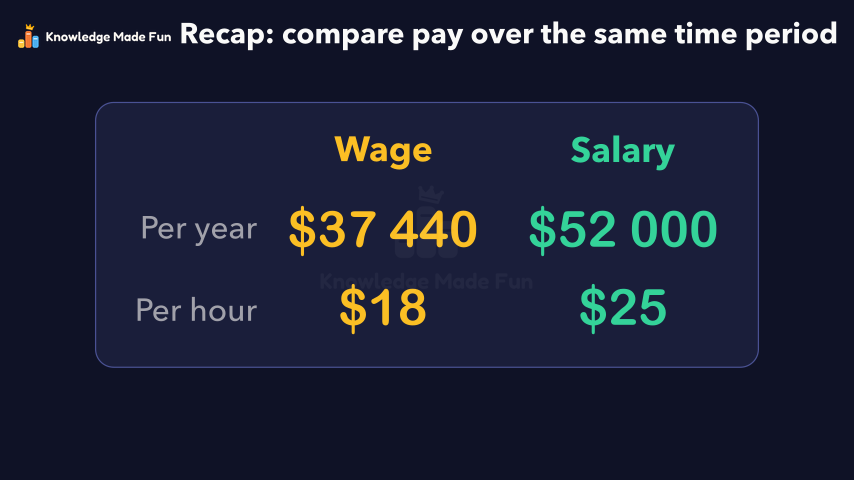
Five workers show five ways to earn income: a wage of $18 an hour, a salary of $52 000 a year, commission of 5% of sales, tips from customers, and self-employment at $80 a job with the worker keeping their own records. The video compares how steady each one is, then avoids the common mistake of comparing an hour with a year: $18 × 40 hours × 52 weeks = $37 440 a year, checked per hour as $52 000 ÷ 52 ÷ 40 = $25, so the salary pays more, and it ends on the recap to compare pay over the same time period.
Concept: Types of income: wages, salary, commission, tips and self-employment
Anyone can watch two lessons on the website without an account. Signing in is free, no payment and no card, and opens three a day; Plus has no limit.
Loading
In one sentence
The question this lesson answers
Income is money you receive. These five workers are each paid in a different way.
A wage is pay for each hour worked, here 18 dollars an hour.
Transcript
What the lesson says
Income is money you receive. These five workers are each paid in a different way.
A wage is pay for each hour worked, here 18 dollars an hour.
A salary is a fixed amount for a year, paid in equal parts, here 52,000 dollars a year.
Commission is usually a percent of sales: 5 percent of 20,000 dollars in sales is 1000 dollars.
Tips are extra money from customers, often on top of an hourly wage.
A self-employed person charges a fee for each job, here 80 dollars, and keeps their own records.
How steady is each one? A salary pays the same amount every payday. A wage changes with the hours worked.
Commission changes with sales, tips with customers, and self-employment with the number of jobs.
So which pays more: 18 dollars an hour or 52,000 dollars a year?
A common mistake is comparing 18 with 52,000. An hour and a year are different time periods.
Turn the wage into a year. At 40 hours a week, 18 times 40 is 720 dollars a week.
With 52 weeks in a year, 720 times 52 is 37,440 dollars a year.
Now both are per year: 52,000 minus 37,440 is 14,560 dollars more for the salary.
Check it per hour: 52,000 divided by 52, then by 40, is 25 dollars an hour, more than 18.
These are all gross pay: pay before deductions such as income tax.
Recap: compare pay over the same time period, year with year or hour with hour.
Curriculum
Where this fits
- British Columbia, Grade 10
Foundations of Mathematics and Pre Calculus 10, Financial literacy: financial literacy: gross and net payBC10-MA-40
- British Columbia, Grade 10
Workplace Mathematics 10, Financial literacy: financial literacy: gross and net payBC10-MA-62
The outcomes and strands follow the British Columbia curriculum.
Keep going
 2 min
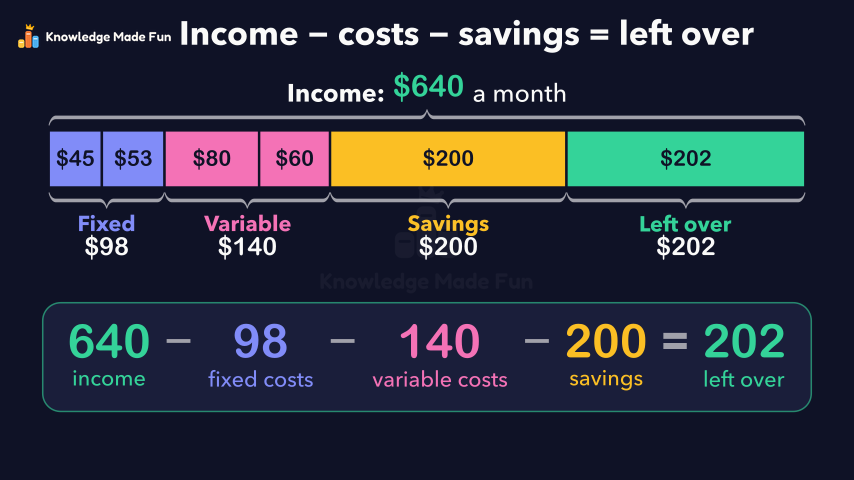
A Monthly Budget: Income, Fixed Costs and Variable Costs
Grade 9 · 2 min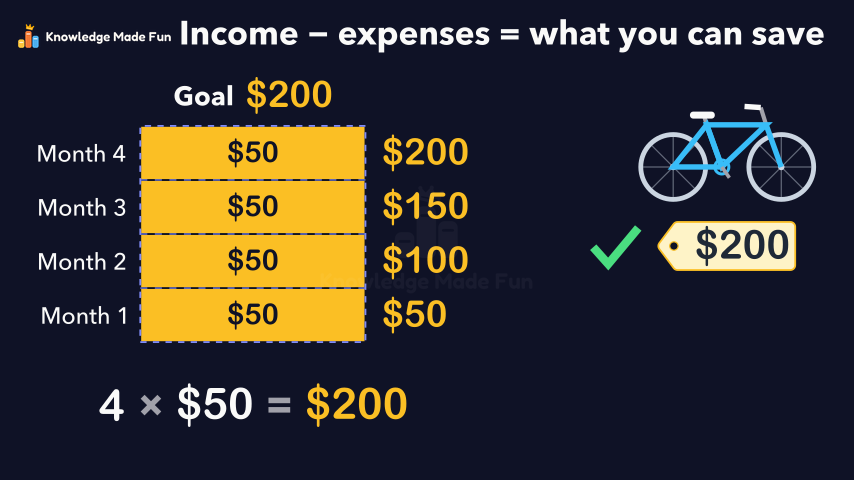 1 min 13 s
A Simple Budget: Income, Expenses and a Savings Goal
Grade 5 · 1 min 13 s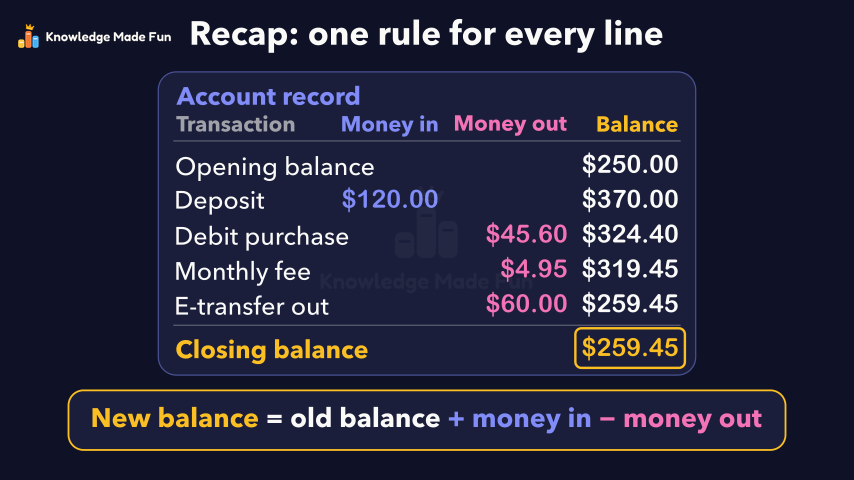 1 min 55 s
Bank Accounts: Deposits, Withdrawals, Fees and the Balance
Grade 9 · 1 min 55 s 2 min 22 s
Best buy: comparing unit prices
Grade 8 · 2 min 22 s 1 min 3 s
Coins and What Each One Is Worth
Grade 1 · 1 min 3 s 1 min 9 s
Coins: Size, Colour and Pictures
Kindergarten · 1 min 9 s 2 min 7 s
Compound interest: earning interest on interest
Grade 11 · 2 min 7 s 1 min 12 s
Counting Bills and Coins to 100 Dollars
Grade 3 · 1 min 12 s
- All Grade 10 Foundations of Mathematics and Pre Calculus lessons
- Create a free account to watch three lessons a day, no payment and no card.