Lesson · Grade 10 · Foundations of Mathematics and Pre Calculus
Gross Pay: Hours, Overtime and Commission
- Grade 10
- Foundations of Mathematics and Pre Calculus
- 2 min 41 s
- British Columbia
- BC10-MA-41
A worker paid $18.50 an hour works 46 hours, and the video splits them into 40 regular hours and 6 overtime hours at time and a half. It finds a gross pay of $906.50, checks it another way and shows why paying all 46 hours at the higher rate is wrong. It then works out a $500 base salary plus 4% commission on $12 000 of sales to get $980, and ends with a one-line recap of what gross pay means.
Anyone can watch two lessons on the website without an account. Signing in is free, no payment and no card, and opens three a day; Plus has no limit.
Loading
In one sentence
The question this lesson answers
A worker earns $18.50 an hour and works 46 hours this week. What is their gross pay?
Gross pay is your total pay before deductions, such as taxes. Net pay is what is left after them.
Transcript
What the lesson says
A worker earns $18.50 an hour and works 46 hours this week. What is their gross pay?
Gross pay is your total pay before deductions, such as taxes. Net pay is what is left after them.
Here, hours past 40 in a week are overtime, paid at time and a half: 1.5 times the regular rate.
Overtime rules depend on the place and the job.
So split the 46 hours into 40 regular hours and 6 overtime hours.
Regular pay is 40 times $18.50, or $740.
The overtime rate is 1.5 times $18.50, or $27.75 an hour.
Overtime pay is 6 times $27.75, or $166.50.
Add them: $740 plus $166.50 gives a gross pay of $906.50.
Check another way: all 46 hours at $18.50 is $851. The extra half rate, $9.25, for 6 hours adds $55.50. Together, $906.50.
A common mistake is paying all 46 hours at time and a half: $1276.50, which is too much. Only the 6 overtime hours earn time and a half.
Some jobs pay a base salary, a fixed amount, plus commission, usually a percentage of sales.
This week, a salesperson has a $500 base salary, plus 4% commission on $12,000 of sales.
4% of $12,000 is 0.04 times $12,000, which is $480.
Check: 1% is $12,000 divided by 100, or $120, so 4% is 4 times $120, or $480.
Add the base salary: $500 plus $480 gives a gross pay of $980.
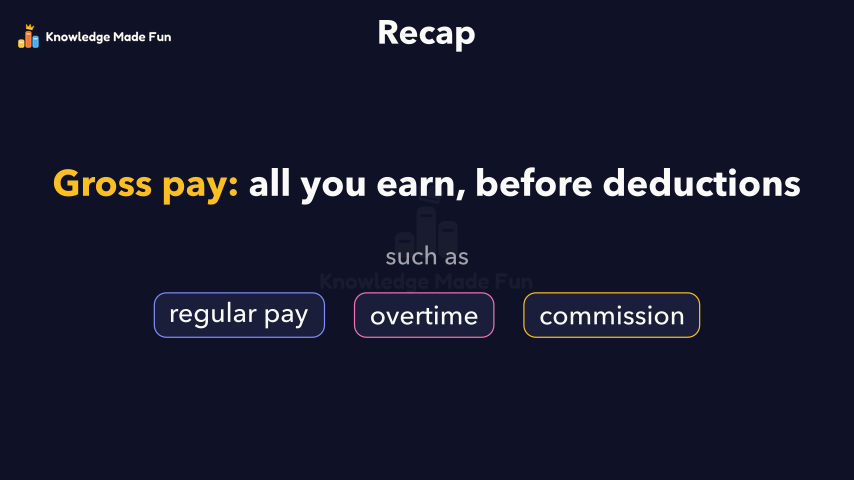
Gross pay is all you earn, such as regular pay, overtime and commission, before deductions.
Curriculum
Where this fits
- British Columbia, Grade 10
Foundations of Mathematics and Pre Calculus 10, Financial literacy: financial literacy: gross and net payBC10-MA-41
Previous: Types of income: wage, salary, commission, tips and self-employment
- British Columbia, Grade 10
Workplace Mathematics 10, Financial literacy: financial literacy: gross and net payBC10-MA-63
Previous: Types of income: wage, salary, commission, tips and self-employment
The outcomes and strands follow the British Columbia curriculum.
Keep going
 2 min
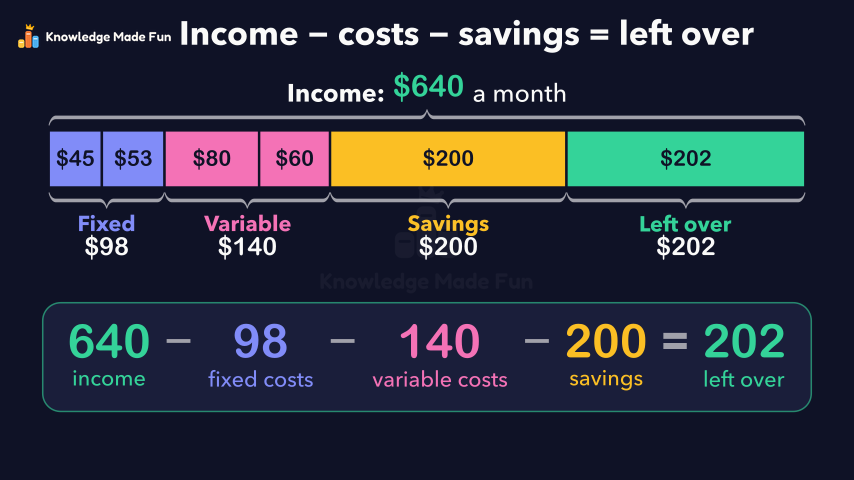
A Monthly Budget: Income, Fixed Costs and Variable Costs
Grade 9 · 2 min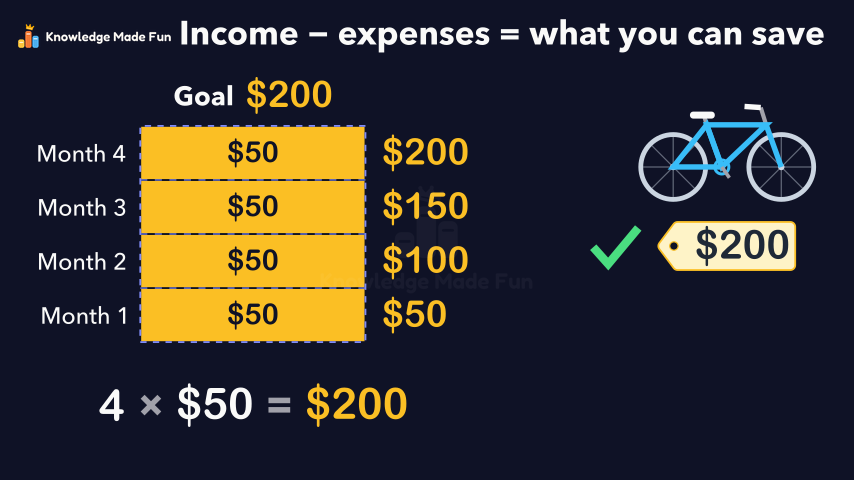 1 min 13 s
A Simple Budget: Income, Expenses and a Savings Goal
Grade 5 · 1 min 13 s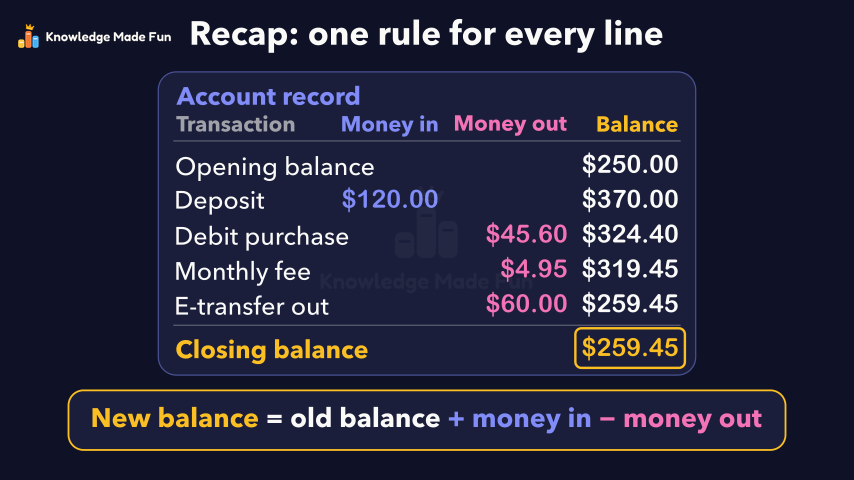 1 min 55 s
Bank Accounts: Deposits, Withdrawals, Fees and the Balance
Grade 9 · 1 min 55 s 2 min 22 s
Best buy: comparing unit prices
Grade 8 · 2 min 22 s 1 min 3 s
Coins and What Each One Is Worth
Grade 1 · 1 min 3 s 1 min 9 s
Coins: Size, Colour and Pictures
Kindergarten · 1 min 9 s 2 min 7 s
Compound interest: earning interest on interest
Grade 11 · 2 min 7 s 1 min 12 s
Counting Bills and Coins to 100 Dollars
Grade 3 · 1 min 12 s
- All Grade 10 Foundations of Mathematics and Pre Calculus lessons
- Create a free account to watch three lessons a day, no payment and no card.