Lesson · Grade 8 · Mathematics
Sharing an Amount in a Ratio
- Grade 8
- Mathematics
- 2 min 15 s
- British Columbia
- BC8-MA-12
The video shares $60 in the ratio 2 : 3 on a bar model, then cuts a 105 cm string in the three-part ratio 3 : 5 : 7 the same way: add the parts, find one part, then multiply. Each answer is checked against the whole, and the video shows why dividing by the number of pieces instead of the number of parts gives the wrong answer.
Concept: Sharing an amount in a ratio, including three-part ratios
Anyone can watch two lessons on the website without an account. Signing in is free, no payment and no card, and opens three a day; Plus has no limit.
Loading
In one sentence
The question this lesson answers
How do you share 60 dollars in the ratio 2 to 3?
A ratio compares amounts. 2 to 3 means Ava gets 2 parts for every 3 parts Ben gets, and every part is the same size.
Transcript
What the lesson says
How do you share 60 dollars in the ratio 2 to 3?
A ratio compares amounts. 2 to 3 means Ava gets 2 parts for every 3 parts Ben gets, and every part is the same size.
First, add the parts of the ratio. 2 plus 3 makes 5 parts in total.
Next, find one part. Divide the amount by the total number of parts: 60 dollars divided by 5 is 12 dollars.
Then multiply. Ava gets 2 times 12, which is 24 dollars. Ben gets 3 times 12, which is 36 dollars.
Check: 24 dollars plus 36 dollars is 60 dollars, the whole amount.
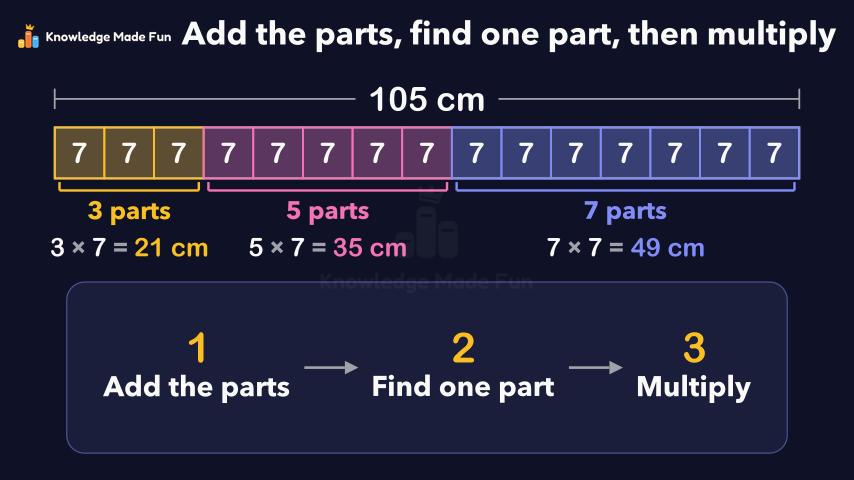
A ratio can compare three amounts too. Cut a 105 centimetre string in the ratio 3 to 5 to 7.
The first piece gets 3 parts, the second gets 5 parts and the third gets 7 parts.
Add the parts: 3 plus 5 plus 7 is 15 parts.
Find one part: 105 divided by 15 is 7, so each part is 7 centimetres.
Then multiply each number in the ratio by 7. 3 times 7 is 21, 5 times 7 is 35, and 7 times 7 is 49 centimetres.
Check: 21 plus 35 plus 49 is 105 centimetres, the whole string.
A common mistake is to divide by the number of pieces instead of the number of parts.
105 divided by 3 is 35, which makes three equal pieces. That is not the ratio 3 to 5 to 7.
To find one part, divide by the total number of parts. Here that is 15, not 3.
To share in a ratio, add the parts, find one part, then multiply.
Curriculum
Where this fits
- British Columbia, Grade 8
Mathematics, Number: numerical proportional reasoning (rates, ratio, proportions, and percent)BC8-MA-12
Previous: Solving a proportion with equivalent ratiosNext: Adding and Subtracting Fractions with Different Denominators
The outcomes and strands follow the British Columbia curriculum.
Keep going
 1 min 26 s
15.2 − 7.85
Grade 4 · 1 min 26 s 1 min 37 s
2.4 × 1.3
Grade 7 · 1 min 37 s 1 min 4 s
3 × 7 = 7 × 3: Equal Groups, Skip Counting and Arrays
Grade 4 · 1 min 4 s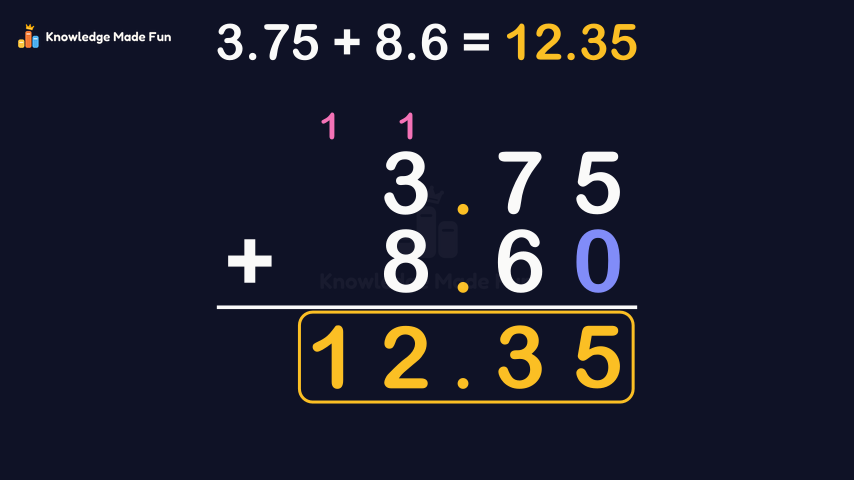 59 s
3.75 + 8.6
Grade 4 · 59 s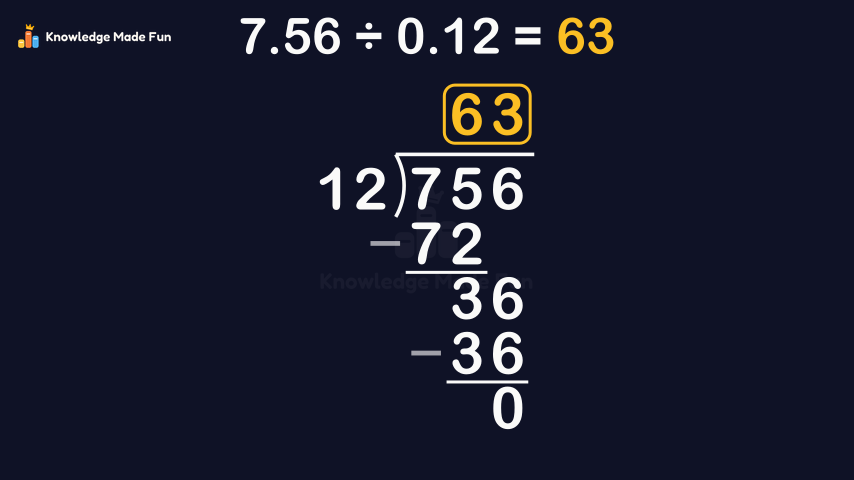 1 min 32 s
7.56 ÷ 0.12
Grade 7 · 1 min 32 s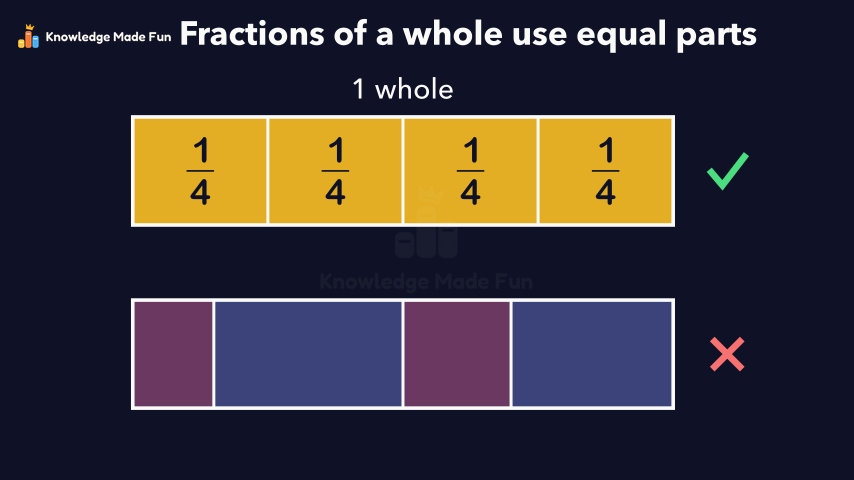 56 s
A Fraction Is Equal Parts of One Whole
Grade 3 · 56 s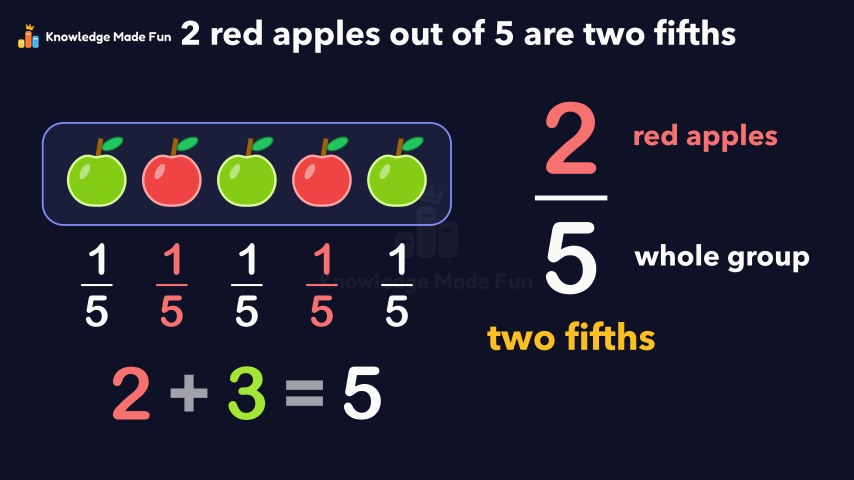 57 s
A Fraction of a Group
Grade 3 · 57 s 1 min 23 s
Adding and subtracting are related
Grade 1 · 1 min 23 s
- All Grade 8 Mathematics lessons
- Try the graph paper, free for everyone, no account needed.
- Create a free account to watch three lessons a day, no payment and no card.