Lesson · Grade 8 · Mathematics
Adding and Subtracting Fractions with Different Denominators
- Grade 8
- Mathematics
- 2 min 9 s
- British Columbia
- BC8-MA-13
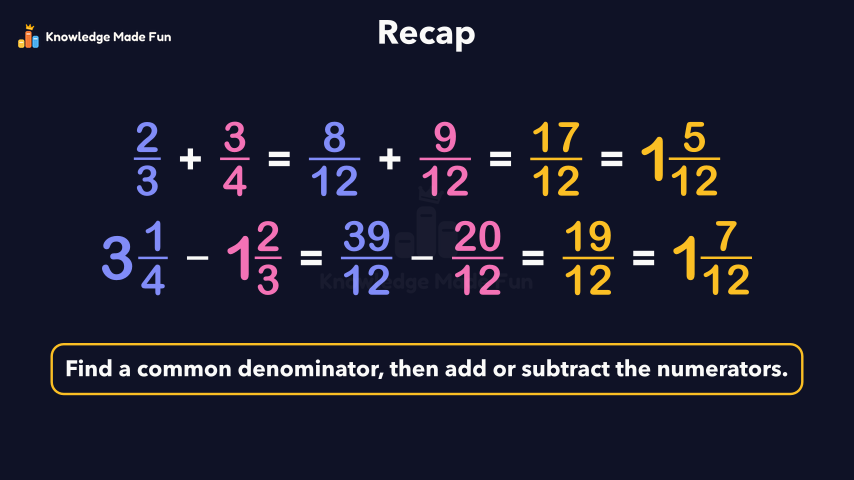
Fraction strips show why 2/3 + 3/4 is not 5/7, then find the common denominator 12 by counting in threes and fours, and cut both strips into twelfths to get 8/12 + 9/12 = 17/12 = 1 5/12. The same twelfths solve 3 1/4 − 1 2/3 = 39/12 − 20/12 = 19/12 = 1 7/12, and the video ends on the recap: find a common denominator, then add or subtract the numerators.
Anyone can watch two lessons on the website without an account. Signing in is free, no payment and no card, and opens three a day; Plus has no limit.
Loading
In one sentence
The question this lesson answers
How do we add two thirds and three quarters?
The top number is the numerator. The bottom number is the denominator: how many equal parts make a whole.
Transcript
What the lesson says
How do we add two thirds and three quarters?
The top number is the numerator. The bottom number is the denominator: how many equal parts make a whole.
Thirds and quarters are different sizes, so we cannot just count the pieces.
A common mistake is to add the tops and the bottoms, giving five sevenths.
But five sevenths is less than three quarters alone, so it is wrong.
Instead, use a common denominator: the lowest common multiple of 3 and 4.
Count in threes: 3, 6, 9, 12. Count in fours: 4, 8, 12. 12 is first in both lists.
Cut both strips into twelfths: a third is 4 twelfths, a quarter is 3.
Multiply the top and bottom of two thirds by 4: eight twelfths, an equivalent fraction worth the same.
For three quarters, multiply by 3 to get nine twelfths.
Now the pieces match, so add the numerators: 8 plus 9 is 17. The denominator stays 12.
17 twelfths is an improper fraction, because its top is bigger than its bottom. 12 twelfths make 1 whole, and 5 are left.
So the answer is the mixed number 1 and five twelfths: a whole number and a fraction.
Subtraction works the same way: 3 and one quarter minus 1 and two thirds.
In twelfths, 3 and one quarter is 36 plus 3, or 39. 1 and two thirds is 12 plus 8, or 20.
Subtract the numerators: 39 minus 20 is 19. 19 twelfths is 1 and seven twelfths.
Recap: find a common denominator, then add or subtract the numerators.
Curriculum
Where this fits
- British Columbia, Grade 8
Mathematics, Number: operations with fractions (addition, subtraction, multiplication, division, and order of operations)BC8-MA-13
Previous: Sharing an Amount in a RatioNext: Multiplying Fractions: A Fraction of a Fraction
The outcomes and strands follow the British Columbia curriculum.
Keep going
 1 min 26 s
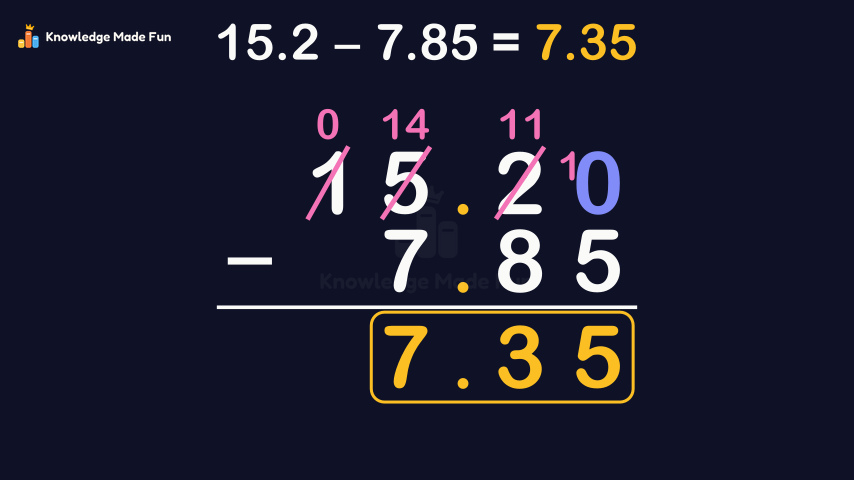
15.2 − 7.85
Grade 4 · 1 min 26 s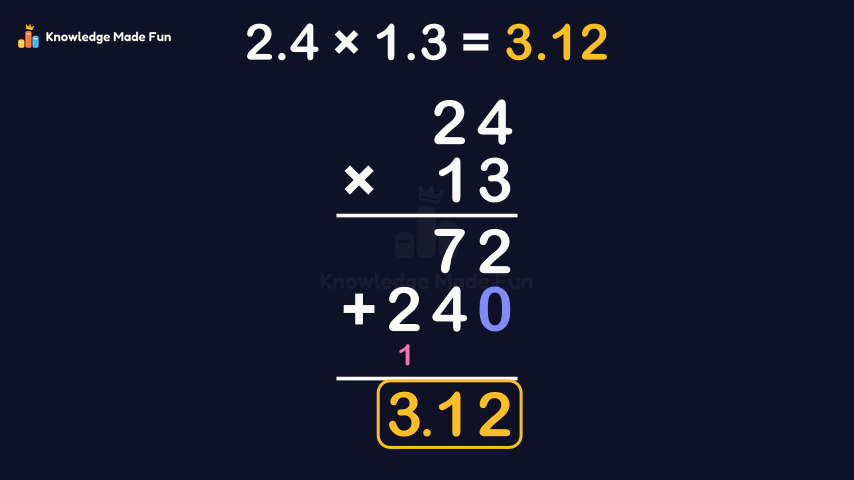 1 min 37 s
2.4 × 1.3
Grade 7 · 1 min 37 s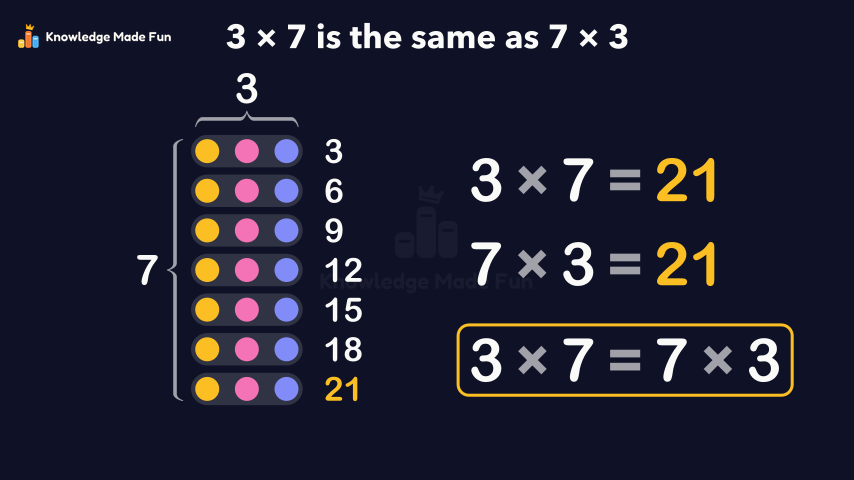 1 min 4 s
3 × 7 = 7 × 3: Equal Groups, Skip Counting and Arrays
Grade 4 · 1 min 4 s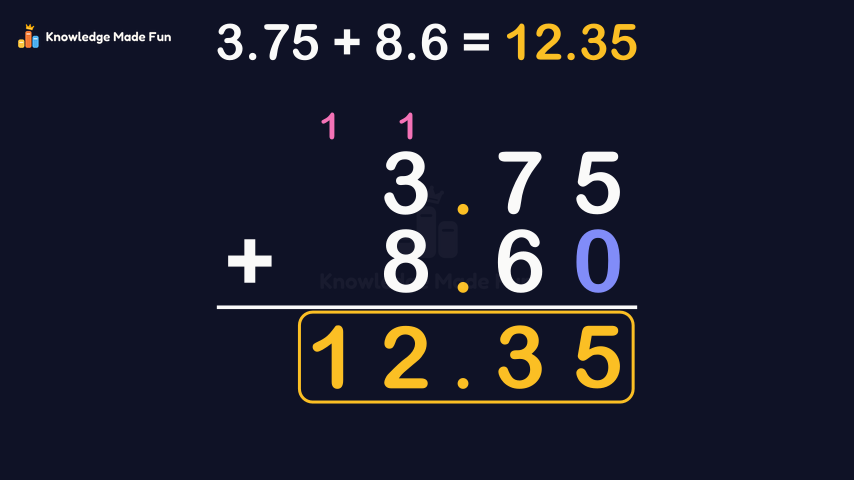 59 s
3.75 + 8.6
Grade 4 · 59 s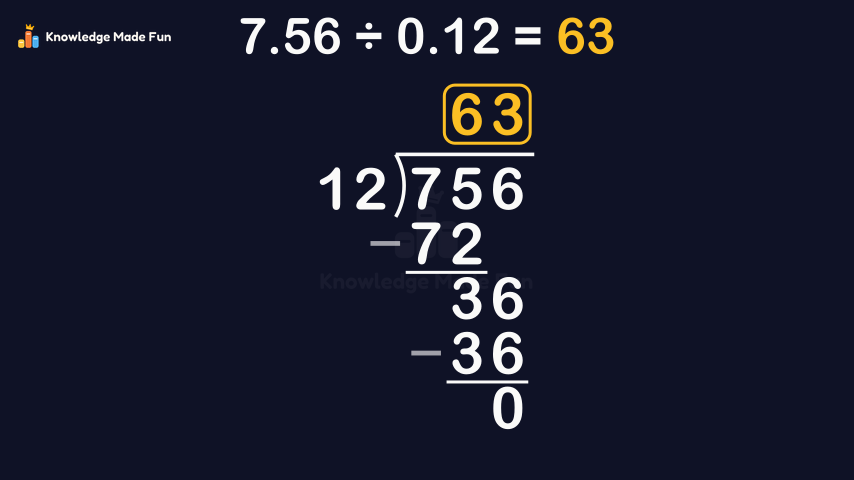 1 min 32 s
7.56 ÷ 0.12
Grade 7 · 1 min 32 s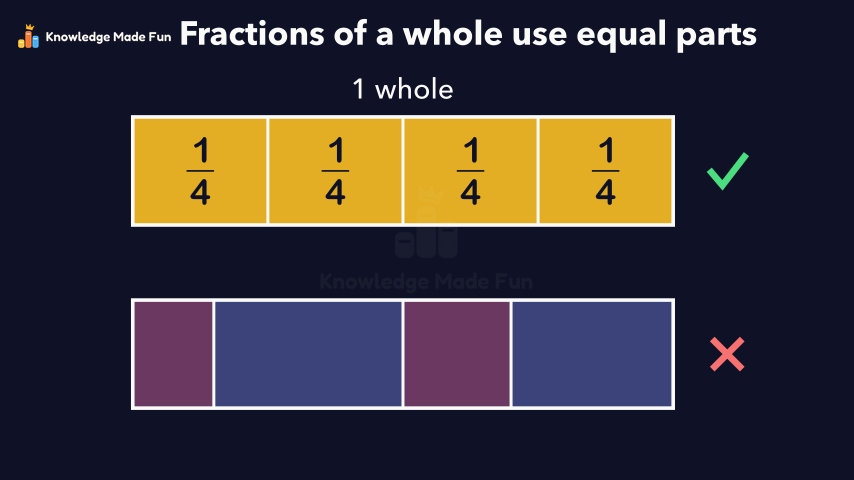 56 s
A Fraction Is Equal Parts of One Whole
Grade 3 · 56 s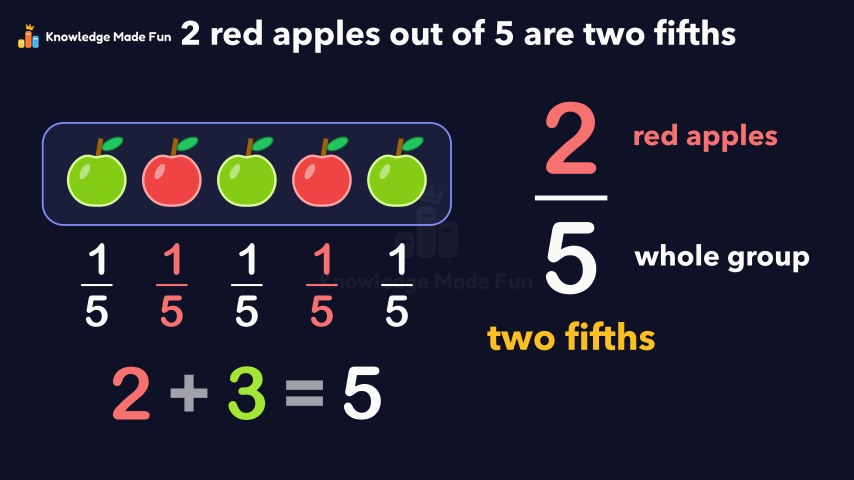 57 s
A Fraction of a Group
Grade 3 · 57 s 1 min 23 s
Adding and subtracting are related
Grade 1 · 1 min 23 s
- All Grade 8 Mathematics lessons
- Try the graph paper, free for everyone, no account needed.
- Create a free account to watch three lessons a day, no payment and no card.