Lesson · Grade 4 · Mathematics
Estimating Sums and Differences by Rounding
- Grade 4
- Mathematics
- 1 min 31 s
- British Columbia
- BC4-MA-09
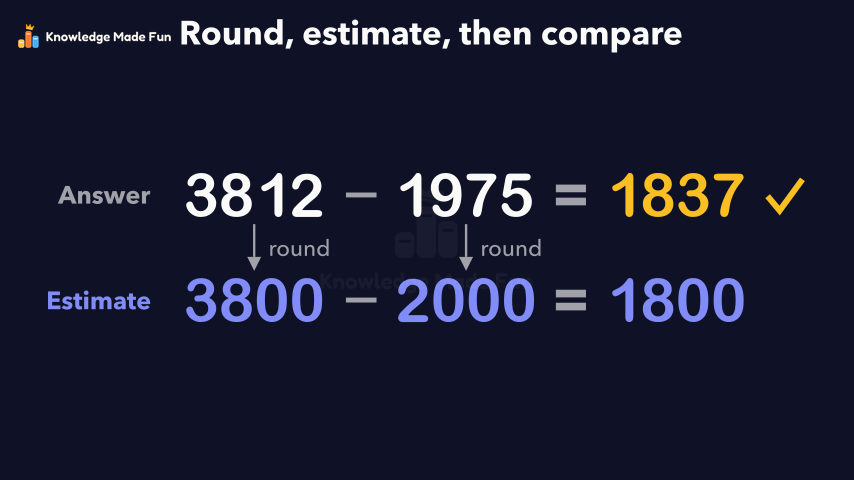
Two number lines show that 3812 rounds to 3800 and 1975 rounds to 2000, so 3812 + 1975 = 5787 is close to the estimate 3800 + 2000 = 5800 and makes sense. The same rounded numbers then show that 2837 is far from 3800 − 2000 = 1800, so the subtraction is worked out again to get 1837, and the video ends on the recap "Round, estimate, then compare."
Anyone can watch two lessons on the website without an account. Signing in is free, no payment and no card, and opens three a day; Plus has no limit.
Loading
In one sentence
The question this lesson answers
Is 3812 plus 1975 really equal to 5787?
To check, round each number to the nearest hundred.
Transcript
What the lesson says
Is 3812 plus 1975 really equal to 5787?
To check, round each number to the nearest hundred.
3812 is between 3800 and 3900, and it is closer to 3800.
1975 is between 1900 and 2000, and it is closer to 2000.
Add the rounded numbers: 3800 plus 2000 is 5800.
5787 is close to 5800, so the answer makes sense.
Now, is 3812 minus 1975 really equal to 2837?
Subtract the rounded numbers: 3800 minus 2000 is 1800.
2837 is far from 1800, so something went wrong.
Work it out again carefully, and you get 1837.
1837 is close to 1800, so this answer makes sense.
To check a sum or a difference, round the numbers, estimate, then compare.
Curriculum
Where this fits
- British Columbia, Grade 4
Mathematics, Number: addition and subtraction to 10 000BC4-MA-09
Previous: Subtracting Across Zeros: 5003 − 1468Next: Break a number apart to multiply
The outcomes and strands follow the British Columbia curriculum.
Keep going
 1 min 26 s
15.2 − 7.85
Grade 4 · 1 min 26 s 1 min 37 s
2.4 × 1.3
Grade 7 · 1 min 37 s 1 min 4 s
3 × 7 = 7 × 3: Equal Groups, Skip Counting and Arrays
Grade 4 · 1 min 4 s 59 s
3.75 + 8.6
Grade 4 · 59 s 1 min 32 s
7.56 ÷ 0.12
Grade 7 · 1 min 32 s 56 s
A Fraction Is Equal Parts of One Whole
Grade 3 · 56 s 57 s
A Fraction of a Group
Grade 3 · 57 s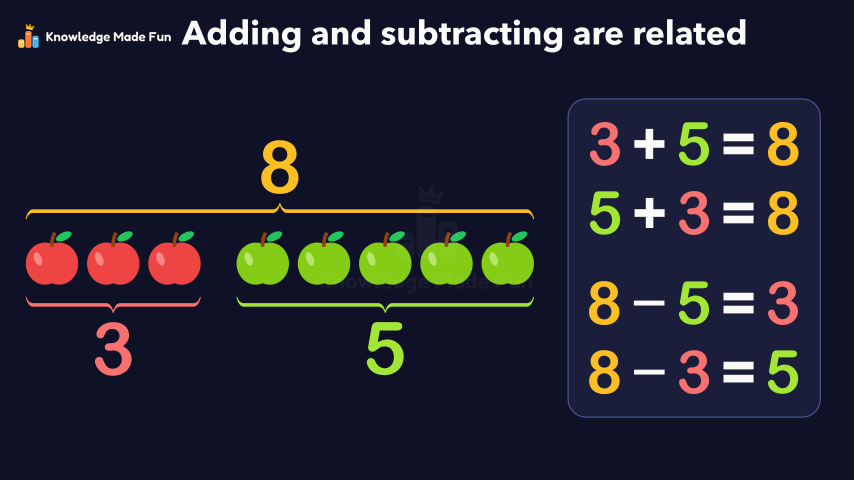 1 min 23 s
Adding and subtracting are related
Grade 1 · 1 min 23 s
- All Grade 4 Mathematics lessons
- Teachers: the maths worksheets for Grade 4 are in the dashboard, each with a worked example and a proven answer key.
- Try the graph paper, free for everyone, no account needed.
- Create a free account to watch three lessons a day, no payment and no card.