Lesson · Grade 7 · Mathematics
Decimal to Fraction in Lowest Form
- Grade 7
- Mathematics
- 1 min 28 s
- British Columbia
- BC7-MA-25
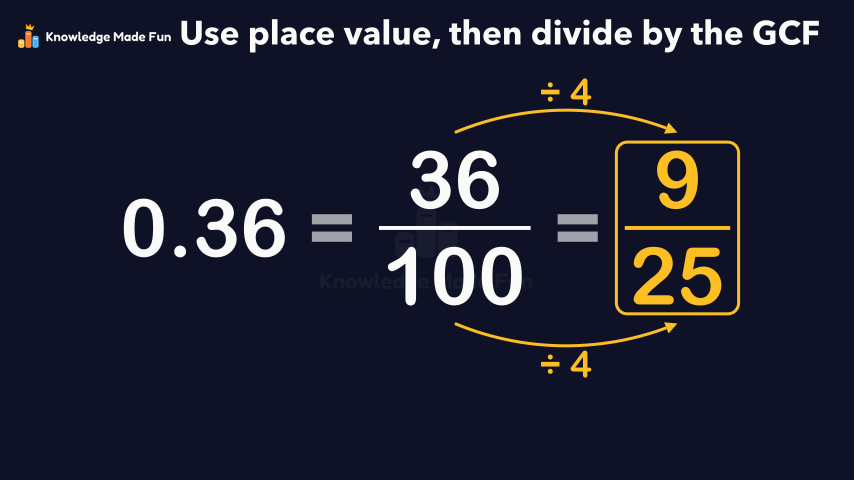
Using 0.36 as the example, the video shows that the 6 is in the hundredths place, so 0.36 is 36 hundredths, which is 36/100. It then lists the factors of 36 and 100 to find their greatest common factor, 4, divides the top and bottom by 4 to get 9/25, checks that only 1 divides both 9 and 25, and ends on the recap "Use place value, then divide by the GCF."
Anyone can watch two lessons on the website without an account. Signing in is free, no payment and no card, and opens three a day; Plus has no limit.
Loading
In one sentence
The question this lesson answers
How do we write 0.36 as a fraction in lowest form?
The last digit, 6, is in the hundredths place.
Transcript
What the lesson says
How do we write 0.36 as a fraction in lowest form?
The last digit, 6, is in the hundredths place.
So 0.36 means 36 hundredths.
As a fraction, that is 36 over 100.
To simplify it, find the greatest common factor, or GCF, of 36 and 100.
The factors of 36 are 1, 2, 3, 4, 6, 9, 12, 18 and 36.
The factors of 100 are 1, 2, 4, 5, 10, 20, 25, 50 and 100.
The numbers 1, 2 and 4 are in both lists.
The greatest of these is 4, so the GCF is 4.
Divide the top and the bottom by 4.
36 divided by 4 is 9, and 100 divided by 4 is 25.
9 and 25 share no factor other than 1, so it is in lowest form.
So 0.36 is nine twenty-fifths in lowest form.
Use place value to write the decimal as a fraction, then divide the top and bottom by the GCF.
Curriculum
Where this fits
- British Columbia, Grade 7
Mathematics, Number: relationships between decimals, fractions, ratios, and percentsBC7-MA-25
Previous: Fraction to Decimal: Divide the Top by the BottomNext: Decimal to Percent and Back
The outcomes and strands follow the British Columbia curriculum.
Keep going
 1 min 26 s
15.2 − 7.85
Grade 4 · 1 min 26 s 1 min 37 s
2.4 × 1.3
Grade 7 · 1 min 37 s 1 min 4 s
3 × 7 = 7 × 3: Equal Groups, Skip Counting and Arrays
Grade 4 · 1 min 4 s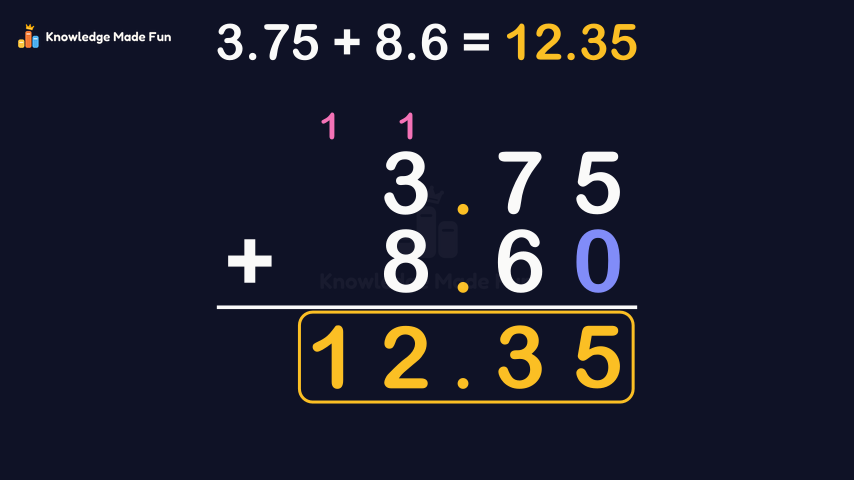 59 s
3.75 + 8.6
Grade 4 · 59 s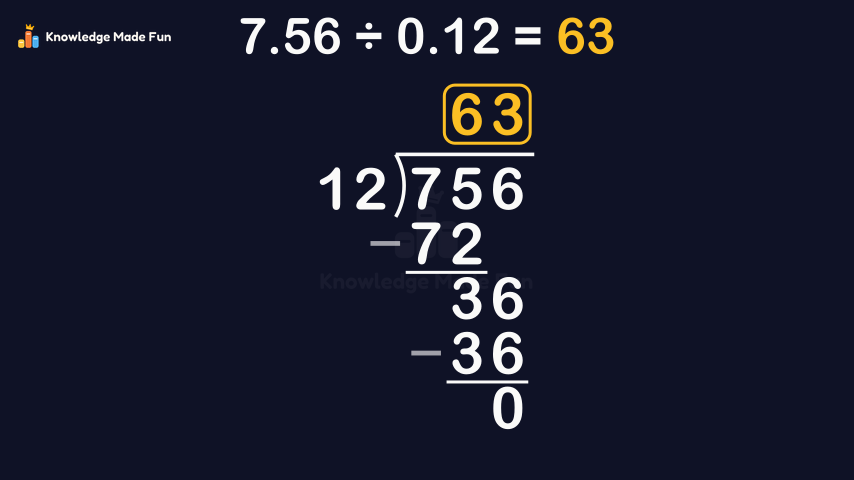 1 min 32 s
7.56 ÷ 0.12
Grade 7 · 1 min 32 s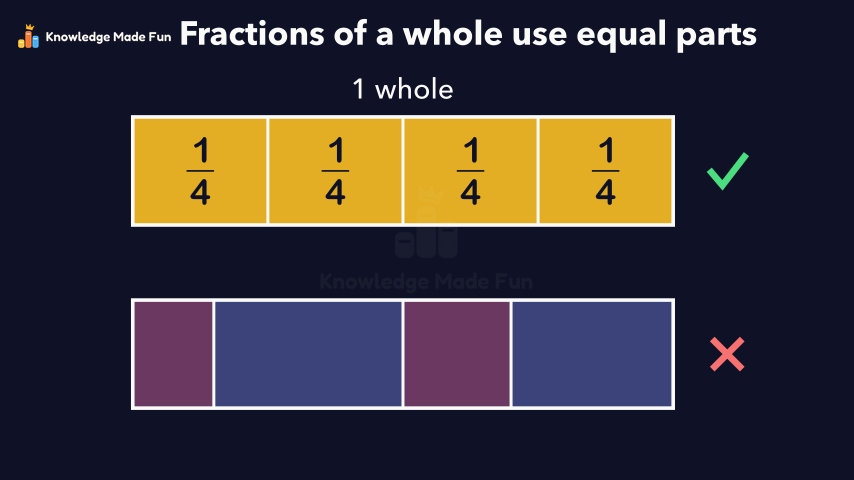 56 s
A Fraction Is Equal Parts of One Whole
Grade 3 · 56 s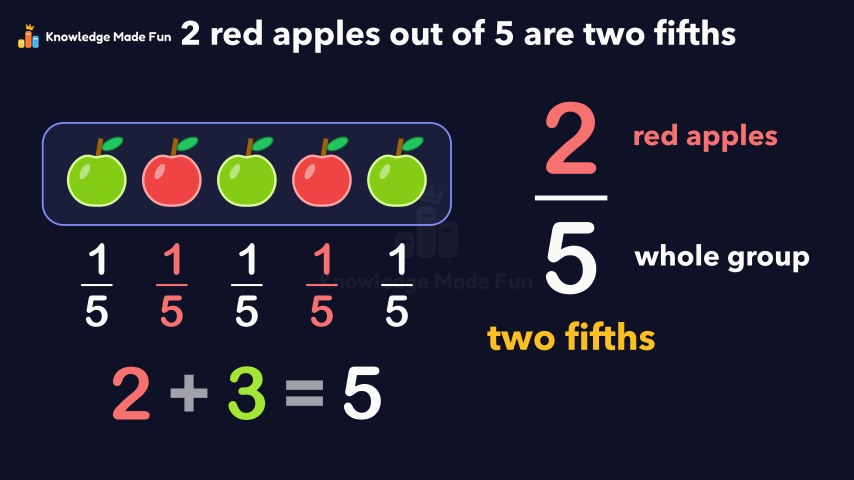 57 s
A Fraction of a Group
Grade 3 · 57 s 1 min 23 s
Adding and subtracting are related
Grade 1 · 1 min 23 s
- All Grade 7 Mathematics lessons
- Teachers: the maths worksheets for Grade 7 are in the dashboard, each with a worked example and a proven answer key.
- Try the graph paper, free for everyone, no account needed.
- Create a free account to watch three lessons a day, no payment and no card.