Lesson · Grade 4 · English Language Arts
Subject-Verb Agreement: Make the Verb Match Its Subject
- Grade 4
- English Language Arts
- 1 min 25 s
- British Columbia
- BC4-EN-21
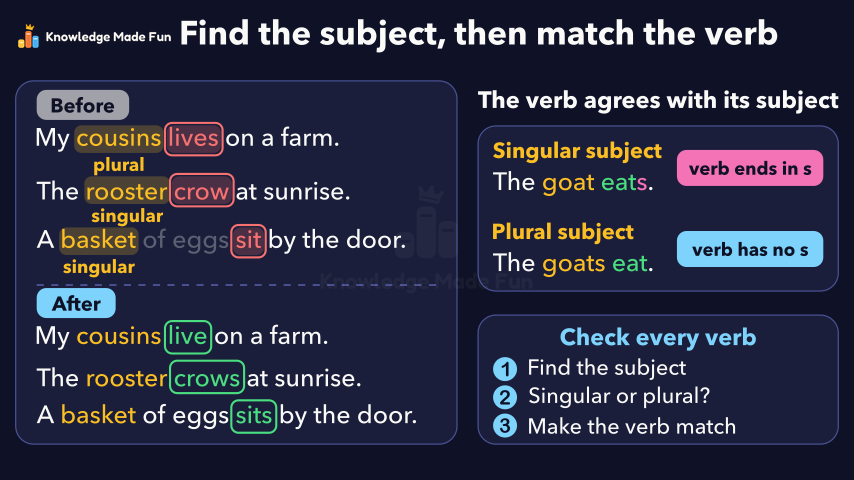
A three-sentence farm passage appears with a verb that does not agree with its subject in each line, and a rule box shows that in the present tense a singular subject takes a verb ending in s while a plural subject takes a verb with no s. Each pair is checked in turn, including one where the words "of eggs" sit between the real subject "basket" and its verb, then the fixed passage appears below and the video ends on a three-step recap: find the subject, decide singular or plural, make the verb match.
Concept: Subject-verb agreement
Anyone can watch two lessons on the website without an account. Signing in is free, no payment and no card, and opens three a day; Plus has no limit.
Loading
In one sentence
The question this lesson answers
What does it mean for a verb to agree with its subject?
Here is a short passage about a visit to a farm.
Transcript
What the lesson says
What does it mean for a verb to agree with its subject?
Here is a short passage about a visit to a farm.
Each sentence has a subject, who or what it is about, and a verb, what the subject does.
The verb must agree with its subject: singular with singular, plural with plural.
In the present tense, a singular noun like the goat takes a verb that ends in s: the goat eats.
A plural subject takes a verb with no s, as in the goats eat.
Cousins is plural, but lives ends in s, so they do not agree.
Rooster is singular, but crow has no s, so that pair is wrong too.
In the last sentence, the subject is basket, not eggs. The words of eggs only describe the basket.
Basket is singular, but sit has no s.
Here is the same passage with every verb matching its subject.
Live loses its s, and crows and sits each gain one.
Now every verb agrees with its subject, and the passage reads smoothly.
Find the subject, decide if it is singular or plural, and make the verb match.
Curriculum
Where this fits
- British Columbia, Grade 4
English Language Arts, Language features, structures, and conventions: sentence structure and grammarBC4-EN-21
Previous: Verb Tenses: Past, Present and FutureNext: Commas in a List
- British Columbia, Grade 5
English Language Arts, Language features, structures, and conventions: sentence structure and grammarBC5-EN-23
Previous: Past, Present and Future TenseNext: Commas: a small pause that separates the parts of a sentence
- British Columbia, Grade 6
English Language Arts, Language features, structures, and conventions: sentence structure and grammarBC6-EN-26
Previous: Fixing Sentence FragmentsNext: Using Pronouns Correctly: Point Clearly to One Noun, and Match It
- British Columbia, Grade 7
English Language Arts, Language features, structures, and conventions: syntax and sentence fluencyBC7-EN-30
Previous: Fixing Sentence FragmentsNext: Using Pronouns Correctly: Point Clearly to One Noun, and Match It
This lesson is also listed in Grade 5, Grade 6 and Grade 7.
The outcomes and strands follow the British Columbia curriculum.
Keep going
 42 s
A Sentence Tells a Whole Idea: Who Did What
Grade 1 · 42 s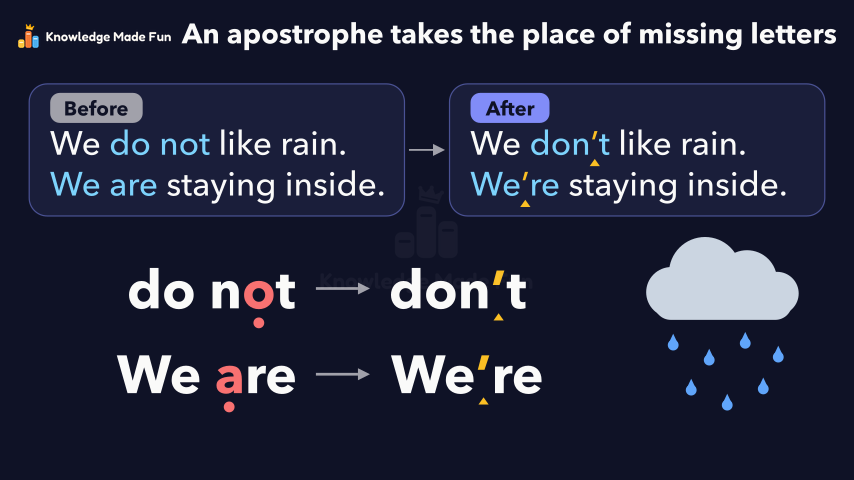 1 min 1 s
Apostrophes in Contractions: Do Not Becomes Don't
Grade 3 · 1 min 1 s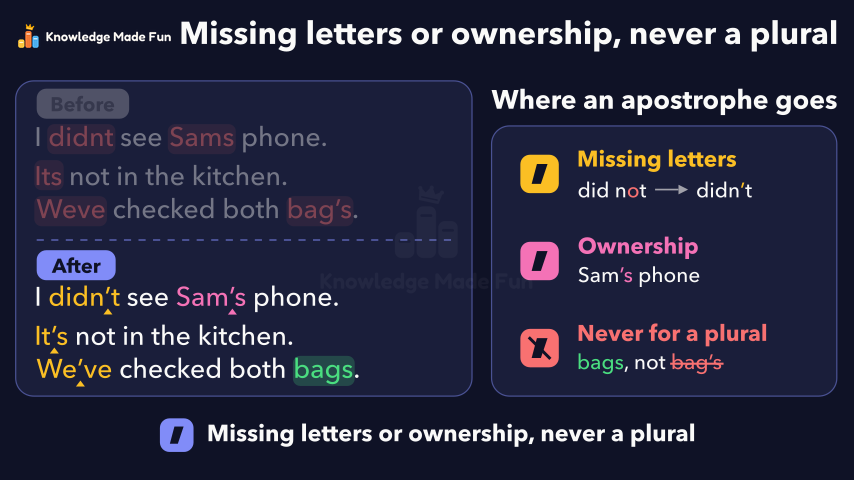 1 min 45 s
Apostrophes: Missing Letters or Ownership, Never a Plural
Grade 4 · 1 min 45 s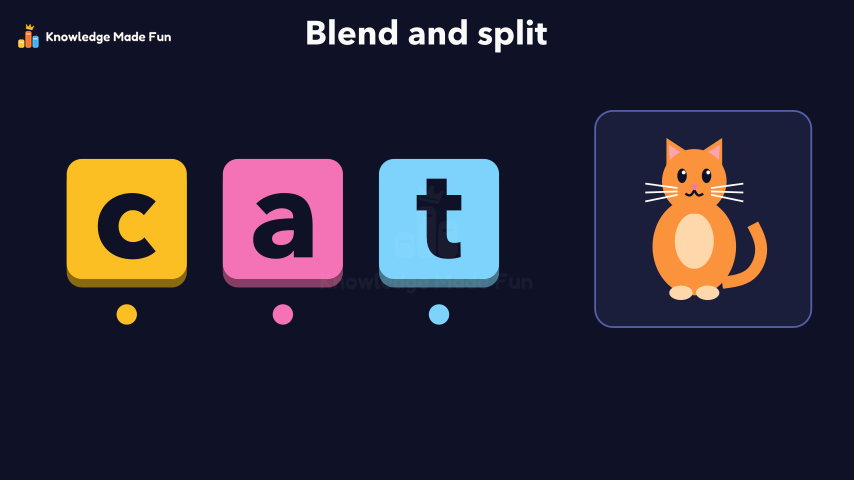 54 s
Blending and Splitting Sounds: c, a, t Makes cat
Grade 1 · 54 s 54 s
Blending Sounds: c, a, t Makes cat
Kindergarten · 54 s 1 min 5 s
Canadian and American Spelling: Two Ways, Both Correct
Grade 5 · 1 min 5 s 53 s
Capital Letters and End Marks
Grade 2 · 53 s 1 min 12 s
Capital Letters in Titles and Headings
Grade 5 · 1 min 12 s
- All Grade 4 English Language Arts lessons
- Create a free account to watch three lessons a day, no payment and no card.