Lesson · Grade 5 · Science
Pulleys: Changing the Direction of a Pull
- Grade 5
- Science
- 1 min 12 s
- British Columbia
- BC5-SC-10
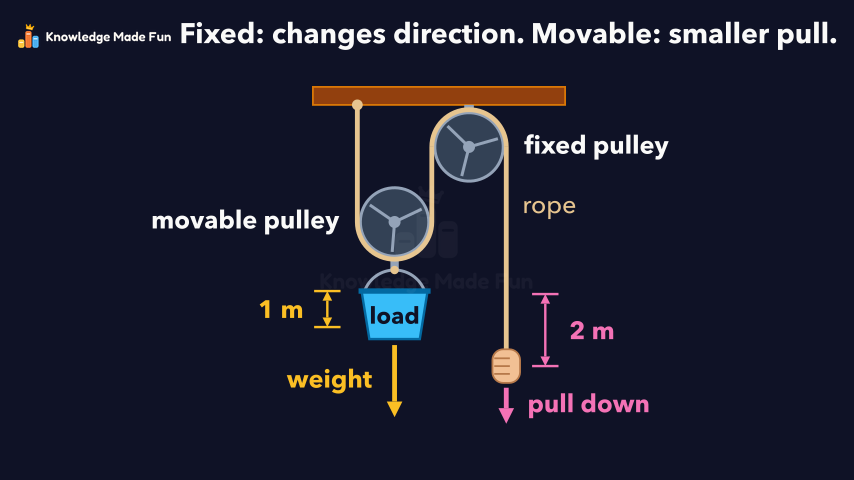
A fixed pulley hanging from a beam lets a hand pull down on a rope to lift a bucket up, and the arrows show the pull is about as big as the load's weight. Adding a movable pulley lets two parts of the rope share the weight, so the pull is about half as big, but the rope has to be pulled twice as far (2 m to lift the load 1 m).
Anyone can watch two lessons on the website without an account. Signing in is free, no payment and no card, and opens three a day; Plus has no limit.
Loading
In one sentence
The question this lesson answers
How can pulling down on a rope lift a heavy load up?
A pulley is a wheel with a rope running over it.
Transcript
What the lesson says
How can pulling down on a rope lift a heavy load up?
A pulley is a wheel with a rope running over it.
This wheel turns, but it stays in one place, so it is called a fixed pulley.
We tie a load, like this bucket, to one end of the rope.
When you pull down on the other end, the load goes up.
The fixed pulley changes the direction of the pull, from down to up.
But you still have to pull about as hard as the weight of the load.
Now hang the load from a movable pulley, which rises with the load.
Now two parts of the rope hold up the load and share its weight.
So you only need to pull with about half the force.
The fixed pulley still lets you pull down to lift the load.
But you have to pull the rope twice as far.
Pull 2 metres of rope, and the load rises just 1 metre.
A fixed pulley changes the direction of a pull, and a movable pulley makes the pull smaller.
Curriculum
Where this fits
- British Columbia, Grade 5
Science, Physics: properties of simple machines and their force effectsBC5-SC-10
Previous: Levers: Fulcrum, Effort and LoadNext: Ramps, Wedges and Screws
The outcomes and strands follow the British Columbia curriculum.
Keep going
 1 min 51 s
A Complete Circuit: Source, Load, Conductors and Switch
Grade 9 · 1 min 51 s 1 min 18 s
A current makes a magnet: the electromagnet
Grade 7 · 1 min 18 s 1 min 12 s
A Moving Magnet Makes a Current
Grade 7 · 1 min 12 s 54 s
A Push or a Pull Makes Things Move
Kindergarten · 54 s 1 min 48 s
AC and DC: Two Ways Current Can Flow
Grade 9 · 1 min 48 s 1 min 3 s
Air Resistance: Why a Flat Sheet Falls Slower
Grade 2 · 1 min 3 s 1 min 40 s
Alpha, Beta and Gamma Radiation
Grade 10 · 1 min 40 s 1 min 6 s
Balanced and Unbalanced Forces in Sport and Play
Grade 6 · 1 min 6 s
- All Grade 5 Science lessons
- Create a free account to watch three lessons a day, no payment and no card.