Lesson · Grade 5 · Science
Your Arm Is a Lever
- Grade 5
- Science
- 59 s
- British Columbia
- BC5-SC-13
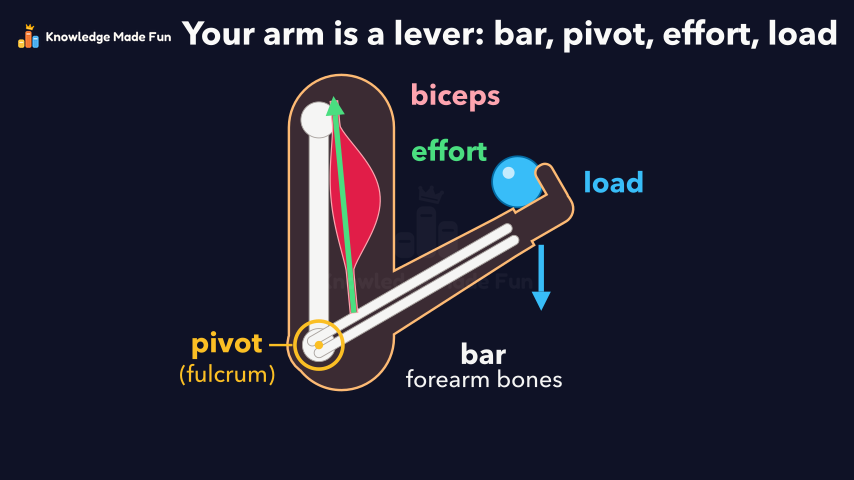
A labelled side view of an arm holding a ball builds up step by step to show the four parts of a lever: the forearm bones are the bar, the elbow is the pivot (fulcrum), the ball in the hand is the load and the pull of the biceps is the effort. The biceps then shortens to lift the forearm, showing that a short pull near the elbow moves the hand a long way but means the muscle must pull harder than the load, and the video ends on the recap "Your arm is a lever: bar, pivot, effort, load".
Concept: Levers in the body: your arm is a lever
Anyone can watch two lessons on the website without an account. Signing in is free, no payment and no card, and opens three a day; Plus has no limit.
Loading
In one sentence
The question this lesson answers
How does your arm lift things up?
Your arm works as a lever, which is a simple machine.
Transcript
What the lesson says
How does your arm lift things up?
Your arm works as a lever, which is a simple machine.
A lever has a stiff bar, and in your arm it is the forearm bones.
The bar turns at your elbow, which is the pivot, or fulcrum.
The load is the thing you hold in your hand.
Your biceps muscle pulls on the bar, and this pull is the effort.
The biceps is joined to the forearm close to the elbow.
When the biceps gets shorter, the forearm turns up and lifts the load.
A short pull near the elbow moves your hand a long way.
But the muscle must pull harder than the load pushes down.
Many other joints in your body work as levers too.
Your arm is a lever with a bar, a pivot, an effort and a load.
Curriculum
Where this fits
- British Columbia, Grade 5
Science, Physics: machines: found in natureBC5-SC-13
Previous: Complex Machines: Simple Machines Working TogetherNext: Power: How Fast Energy Is Transferred
The outcomes and strands follow the British Columbia curriculum.
Keep going
 1 min 51 s
A Complete Circuit: Source, Load, Conductors and Switch
Grade 9 · 1 min 51 s 1 min 18 s
A current makes a magnet: the electromagnet
Grade 7 · 1 min 18 s 1 min 12 s
A Moving Magnet Makes a Current
Grade 7 · 1 min 12 s 54 s
A Push or a Pull Makes Things Move
Kindergarten · 54 s 1 min 48 s
AC and DC: Two Ways Current Can Flow
Grade 9 · 1 min 48 s 1 min 3 s
Air Resistance: Why a Flat Sheet Falls Slower
Grade 2 · 1 min 3 s 1 min 40 s
Alpha, Beta and Gamma Radiation
Grade 10 · 1 min 40 s 1 min 6 s
Balanced and Unbalanced Forces in Sport and Play
Grade 6 · 1 min 6 s
- All Grade 5 Science lessons
- Create a free account to watch three lessons a day, no payment and no card.