Lesson · Grade 7 · Science
How a Generator Works
- Grade 7
- Science
- 1 min 14 s
- British Columbia
- BC7-SC-25
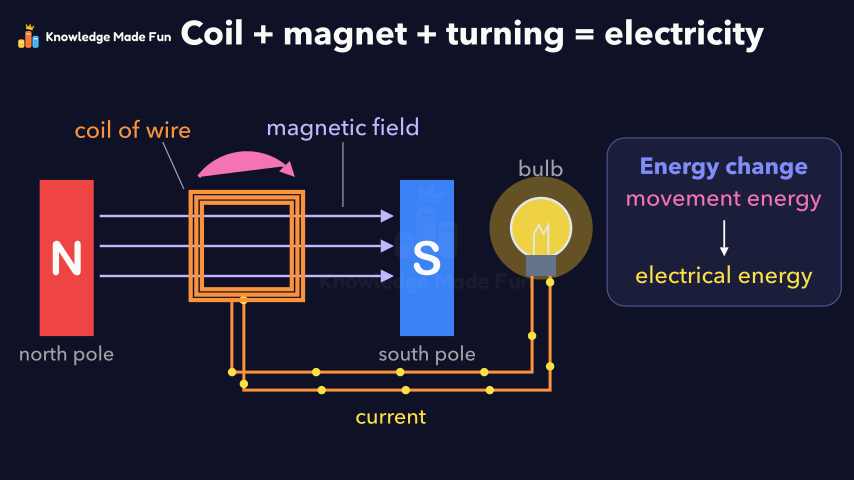
The new scene scenes/lib_sci_how_a_generator_works.py builds one labelled diagram step by step: the north and south poles of a magnet, the field lines between them, a coil of wire, and wires out to a bulb. The coil visibly spins and yellow current dots run round the circuit while the bulb glows, the current stops when the coil stops, turning faster makes it brighter, and a side card lists what gives a bigger current before showing the energy change from movement to electrical energy. It renders without errors at about 56 seconds with 14 spoken lines, ending on the recap "Coil + magnet + turning = electricity".
Anyone can watch two lessons on the website without an account. Signing in is free, no payment and no card, and opens three a day; Plus has no limit.
Loading
In one sentence
The question this lesson answers
Most of the electricity we use is made by generators. How do they work?
Start with a magnet. It has a north pole and a south pole.
Transcript
What the lesson says
Most of the electricity we use is made by generators. How do they work?
Start with a magnet. It has a north pole and a south pole.
Between the poles there is a magnetic field. We draw it with field lines.
Now put a coil of wire between the poles.
Join the two ends of the coil to a bulb with wires.
While nothing moves, nothing happens. The bulb stays off.
Now turn the coil. In a power station, wind, water or steam does the turning.
As it turns, the coil cuts through the magnetic field lines.
This pushes an electric current through the wire, and the bulb lights up.
Stop turning, and the current stops. The bulb goes dark.
Turn the coil faster, and you get a bigger current. The bulb glows brighter.
More turns of wire, or a stronger magnet, also give a bigger current.
So a generator changes movement energy into electrical energy.
A generator makes electricity by turning a coil of wire in a magnetic field.
Curriculum
Where this fits
- British Columbia, Grade 7
Science, Physics: electromagnetismBC7-SC-25
Previous: A Moving Magnet Makes a CurrentNext: Hydroelectric Power: How a Dam Makes Electricity
The outcomes and strands follow the British Columbia curriculum.
Keep going
 1 min 51 s
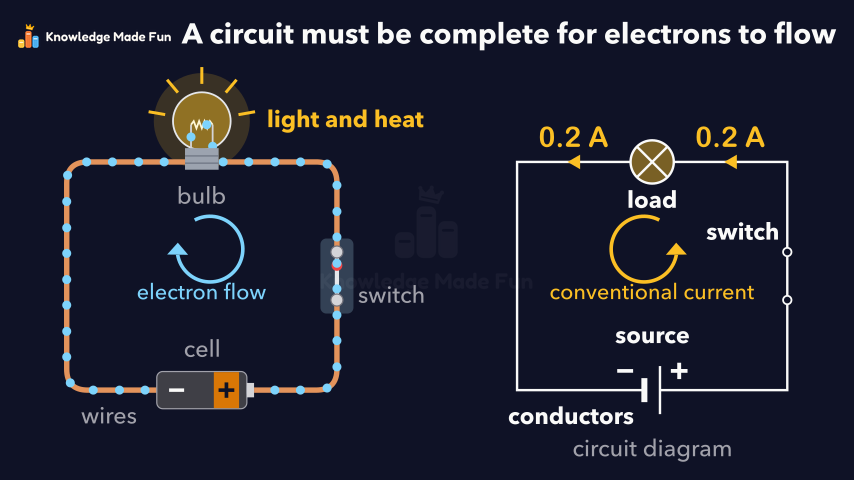
A Complete Circuit: Source, Load, Conductors and Switch
Grade 9 · 1 min 51 s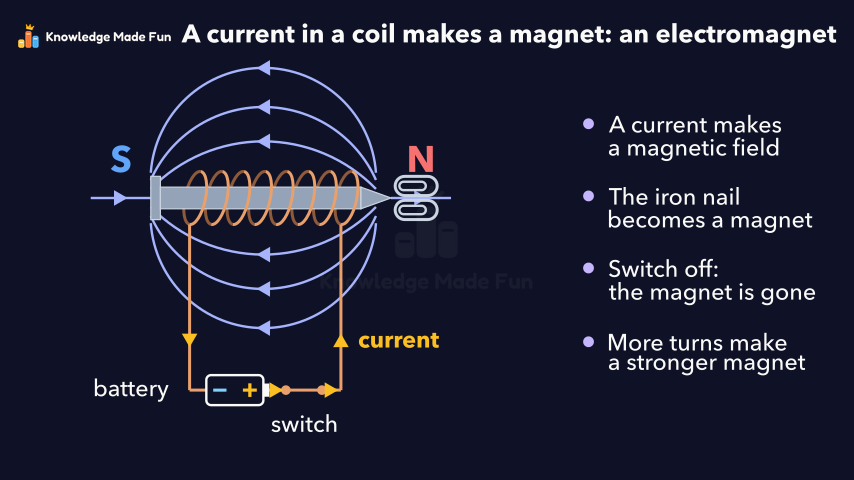 1 min 18 s
A current makes a magnet: the electromagnet
Grade 7 · 1 min 18 s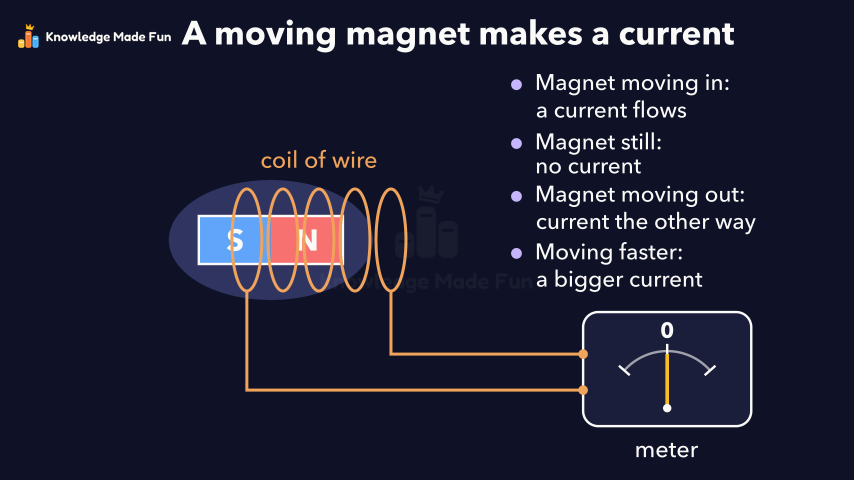 1 min 12 s
A Moving Magnet Makes a Current
Grade 7 · 1 min 12 s 54 s
A Push or a Pull Makes Things Move
Kindergarten · 54 s 1 min 48 s
AC and DC: Two Ways Current Can Flow
Grade 9 · 1 min 48 s 1 min 3 s
Air Resistance: Why a Flat Sheet Falls Slower
Grade 2 · 1 min 3 s 1 min 40 s
Alpha, Beta and Gamma Radiation
Grade 10 · 1 min 40 s 1 min 6 s
Balanced and Unbalanced Forces in Sport and Play
Grade 6 · 1 min 6 s
- All Grade 7 Science lessons
- Create a free account to watch three lessons a day, no payment and no card.